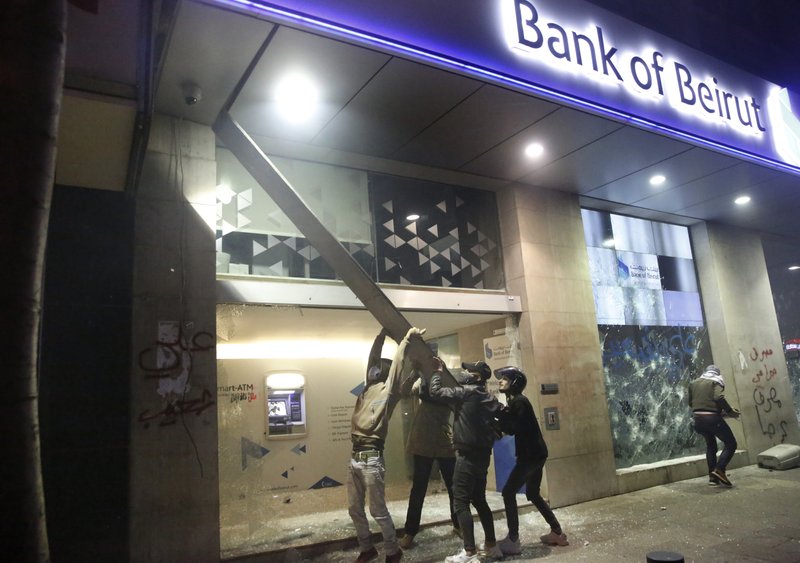
BEIRUT (AP) SARAH EL DEEB— Lebanese security forces fired volleys of tear gas at protesters who responded with rocks outside the country’s central bank in pitched street battles that lasted for hours late Tuesday. The clashes ended a day of rallies that followed a lull in the three-months-long protests. The street clashes stretched down one of Beirut’s busiest commercial areas and come after a day when protesters resorted to blocking roads to express their impatience at a ruling elite they say has failed to address a fast crumbling economy. The protesters have also turned their anger at the country’s banks, which have imposed capital controls on foreign currency accounts in the highly dollarized economy. Protesters using metal bars and sticks smashed windows of commercial banks and foreign exchange bureaus nearby.
Beirut’s most bustling commercial boulevards, Hamra Street, also packed with theaters and restaurants, was deserted late Tuesday save for protesters and security forces. Local TV stations carried the pitched street battles live, including late night arrests of at least half a dozen protesters. Calm had prevailed since the designation of Hassan Diab as prime minister in mid-December. But Diab, nominated by the President and a simple majority of parliament members, has so far failed to form an emergency government amid political divisions and jockeying for power. The lull was also partly due to the holidays followed by soaring regional tensions between the U.S. and Iran that eclipsed the protesters in Lebanon and Iraq demanding sweeping political change. Clashes at the bank began late Tuesday after security forces arrested a few of the protesters. It was not immediately clear why they were arrested. Local media said the protesters had removed metal barriers erected around the central bank. Lebanon’s Internal Security forces later said “vandals” attacked the central bank and injured a number of the personnel guarding it. The demonstrators accuse the central bank’s governor of financial policies that have worsened Lebanon’s liquidity crunch. The country is facing its worst economic crisis in decades. The local currency has lost over 60% of its value in just the past few weeks, while sources of foreign currency have dried up. Meanwhile, banks have imposed informal capital controls limiting withdrawal of dollars and foreign transfers in the country, which relies heavily on imports of basic goods.