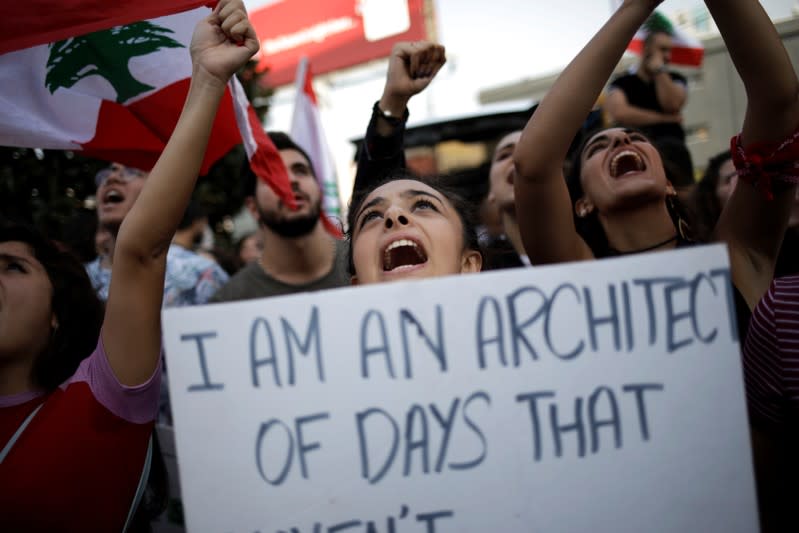
By Ellen Francis, Reuters — BEIRUT (Reuters) – Lebanese are protesting outside failing state agencies they see as part of a corrupt system in the hands of the ruling elite, as well as at banks they deem part of the problem. Protesters accuse sectarian political leaders of exploiting state resources for their own gain through networks of patronage and clientelism that mesh business and politics. Where have Lebanese protested and why?
ELECTRICITE DU LIBAN (EDL)
Lebanon’s electricity sector is at the heart of its financial crisis, bleeding some $2 billion in state funds every year while failing to provide 24-hour power. “This is one of the peak symbols of corruption,” said Diyaa Hawshar, an electrician protesting outside state power firm EDL in Beirut. “We pay two bills, one for the government and another for generators.” “It’s about carving up the cake, with deals on power barges and overhauling power plants, shady deals in public and under the table,” he said. “Every minister who comes makes promises. They come and go.” Power cuts can last several hours every day. People and businesses rely on so-called “generator mafias” who often have political ties and charge hefty fees to keep the lights on. The average household ends up paying $300 to $400 a month on average for electricity, said Jad Chaaban, economics professor at the American University of Beirut. Lebanon’s minimum wage is the equivalent of $450 a month. “It is an insult for a lot of people to keep paying for services that are dysfunctional and at the same time funding the parties and travel of corrupt leaders,” he said.
The government has for years touted plans to overhaul the sector including new power stations, fixing the grid and stopping electricity theft. But the Lebanese saw no tangible progress by the time the prime minister resigned last week. “People have to beg for their rights…for a few hours of electricity at home,” said Mia Kozah, a university student. “It should be one of the simplest matters. Enough humiliation.”
MOBILE OPERATORS
![Demonstrators block access to the state-owned electricity company during anti-government protests in Beirut, Lebanon [Andres Martinez Casares/Reuters]](https://www.aljazeera.com/mritems/imagecache/mbdxxlarge/mritems/Images/2019/11/8/02087cf9ae4f4eedbfdfafa2eab6acce_18.jpg)