by Rafi Letzter There’s an endless supply of fad diets out there. Many of them have at least some studies to back them up. Others don’t. But there’s one way of eating that has an unusually substantial body of research and scientific consensus to back it up: the restricted Mediterranean diet. If all you want to do […]

By Pamela Engel- Business Insider
The terrorist group ISIS, while dealing with a consistent
loss of territory in Iraq and Syria and unfulfilled
plans for Libya, has shed benefits and raised taxes as it
starts
running out of money. An ISIS memo found earlier this year saying the group had
cut salaries for fighters by 50% was widely circulated as
evidence of the group’s financial problems.
But Adam J. Szubin, the acting under secretary for terrorism and
financial intelligence at the US Treasury Department, explained
that’s not the extent of the measures ISIS has taken to rein in
its spending. “Overall, ISIL is significantly constrained in terms of its
funding,” he
told the CTC Sentinel, a publication of the Combatting
Terrorism Center at West Point.
Szubin noted that ISIS is cutting benefits as it tries to deal
with a cash crunch. “We received information earlier this year indicating that ISIL
stopped paying death benefits to families of ISIL personnel,”
Szubin said. “That’s a core benefit that a group like ISIL needs
to promise to the families of those going on suicide or likely
suicide missions in order to maintain their operational tempo.”

BEIRUT // For a city still divided more
than 25 years after the end of Lebanon’s civil war, Beirut is embarking
on a journey to preserve fading memories of the conflict in the
once-residential building-turned snipers’ lair of Beit Beirut or house
of Beirut. Also known as the Barakat house, the building – which
sits on Damascus Road and straddles the green line that used to separate
Christian East Beirut and Muslim West Beirut – will be transformed into
a museum and cultural centre when it opens in late September this year.
The
ochre Ottoman-style edifice with elements of Art Deco and Rocco styles
will tell the stories of the snipers who once lived and fought within
its walls, as well as the story of the bourgeois Barakat family, who
commissioned the building in 1924. It was designed by Lebanese
architect Youssef Afandi Aftimos, with two more stories added by
architect Fouad Kozah in 1932. Aftimos was a well-known architect, who
built the grand theatre in downtown Beirut and the clock tower of the
Grand Serai, now the seat of the Cabinet.
The
Barakat family plaque still hangs in the ruins of the building,
surrounded by pockmarked walls that serve as a lasting memory of the
15-year civil war that killed more than 100,000 people and left several
building carcasses strewn along the green line.
The Daily Star BEIRUT: Lebanon’s Foreign Ministry offered its condolences Friday to Italy over a powerful earthquake two days earlier that caused more than 200 deaths. “The ministry extends its condolences to the leadership and people of Italy, who lost many innocent lives to a deadly earthquake,” the statement said. “We stand by the Italian […]

by Josh Wood
Saudi’s oil price fallout echoes beyond the bounds of the GCC. For more on how it is affecting Pakistan – Lebanon’s economy has long depended on the Arab Gulf states.
Hundreds
of thousands of Lebanese work there, sending their savings home to
relatives. It is the main destination for exports — both human capital
and produced goods — as well as the leading supplier of investment. There
is often a feeling that without the Gulf’s role, Lebanon’s beleaguered
economy could not survive. But this relationship could be in trouble.
With
global oil prices falling since 2014, the economic diversification
plans touted by Gulf states are finally being put to the test. For the
many Lebanese working in the Gulf, their livelihoods and billions of
dollars in annual remittances, depend on the continued strength of these
economies. More
immediate is the growing divide between GCC countries and the Lebanese
government over the role of Hizbollah, with Saudi Arabia leading the
charge against the group and economists fearing major economic
ramifications on Lebanon.

SEOUL, South Korea – Lebanese Cardinal Bechara Rai, visiting the
South Korean capital of Seoul, said that terrorist organizations
“working for the destruction of the Middle East do not represent Islam
or Muslims.” Such groups, he said in an address during the Forum for Peace on the
Korean Peninsula that met Aug. 18-21, work to destroy “a moderate and
open Islam, resulting from coexistence with Christians.”
Rai also urged the international community to end the wars raging in the Middle East “fueled by foreign countries.” Rai addressed the forum under an invitation of Seoul Cardinal Andrew
Yeom Soo-jung, imploring the international community “to speed up the
solutions and impose a halt to the wars, fueled by foreign countries,
raging in the Middle East.”
Stressing the need for a “series of reforms” in the Arab states, Rai
called for the separation of state and religion, the development of
democracy and “respect for human rights and fundamental freedoms.”
He also called on the international community to “help the
rapprochement between Iran and Saudi Arabia” which he said would reduce
sectarian tension in the region.

By Vivian Haddad – aawsat.com
Beirut-Lebanese cooks were not surprised when Beirut ranked in first
place as the Best International Cities for Food, according to statistics
released by Travel + Leisure (T+L) website. They all know that this
achievement is the result of years of efforts to spread the Lebanese
cuisine across the world, which made them excellent ambassadors for the
national cuisine.
The mentioned website carries out an annual survey “The World’s Best
Awards” to ask travelers to weigh in on travel experiences around the
globe to share their opinions and tourism experiences.
This year, Beirut’s gastronomy has beaten European and Asian countries;
Lebanese delicious platters have stolen lights from cities like Paris,
Florence, Bordeaux, Saint Miguel, and Rome despite their excellence in
the field.
Readers of the website shared their opinions on the top cities, islands, cruise lines, spas, airlines, and more. Results showed that Beirut has succeeded in capturing the first place
among ten other countries for serving best platters in its restaurants.
The Lebanese capital was respectively followed by San Sebastian, Paris,
Florence, Bologna, Roma, Saint Miguel, Chiang Mai, Barcelona, and
Bordeaux.
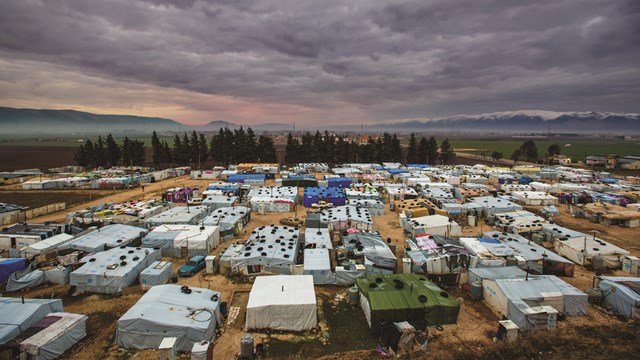
By Jeremy Weber is CT senior news editor.
Faysal stands amid the rolling fields of the Bekaa
Valley. Just down the road are award-winning, decadent vineyards—a
product of the fertile agricultural region’s 5,000-year head start on
Napa Valley. The Romans even chose to build their temple to Bacchus
here. Above loom the snow-covered slopes of Mt. Hermon, where many today
place Jesus’ transfiguration. Surveying the sea of green plants
rustling in a pleasant breeze, the 43-year-old describes what he feels:
“A knife in my heart.”
For Faysal, a Syrian refugee, the scene is not one of
grandeur but of guilt; in the field before him are three of his
children—his 15-year-old son and 13- and 11-year-old daughters—bent in
half as they weed potatoes instead of attending school.
“I have no choice,” says the father of six. In Aleppo,
one of Syria’s most war-torn cities, his job as a truck driver once
provided a four-room house and a middle-class, urban life. Now, having
injured his back in his own efforts at day labor, he can’t pay the rent
for their cobbled-together shelter on a farmer’s property. So he just
stands and watches his children. And cries.

by Belen Fernandez
On 30 August, the International Day of the Disappeared will once again be observed. In Lebanon, where an estimated 17,000 persons are still missing on account of the “civil” war that ravaged the country – with plenty of outside help – from 1975 until 1990, it will mark yet another year of unanswered questions for family members of the victims.
Earlier
this year, I spoke with one such family member: a silver-haired man
named Abed, whose younger brother, Ahmad, joined the PLO in 1983 at the
age of 17 and then promptly disappeared. Over pineapple juice in
the garden of his home in the tiny south Lebanese village of Maaroub,
Abed recounted the decades of futile searches for Ahmad.
During
one period, the family was strung along by an enterprising fellow
involved in a missing persons scam industry; in exchange for several
hefty payments, he produced what he claimed was an official paper from a
prison in Aleppo, Syria, confirming that Ahmad was being held there.

There are delicate-sounding Arab pop-stars – and then you have Assi El Helani. Nicknamed
“The Knight of the Arab Song”, the Lebanese singer is a powerful
presence – both on stage and television screens as a mentor on MBC’s
reality-singing contest, The Voice. Speaking
of voice, his is a full-bodied husky tenor that captures the drama and
heartache of the original and classic Levantine folk songs that have
become his calling card.
When
we caught up with the 45-year-old at this summer’s Mawazine Festival
in Rabat, Morocco, El Helani said he is proud that he has helped to
revive the once-neglected Arab folk music genre. More so than
talent, however, he credits his success to hard work – something he
repeatedly reiterates to the youngsters he guides on The Voice.




Population Movements to Keserwan - The Khazens and The Maans
ما جاء عن الثورة في المقاطعة الكسروانية
ثورة أهالي كسروان على المشايخ الخوازنة وأسبابها
Origins of the "Prince of Maronite" Title
Growing diversity: the Khazin sheiks and the clergy in the first decades of the 18th century
Historical Members:
Barbar Beik El Khazen [English]
Patriach Toubia Kaiss El Khazen(Biography & Life Part1 Part2) (Arabic)
Patriach Youssef Dargham El Khazen (Cont'd)
Cheikh Bishara Jafal El Khazen
Patriarch Youssef Raji El Khazen
The Martyrs Cheikh Philippe & Cheikh Farid El Khazen
Cheikh Nawfal El Khazen (Consul De France)
Cheikh Hossun El Khazen (Consul De France)
Cheikh Abou-Nawfal El Khazen (Consul De France)
Cheikh Francis Abee Nader & his son Yousef
Cheikh Abou-Kanso El Khazen (Consul De France)
Cheikh Abou Nader El Khazen
Cheikh Chafic El Khazen
Cheikh Keserwan El Khazen
Cheikh Serhal El Khazen [English]
Cheikh Rafiq El Khazen [English]
Cheikh Hanna El Khazen
Cheikha Arzi El Khazen
Marie El Khazen