Khazen

Church, State, USA vs Europe

By Conrad Black


It has been a learned joke for 40 years that long-serving Chinese premier Chou En-lai, when asked the principal consequence of the French Revolution, replied: “It is too early to say.” As events unfold in this rather dismal election year in the United States, that does not now seem such a jokey comment. The Revolution in France was carried out in successively more radical stages in the name of Reason, culminating in the bloodbath of the Terror of Prairial in 1794 under the Committee of Public Safety headed by Maximilien de Robespierre. Robespierre menaced the National Convention; he was deposed, declared outside the law, and executed without trial. The calm of Thermidor ensued and there followed pell-mell in the next 165 years a cavalcade of directory, consulate, empires, restorations, republics, and occupations.


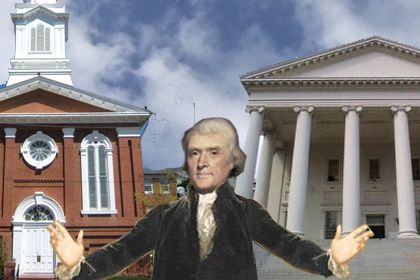
The central struggle, in France and in most of the West, was over the role of the state, and more generally, over the cohabitation in Western civilization of the forces of Faith and the forces of, broadly speaking, Reason. (Between 1793 and 1871, one archbishop of Paris fled, one was publicly guillotined, one executed by firing squad, and two were assassinated — pretty rough treatment for normally serenely eminent pillars of society; yet, at intervals, the Church was exalted.) This naturally unstable balance, as the sage Chinese statesman realized, is unresolved, even in America. Most of the leaders of the American Revolution were not religious men; of the six principal founders of the United States, Washington, Franklin, Jefferson, Hamilton, Madison, and Adams, only Adams was a practicing Christian. Washington managed the vocabulary and rites occasionally, as when he prayed at Fort Necessity in 1754 (as well he might, after effectively starting the Seven Years’ War with France and being in a desperate military siege), or when he recommended, for war profiteers in the Continental Congress, a higher gallows than Haman’s in the Old Testament (reckoned to have been 50 feet tall). Jefferson was a deist but managed to refer to “Nature’s God” and Man’s “Creator” in the Declaration of Independence.


 

Read more
The Economics of Outsourcing


By W. Michael Cox & Richard Alm


Economic change unleashes powerful forces. We can stubbornly resist them and cling to the status quo, but at best, that ushers in a slow but inevitable decline. A better approach lies in understanding the forces that periodically remake the economy, so we can seize the emerging opportunities they bring. This strategy has worked in the past, and it will work today.

A significant force in recent decades has been globalization. It has brought with it a surge in outsourcing, the shorthand term for businesses’ cutting jobs in the United States and moving production overseas to gain access to lower-cost labor. Many Americans view this development as a scourge, meaning the business practices of Mitt Romney’s private-equity firm, Bain Capital, have become fodder for the presidential campaign’s mudslinging.

Outsourcing makes for perfect political posturing — a quick-jab sound bite, serving up big business and foreign workers as villains and unemployed Americans as victims. But the economic reality of outsourcing isn’t so black and white. The issue goes far beyond the simple fact of job losses and touches on the broader realities of trade, basic human rights, and economic progress.

In economic terms, outsourcing jobs differs little from importing goods. Both involve using labor abroad rather than at home — so there’s no logical consistency in cursing one while tolerating the other. In 2011, America imported $2.6 trillion in goods and services, suggesting that outsourcing has just a tiny share of the effect foreign trade overall has on American jobs.

Read more
Maronite bishops slam government, warn Lebanon might collapse

  DIMAN, Lebanon: The Council of Maronite Bishops launched a scathing attack on Prime Minister Najib Mikati’s government Wednesday, warning that the deteriorating economic situation and lack of decision-making could lead to Lebanon’s collapse. The “deep political divisions … lack of a clear, unified vision … putting personal and sectarian interests before national interests … lack […]

Read more
No happy outcome in Syria as conflict turns into proxy war

  BEIRUT: Regional powers are pouring in money and guns, jihadists are joining rebels battling to overthrow Bashar al-Assad, while his own well-armed but hard-pressed forces are fighting back ruthlessly with combat aircraft and artillery. Gruesome scenes of slaughtered civilians or executed rebel fighters provide daily snapshots of the worsening conflict in Syria. Video apparently showing […]

Read more
Suleiman Says No to Randomly Spread Arms, Supports Prosecution of those who Target Army

  President Michel Suleiman on Wednesday threw his weight behind the Lebanese army’s decision to bring to trial those who target the military and rejected arms spread randomly across the country. In his Army Day speech at the Shukri Ghanem barracks in Fayyadiyeh, a suburb of Beirut, Suleiman said: “The judiciary should issue verdicts against those […]

Read more
How Is Social Media Used By Law Enforcement? [INFOGRAPHIC]


By Shea Bennett on August 1, 2012 8:00 AM


Did you know that, when challenged, social media as evidence for search warrants holds up in court 87 percent of the time?

Social media has rapidly changed the world, and law enforcement is no exception to its charms. Authorities use platforms such as Twitter and Facebook to identify associates with persons of interest, track the location of criminal activity, gather photos or statements to corroborate evidence, solicit tips on crimes and better understand criminal networks.

It’s very much a work in progress, as 80 percent of law enforcement professionals are self-taught when it comes to using social media for investigations. Still, two thirds believe these tools help them solve crimes more quickly.

This infographic from PoliceOne.com takes a closer look at social media use by law enforcement.


Read more
The Muddle East


No one has any idea what the Middle East will look like next year, much less in five years — especially the revolutionary players themselves.

There are not even the old familiar fault lines this revolutionary time around. Are the Sunni Gulf kingdoms eager to support revolutionaries in Syria and North Africa? Perhaps and perhaps not — given that the fall of strongmen like Mubarak, bin Ali, Qaddafi, and Assad may lead to Muslim Brotherhood–inspired Islamist governments, which would like to see the oil-rich monarchies become less Western and more theocratic. Or — though this is less likely — if pro-Western reformist movements were to prevail, such governments would like to democratize and secularize the Gulf. Who are our best allies in breaking up the dangerous Iran-Hezbollah-Syria axis? Islamist extremists who want to kill the hated Assad slightly more than they do us — at least for now?

Who can sort out Lebanon? Does a grateful Iraq feel that Syria has been more sympathetic to its Shiite government than its Sunni neighbors have been, or is it experiencing schadenfreude that its terrorists are now doing to Syria what Syria’s used to do to Iraq? Will new Arab Islamist governments seek solidarity with the anti-Western Persian theocracy, or will they fall back into their religious and ethnic fears of Iranian Shiites?


Amid this chaos there are a handful of constants that can guide U.S. foreign policy.

Read more
إرشاد البابا لمسيحيّي الشرق: المجتمع يحمي الأقلية

  في جانب من مبرّرات برودة الحماسة الظاهرة حيال زيارة البابا بنيديكتوس السادس عشر، أنها ليست للبنان على غرار تلك التي قام بها البابا يوحنا بولس الثاني في أيار 1997 وأودع اللبنانيين، والموارنة خصوصاً، الإرشاد الرسولي الخاص بلبنان. يأتي خلفه لتسليم بطاركة الكنائس الكاثوليكية في ست دول عربية، هي مصر والعراق وسوريا والأردن وفلسطين ولبنان، […]

Read more
Lebanon to Plunge in Darkness

  Efforts to resolve the controversial crisis of Electricite du Liban reached a standstill on Tuesday as the contract workers refused to budge on their demands and the company’s board of directors is insisting on its stance. Prime Minister Najib Miqati entered into negotiations between the rival sides in an attempt to avert a looming electricity […]

Read more