RMONK, N.Y., June 24, 2011 /PRNewswire/ — IBM (NYSE: IBM) today announced that the Sheldon B. Lubar School of Business at the University of Wisconsin–Milwaukee selected IBM software and hardware to automate and consolidate its data center operations to enable a cloud-based service for delivering SAP®-based courses to students. The school switched its system from Oracle and Dell products to IBM cloud-ready infrastructure and software to deliver faster services with lower administration costs and greater energy efficiency. Specifically, this announcement demonstrates the school’s move to a smarter computing environment that will extract greater economics and performance from its technology infrastructure.
As an SAP University Competence Center (UCC), the University of Wisconsin-Milwaukee‘s Center for Technology Innovation (CTI) acts as an education service provider, hosting a wide range of SAP systems for educational purposes on its campus and virtually to more than 105 universities across North America. SAP software is used to reinforce and supplement classroom content for more than 40,000 students with 1,450 courses per year, preparing them for post-graduation employment. Students from a variety of academic disciplines participate in the program with classes ranging from accounting and information systems to retail merchandising and supply chain management.
rmonk, NY, USA – 06 Jun 2011: IBM (NYSE: IBM) today announced the IBM Intelligent Operations Center for Smarter Cities, a new solution designed to help cities of all sizes gain a holistic view of information across city departments and agencies. By infusing analytical insights into municipal operations through one central point of command, cities will be able to better anticipate problems, respond to crises, and manage resources.
The Intelligent Operations Center for Smarter Cities will allow cities to use information and analytics to make smarter and more timely decisions, helping local leaders manage a spectrum of events, both planned and unplanned, such as deploying water maintenance crews to repair pumps before they break, alerting fire crews to broken fire hydrants at an emergency scene, or anticipating traffic congestion and preparing redirection scenarios.
IDC Government Insights estimates the new Smarter Cities information technology market opportunity at $34 billion in 2011, increasing more than 18 percent per year to $57 billion by 2014.
Thanks to our President Michel Suleiman, who is leading Lebanon to defend its interest and constitution the new Government was created under his leadership . We hope for the new ministers to serve Lebanese daily problems, from insurance, health care, internet connection, retirement, electricity, transportation and many more issues and concentrate less on foreign relation. khazen.org understands that it is not possible to ignore our foreign policy because of our geopolitical situation but stresses it is as important to concentrate and focus in Lebanese domestic policies. We hope that the government concentrate on local government efficiency and problems, having an effective financial plan, city development, investment, growth and privatization. Most importantly khazen.org stand by the presidency under the leadership of President Michel Suleiman who has been leading us for a prosperous Lebanon. We also praise the close relationship and alliance btw the President and the Maronite Patriarch who is our father. A golden alliance between an improvement of local policies to better serve the Lebanese interest under the morality umbrella lead by our Patriarch.
We also thank our Maronite Patriarch Mar. Bechara Raai leadership in bringing all of the communities together and reminding the politicians about the day to day misery and difficulties of Lebanese citizen.
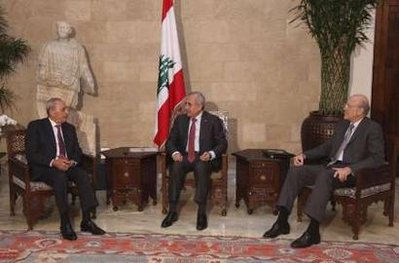
President of Lebanon H.E General Michel Suleiman (center), Prime Minister H.E. Najib Najib Mikati (right), Speaker of the House H. E. Nabih Berri
Lebanon’s new government convened at the Presidential Palace for its first meeting, in which a committee of ministers tasked with drafting the new Cabinet’s policy statement was formed. The Lebanese president also expressed hope that the ministerial statement be based on national fundamental principles, the national Constitution and the Taif Accord, which ended Lebanon’s bloody 1975-1990 Civil War. ""The Lebanon government was 100 percent Lebanese without any foreign intervention (in the Cabinet formation process)," Suleiman said after the first meeting of Prime Minister Najib Mikati’s government." Suleiman also urged cabinet ministers to "promptly start work."
For his part, Mikati called on ministers to join forces in order to meet the internal and external political challenges lying ahead. The new Lebanese Cabinet’s policy statement will outline the government’s position on issues such as Hezbollah’s arsenal and the UN-backed Special Tribunal for Lebanon, which is investigating the 2005 assassination of Lebanese Sunni Former Prime Minister Rafik Hariri.
Invited by Patriarch Rahi, Christian political leaders from both government and opposition met to talk. The issues on the table were the separation of religion and politics, the defence of Christian-owned land, a greater Christian presence in public institutions, the promotion of the common good, and the collective responsibility Christians have in promoting the values of the Gospel in society. A committee is set up to promote further meetings.Beirut (AsiaNews) – The separation of religion and politics, the defence of Christian-owned land, a greater Christian presence in public institutions and the promotion of the common good “for the betterment of the country, society and government” were the goals laid out by Maronite Patriarch Beshara Rahi at a meeting with 34 Maronite political leaders, from both the ruling coalition and opposition parties, held at the Patriarchal See in Bkerke.
For Mgr Rahi, Lebanese Christians, independently of their political beliefs, have a “collective responsibility” to promote the values of the Gospel and the teachings of the Church in society.“We are here to examine our reality and decide how to improve it, despite [our] different political beliefs, which still follow our values and culture, in light of the teachings of the Church and Lebanon’s special character.”
Maronite Catholic Patriarch Beshara Rai has scolded Lebanese political leaders for their failure to resolve a 4-month deadlock in the formation of a national-unity government. “All of us, Muslim and Christian Lebanese, are looking forward to building a country that we inherited from our grandfathers,” Patriarch Rai said.
Before the meeting, an agreement was expected on two topics, namely the sale of Christian-owned land and the ways to enhance the Christian presence in public institutions.“Christians represent 30 per cent of the public work force. This is inacceptable,” Bishop Salim Mazloum said.
“Only by participating in public institutions can Christians maintain an active presence,” the patriarch said.
Some observers expected members of the ruling ‘8 March’ coalition to cause some difficulties with respect to Hizbollah’s weapons and the international tribunal investigating the murder of former Prime Minister Rafik Hariri. Apparently, the issues were discussed but nothing is known as to what was said.
Still, the first comments following the meeting were positive. Participants also decided to set up a committee to prepare further meetings so that “Lebanon can remain an example of democracy and freedom.”
The Lebanese President General Michel Suleiman has saved Lebanon during this unfortunate event at the Telecommunication Ministry and unified the country by preventing clashes btw the new and old majority through his unique judgment, leadership, and power of the constitution.
khazen.org offers its complete support to the President as the Commander in Chief of all of Lebanon and more specifically in this particular case of the Armed Forces. Regardless of the unfortunate event of what has happened in the Telecommunication Ministry, and the intention of the Minister Charbel Nahas, we can ask many questions:
·Why did Minister Nahas decide to find more information at this time?
·Why not when the government was created and when he took in charge the ministry of Telecommunication?
All of these questions we may never find the answers, but one important factor this is NOT THE ISSUE. The Problem is that you have the head of the internal security forces General Rifi abusing his power by not respecting the oders of the Interior Minister.
The President of the Republic because of his unique leadership as preserving the constitution has saved Lebanon an additional time by preventing any fights btw different camps, and sending the army under his authority to take in charge of the building.
Khazen.org salutes our President as the Commander in Chief of all of the Armed forces and stand by him. Most importantly khazen.org request for General Rifi to be tried in Justice.
The 14 March Camp is pointing fingers at Nahas while the 8 March Group is pointing fingers at the Future Movement and each group is speaking about legality of the issue. The first group is questioning the timing of Nahas, while the other group is questioning the allegiance of Rifi and attacking the victim (here the Lebanese Constitution). In reality the REAL ISSUE: is Rifi has abused his power.
· Rifi has shown poor judgement, regardless of why Nahas was there when the Interior Minister Baroud requests his forces to leave the building, his duty is make them leave! The actions of Rifi are action of a person that do not respect Lebanese Laws and constitution.
Because of the action of Rifi and disrespecting the orders of the Interior Minister Baroud until our President stepped in, we request his case to be persecuted within the Lebanese Justice and we demand his direct resignation from Head of the internal security forces. He is not fit anymore to be able to control ISF when he takes political stands; This is not a political position!
We thank our president of bringing the country together at these hard moments.
By Morgan Housel – In a way, Microsoft (Nasdaq: MSFT) and IBM (NYSE: IBM) couldn’t be more different. Microsoft has lost a third of its value over the past decade; IBM has gained 50%. IBM recently surpassed Microsoft in market capitalization for the first time since 1996.
In other ways, they’re a lot alike. Microsoft has grown earnings per share by 10.9% annually for the past decade. IBM’s growth over the same period? 10.2%. Analyst estimates for Microsoft’s five-year projected growth rate is 10.3% — IBM’s, 11.2%.
These are different companies with different products in different industries, yet both past and projected growth are about equal. Shareholder returns, however, couldn’t be more night and day.
Why?
I think you can break this conundrum down into two parts. Both are huge lessons every investor should be aware of.
1) The most important lesson in investing The most important lesson in investing is simple: Starting price determines future returns.
A parade of analysts and investors chide Microsoft for its abysmal shareholder returns over the past decade. In reality, Microsoft the company has done terrific. How many large companies grew earnings at 10% annually during one the worst economic decades on record? (11, if you’re wondering). Nearly all of the misery Microsoft investors experienced over the past 10 years can be explained by starting valuation. Shares traded at 60 times earnings at the start of the last decade. Shareholders’ fate was already sealed at that point. There was no realistic outcome that could have left them with anything other than tears today.
IBM was a different story. While it, too, was caught up in the dot-com bubble, it never got outrageously out of whack. Ten years ago, IBM shares traded at roughly 25 times earnings. That created a high hurdle but not an insurmountable one. The compression in IBM’s earnings multiple over the past 10 years hasn’t been drastic, letting shareholders enjoy at least some of the company’s earnings growth. Microsoft’s earnings multiple compression has been astronomical, causing shares to crumble even while the company grew briskly. The same story of flatlining returns amid strong earnings growth has happened to Wal-Mart (NYSE: WMT) , Google (Nasdaq: GOOG) , and Johnson & Johnson (NYSE: JNJ) . Each case can be explained simply: Starting valuation determines future returns.
Technology companies IBM Corp. and SAP AG are teaming up with the University of Wisconsin-Milwaukee Lubar School of Business to establish a data center that focuses on bringing more technologically trained business graduates into the workforce.
The center is being unveiled on Monday.
IBM is providing computer hardware, software and training for the center, officially known as "The Technology Innovation Datacenter – Powered by IBM," university officials said.
The data center features the high-performance IBM Power 750, the server used for IBM’s Watson, the recent "Jeopardy" winner.
The data center will support the SAP University Competence Center, which is located in the Lubar School. The UCC is a hub for universities across a large portion of North America that offer a technology-focused business curriculum.
"The UCC provides hosting services and help-desk support for faculty and the 40,000-plus students in the more than 100 universities in North America where SAP software is used to reinforce and supplement classroom content," UWM said.
"Students from all over North America can access the center via the Internet to use in their course work," said Dave Haseman, director of the Lubar School’s Center for Technology Innovation and IBM Professor of Information Technology Management.
The Lubar School’s UCC is one of only five such competence centers in the world.
A business, tech marriage
Demand for workers who have a combination of technology and business skills is growing.
"It’s huge," said Aaron Ritchie, managing director at Experis, the specialty recruitment arm of ManpowerGroup that focuses on information technology, engineering and finance/accounting.
Khazen.org prays for all of the minorities being persecuted in the Middle-East. Mainstream media do not cover these injustice and massacres against Christians unfortunately. On a daily Basis the Christians are being totured, killed, persecuted, and attacked in very large numbers. We pray for these atrocities to end. And we request for the media, and world leaders to put an end on this injustice by first covering the news and second for the world leaders to take a firm stand against these atrocities and apply sanctions against the countries that cannot defend minorities or leaders that fail to offer their support to the communities being affected.
Unfortunately many of the newly "liberated" countries from dictatoship regime, are not taking swift actions to end violence against Christians! Is this the new democracy that they support?
After Egypt, Iraq what is next? Yemen? Bahrein? Syria? What about the minorities in these countries?
On Monday, May 16, 2011, a 29 year old Christian husband and father of three children was kidnapped by Islamic militants in Iraq. His mutilated body, showing signs of extreme torture, was found by a bridge. His head had been severed and his eyes gouged out.
IRKUK, Iraq (Catholic Online ) – Last Friday, a 29 year old Christian husband and father of three children was kidnapped by Islamic militants in Iraq. A ransom of the equivalent of $100,000 US was demanded.
On Monday, May 16, 2011, his mutilated body, showing signs of extreme torture was found by a bridge. His head had been severed and his eyes had been gouged out.
The heroic Archbishop of Kirkuk, Louis Sako, praised the heroism of this Christian man and the continuing strength and faith of the Christian community in Iraq.
He strongly condemned the evil noting the growing hostility toward Christians in Iraq, "In all these years, I have never heard of a single Christian converting to Islam, despite the many threats."
(HealthDay News) — Voter registration cards may offer more insight into who people promise to love and cherish than personality or appearance, new research suggests.
Most people marry those whose political views align with their own, according to a study from Rice University and the University of Nebraska-Lincoln.
The study, published recently in the Journal of Politics, examined the physical, personality and behavioral traits of more than 5,000 married couples in the United States. The various qualities — including body shape, height, weight, impulsivity, religion and ideology — were scored on a scale of zero to one, with one being a perfect match.
The researchers found that spouses appeared to instinctively select partners with similar social and political views. In fact, political attitudes were among the strongest shared traits — even taking precedence over personality or looks. The only attribute that scored slightly higher than political views was the frequency of church attendance.
Khazen.org offer its support to the Office of the Lebanese Presidency:
1- We support the Lebanese Presidency and its rights to defend and uphold the Lebanese Constitution. The key for the Lebanese presidency to be a real arbitrator, is for the office to be effectively represented in the Lebanese government. For president Suleiman to be able to follow the constitution and to be a real arbitrator as it is intended and clear, it is the right of this office to have ministers representing him or else he will not be able to be a real arbitrator as the constitution calls for it .
2- The Lebanese Constitution is very clear, the President Issue the decree appointing the prime minister independently. On agreement with the prime minister, issue the decree forming the cabinet. President Suleiman responsibility and role from the constitution is to sign the formation of the government, that will be able to govern independently and represent the interest of Lebanon. Only president Suleiman has the right to decide what kind of government he will support where as an arbitrator he feels it will serve best interest of the Lebanese nation.
3- We support the President as the commander in chef of all of the Armed Forces. Regardless of the unfortunate event of what has happened in the Telecommunication Ministry, and the intention of the Minister Charbel Nahas, we can ask many questions. Why now? Was it necessary? Why not when the government when he took in charge the ministry? All of these questions we may never find the answer, but one important factor, the President of the Republic because of his unique leadership as Preserving the constitution, has saved Lebanon an additional time by preventing any fights!. And we salute our President as the Commander in Chief of all of the Armed forces! Unfortunately Rifi has shown poor judgement, regardles of why he was there when the Interior Minister Baroud request him to leave, his duty is to leave! And because of disrespecting the Lebanese laws and constitution we request his case to be followed within the Lebanese Justice and for his direct resignation from Head of the internal security forces. He is not fit anymore to be able to control ISF when he takes political stands; This is not a political position!
Khazen.org offer its complete support to our Maronite Patriarch, our father, the Hope of Lebanon. His opinions are sacred. He is the voice of the Lebanese. What we need is a government that serve the interest of the people and not a government specialized in foreign relation as they have been building for the last 5 years and our youth are leaving Lebanon. We pray for the very quick formation of the Lebanese government, where our politicians will think less about their own interest and how to create larger parties but rather think more about the Lebanese people their pain, ecnomical suffering and uncertainty. As our Patriarch and President are seeking requesting, a government that will be able to govern freely, prevent conflicts, increase economical prosperity, jobs and create new programs to boost business, education, heath programs and investments.
khazen.org prays for the Christians of the Middle East, especially for the Christians of Egypt and Iraq being persecuted. And all of the minorities in the Middle-East going through an uncertain future. There are no words that we can use to describe these atrocities against the Christians. We hope for the leaders of these countries and of the Free world to act quickly. We also request for the leaders of these countries to create a long term plan and not only a superficial plan as they have been creating for the last 30 years. Every citizen have the right to live in peace and freely and these communities are here to stay. These leaders will need to educate their communities in accepting the others, non-violence and invest in schools and economy.
BEIRUT: Lebanon’s Maronite Patriarch Beshara Rai appealed Sunday for a swift formation of a new government, saying the inexplicable delay was ruining the country “I take this opportunity to make this appeal from the heart: Enough, Enough, enough,” Rai told reporters at Beirut’s airport before flying to Rome for a meeting at the Vatican. “Enough procrastination, and enough paralysis in our Lebanese life. We are sitting on the top of a volcano because of what is going on in the Arab world.” Prime Minister-designate Najib Mikati’s four-month-old efforts to form a Cabinet have yet to succeed despite some progress over the past week. The main hurdle remains Christian representation in the government.“All the people demands that we have a government,” Rai said. “We can’t understand this delay. We have said before that the delay in forming the Cabinet is ruinous, it is destroying the state and suppressing the citizens.
Vatican City – Focusing on youth formation and returning to "proclaim and live the" Good News, with the same spirit of the early Christians: these are Benedict XVI’s recommendations to Lebanese Catholics, in his address to the new Maronite Patriarch Béchara Boutros Raï, received together with the delegation that accompanied him to Rome for the concession of ecclesial communion, following his election by the Maronite Synod.
The Pope, who underscored the presence Card. Nasrallah Sfeir, predecessor of the current patriarch, praising his 25 years of service to the Church "in the midst of the turmoil of history”.Speaking to the 77th leader of the Maronite Church he said that "since you are in the heart of the Middle East, you have an immense mission", to "propose the Gospel to people who know little about it or who have moved away from the Church. " "With all the vital forces present in Lebanon and the Middle East this means" witnessing and living in communion with the Word of life to rediscover the zeal of the early believers. "
"This region of the world, blessed by the presence and preaching of patriarchs, prophets, apostles and of Christ himself, aspires to the lasting peace that the Word of life, accepted and lived, has the ability to establish".
"You must pursue this goal through the human and spiritual, moral and intellectual education of young people, thanks to your schools and catechism classes, of which I know the quality. I very much hope that your role in their formation is increasingly recognized by society, so that the core values are transmitted, without discrimination, so that today’s young people "become responsible men and women within their families and society, to build greater solidarity and fraternity among all components of the nation. "
May Lebanon remain a free and pluralistic country! That’s the hope the new Lebanese Patriarch of the Maronite Church who is watching the current unrest in the region with concern.
Patriarch Bechara Rai expressed his concerns to Pope Benedict in his first audience since he was elected leader of the Maronite Church of Antioch in March. In his words to the new patriarch, Pope Benedict reiterated the urgency of proposing "the Gospel to those who do not know it well or have moved away from the Church” and to help the local faithful “to rediscover the enthusiasm of the first Christians.”
Formerly a director of the Arabic program for 12 years at Vatican Radio, Patriarch Rai spoke to me ahead of his audience with the Holy Father. Tracey McClure asked him if he fears the uprisings in the Middle East and North Africa might in some way spill over into Lebanon…
Speaking in Italian, Patriarch Rai said “Of course we are worried. There could be consequences for Lebanon because we do not know where these protests are going. Lebanon is the place of freedom of expression and the place where all religions are represented; one does not assimilate another.” (And Lebanon is a place) “where there are differences of opinion and the political pluralism of parties. If these regimes of the Arab world were to become tougher,” he said, “it would be the Christians of these countries who would pay! Christians would be the first victims…”
Pope John Paul II often spoke of Lebanon as a model of coexistence among Christians, Muslims and Druze. The nation’s constitution guarantees the political and civil rights of all of its 18 different confessions. The President is always a Christian, the Prime Minister a Sunni and the Speaker of the House a Shiite. Despite the turmoil in countries surrounding Lebanon, Patriarch Rai expressed his belief that its model of pluralism would not be at risk. “I don’t think so because the Lebanese – all the Lebanese: Muslims and Christians – attach great importance to this coexistence: all of them,” he says. “However, if Christians continue to emigrate in ever greater numbers, Lebanon’s political system will be conditioned by this, also demographically. In fact, if the demographics of Christians were to drop significantly, then even their representation will change. It will no longer be balanced, that is, 50-50. Perhaps it will be 75-25, or perhaps it will tend to disappear. But we hope to be able to preserve our presence and maintain our numbers, demographically as well.”