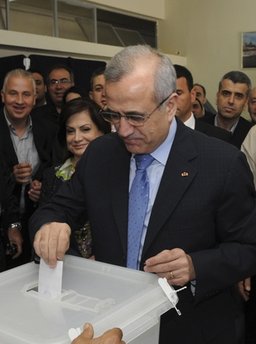

Additional army and police forces have been deployed in Mount Lebanon towns and outside polling stations to ensure security for the vote.
There are 795,372 registered voters in Mount Lebanon, the nation’s most populous province. They will choose 313 municipal councils from among 9,559 candidates and 921 village headmen from among 1,377 candidates.
Interior Minister Ziad Baroud said 57 of the 313 Mount Lebanon municipalities have been won uncontested.
Municipal elections in Lebanon are held every six years. The three remaining stages of voting will be held this month
Cities with tight elections: Jounieh – Ghosta – Zouk Mikhael – Kfardbyen – Sin el Fil – Antelias – Dbaye – Jbeil – Ajaltoun – Dekwaneh many cities in chouf and baabda and many more.
For more pictures please click Read More
Written By Malek el Khazen In one of your Last Week News introduction, in response of the Patriarch of Antioch Mar Nasrallah Boutros Sfeir comments on the incident that occurred in the Bekaa, you accused the Patriarch of triggering, supporting and legitimizing the actions of citizens attacking the army, which is not a […]
By Deacon Keith Fournier 4/10/2010 Catholic Online (www.catholic.org) Now that he is The "800 pound Gorilla" in the room in the coming selection and appointment of a replacement for Justice John Paul Stevens is this legal construct called an "Abortion Right." Its’ manufacture by the Supreme Court out of what it called the "penumbra" of […]
By Fr. Dwight Longenecker
The feminists had promised that their argument was not theological, merely pragmatic and egalitarian. "Women will make good priests," they said, "and it is unfair that they should be barred from ordination." However, the argument became theological because it was always theological. The traditionalists understood this from the beginning, and the saavy feminists did too — but they understood that their case for ordination would be derailed if they hinted that they wanted to unseat God the Father completely.
WASHINGTON, DC (Inside Catholic) – When I was an Anglican priest and the feminists were arguing for women’s ordination, those who were opposed used the theological argument that the fatherhood of the priest was an indispensable part of a patriarchal system of belief, and that the patriarchal system of belief was indispensable to the Judeo-Christian revelation. In other words, in the family of faith, the priest represents God the Father, and a female can’t do that. Tinker with the symbolism of priesthood, and you tinker with the revealed faith.
The feminists countered by saying, "This is not a theological argument. We have no problem with the revelation as it stands. Instead, this is simply a matter of justice. This is about equal rights. That’s all." So, eventually, they won the argument, and the Anglican Church voted for women priests.
Almost immediately, the feminists began to tinker with the liturgy to make it "non-sexist." Prayers to "God the Father" were changed to simply address "God" or "Almighty God," and "Father" or "Father in Heaven" was altered to "Almighty God." The changes were subtle and slight to start with. Then they began their revision on the hymns. Any references to God as Father were changed. If they hymn was too grounded in the Fatherhood of God, it quietly disappeared from hymnals altogether.
The next revision was to excise references to God as Son. An alternative Trinitarian formula was offered: Instead of "Father, Son, and Holy Spirit," it was suggested that we say, "Creator, Redeemer, and Sustainer." New revisions of the prayer book started to include new "female-friendly" psalms and canticles. Not only were feminist-friendly Scripture passages — like the ones personifying Divine Wisdom as female — turned into canticles for worship (no problem with that, necessarily), but sections by much-loved female spiritual writers from the past, like Julian of Norwich, were incorporated and structured as "alternative canticles."
In addition to these innovations, completely new compositions by feminist theologians were also interpolated. You can see the slow drift: Include new scriptural canticles, then include non-scriptural material from the Sacred Tradition, then weave in new material that will eventually become part of the Tradition.
By Fr. Dwight Longenecker
The feminists had promised that their argument was not theological, merely pragmatic and egalitarian. "Women will make good priests," they said, "and it is unfair that they should be barred from ordination." However, the argument became theological because it was always theological. The traditionalists understood this from the beginning, and the saavy feminists did too — but they understood that their case for ordination would be derailed if they hinted that they wanted to unseat God the Father completely.
WASHINGTON, DC (Inside Catholic) – When I was an Anglican priest and the feminists were arguing for women’s ordination, those who were opposed used the theological argument that the fatherhood of the priest was an indispensable part of a patriarchal system of belief, and that the patriarchal system of belief was indispensable to the Judeo-Christian revelation. In other words, in the family of faith, the priest represents God the Father, and a female can’t do that. Tinker with the symbolism of priesthood, and you tinker with the revealed faith.
The feminists countered by saying, "This is not a theological argument. We have no problem with the revelation as it stands. Instead, this is simply a matter of justice. This is about equal rights. That’s all." So, eventually, they won the argument, and the Anglican Church voted for women priests.
Almost immediately, the feminists began to tinker with the liturgy to make it "non-sexist." Prayers to "God the Father" were changed to simply address "God" or "Almighty God," and "Father" or "Father in Heaven" was altered to "Almighty God." The changes were subtle and slight to start with. Then they began their revision on the hymns. Any references to God as Father were changed. If they hymn was too grounded in the Fatherhood of God, it quietly disappeared from hymnals altogether.
The next revision was to excise references to God as Son. An alternative Trinitarian formula was offered: Instead of "Father, Son, and Holy Spirit," it was suggested that we say, "Creator, Redeemer, and Sustainer." New revisions of the prayer book started to include new "female-friendly" psalms and canticles. Not only were feminist-friendly Scripture passages — like the ones personifying Divine Wisdom as female — turned into canticles for worship (no problem with that, necessarily), but sections by much-loved female spiritual writers from the past, like Julian of Norwich, were incorporated and structured as "alternative canticles."
In addition to these innovations, completely new compositions by feminist theologians were also interpolated. You can see the slow drift: Include new scriptural canticles, then include non-scriptural material from the Sacred Tradition, then weave in new material that will eventually become part of the Tradition.
By Elizabeth Lev 4/1/2010 Catholic Online (www.catholic.org) Every year, the forces of evil get very anxious as we reach Holy Week. After six weeks of purification and prayer, we reach the great celebration of Christ´s victory over sin and our reconciliation with God. Satan is a sore loser. ROME (Zenit.org) – Every year, the forces […]
Easter: He Has Been Raised! And We Have Been Raised With Him!
(catholic.org) By Deacon Keith Fournier
Everything is different now because that Tomb is empty. We have been capacitated, through the Resurrection, to begin living our lives in a new way. Have you have heard the old adage, used often in a disparaging way, "He´s so heavenly he is no earthly good." I propose this Easter morning that it misses the mark completely. We Easter people are called to be so heavenly- to live our lives so attractively – that we bring GoodnessHimself to the earth.

Because He has been raised, heaven has come to earth and earth can now come to heaven. Because He has been raised, the new creation has already begun. The seed of the kingdom is manifested in the Church which is His Risen Body, the sign of the new heaven and new earth
CHESAPEAKE, VA. (Catholic Online) – "Brothers and sisters: If then you were raised with Christ, seek what is above, where Christ is seated at the right hand of God. Think of what is above, not of what is on earth; For you have died, and your life is hidden with Christ in God. When Christ your life appears, then you too will appear with him in glory." (Col. 3: 1- 4)
In the Epistle reading for our Mass during the day on this great Feast of Feasts, Easter Sunday, the Apostle Paul reminded the early Christians – and reminds all of us who stand with them in the continuing redemptive mission of the Lord – of an aspect of our celebration. Not only has the Lord whom we love been raised but we who have been baptized into Him have already been raised with Him!
At the Great Easter Vigil the new flame was lit. As a deacon, I had the honor of carrying the Paschal candle into the dark sanctuary proclaiming "Christ our Light". Candle by candle, the light of the Resurrection illuminated the world around us as He who is the Light of the World fills it with His radiance.
Easter: He Has Been Raised! And We Have Been Raised With Him!
(catholic.org) By Deacon Keith Fournier
Everything is different now because that Tomb is empty. We have been capacitated, through the Resurrection, to begin living our lives in a new way. Have you have heard the old adage, used often in a disparaging way, "He´s so heavenly he is no earthly good." I propose this Easter morning that it misses the mark completely. We Easter people are called to be so heavenly- to live our lives so attractively – that we bring GoodnessHimself to the earth.
Because He has been raised, heaven has come to earth and earth can now come to heaven. Because He has been raised, the new creation has already begun. The seed of the kingdom is manifested in the Church which is His Risen Body, the sign of the new heaven and new earth
CHESAPEAKE, VA. (Catholic Online) – "Brothers and sisters: If then you were raised with Christ, seek what is above, where Christ is seated at the right hand of God. Think of what is above, not of what is on earth; For you have died, and your life is hidden with Christ in God. When Christ your life appears, then you too will appear with him in glory." (Col. 3: 1- 4)
In the Epistle reading for our Mass during the day on this great Feast of Feasts, Easter Sunday, the Apostle Paul reminded the early Christians – and reminds all of us who stand with them in the continuing redemptive mission of the Lord – of an aspect of our celebration. Not only has the Lord whom we love been raised but we who have been baptized into Him have already been raised with Him!
At the Great Easter Vigil the new flame was lit. As a deacon, I had the honor of carrying the Paschal candle into the dark sanctuary proclaiming "Christ our Light". Candle by candle, the light of the Resurrection illuminated the world around us as He who is the Light of the World fills it with His radiance.
By Matt Cover, Staff Writer

Pope Benedict XVI (AP Photo)
Levada, who succeeded Ratzinger when the latter was elected Pope in 2005, called the Times’ reporting on the issue, and an accompanying editorial, “deficient by any reasonable standards of fairness.”
“Both the article and the editorial are deficient by any reasonable standards of fairness that Americans have every right and expectation to find in their major media reporting,” Levada wrote March 26.
The article, published March 24, says that Ratzinger “declined” to defrock accused pedophile Fr. Lawrence C. Murphy of Wisconsin, who had been accused of molesting as many as 200 deaf boys while running a school for the deaf from 1950 to 1974.
Levada criticized the Times’ focus on the alleged conduct of then-Cardinal Ratzinger and other unnamed Vatican officials for not removing Murphy from the priesthood, even though the article never provides any evidence that Ratzinger refused to take action or tried to cover up Murphy’s conduct. Levada pointed out that when allegations of abuse were raised at the time, not even the local police investigated.
“Only after eight paragraphs of purple prose does Goodstein [the Times’ reporter] reveal that Fr. Murphy, who criminally abused as many as 200 deaf children while working at a school in the Milwaukee Archdiocese from 1950 to 1974, ‘not only was never tried or disciplined by the church’s own justice system, but also got a pass from the police and prosecutors who ignored reports from his victims, according to documents and interviews with victims,” states Levada.

Population Movements to Keserwan - The Khazens and The Maans
ما جاء عن الثورة في المقاطعة الكسروانية
ثورة أهالي كسروان على المشايخ الخوازنة وأسبابها
Origins of the "Prince of Maronite" Title
Growing diversity: the Khazin sheiks and the clergy in the first decades of the 18th century
Historical Members:
Barbar Beik El Khazen [English]
Patriach Toubia Kaiss El Khazen(Biography & Life Part1 Part2) (Arabic)
Patriach Youssef Dargham El Khazen (Cont'd)
Cheikh Bishara Jafal El Khazen
Patriarch Youssef Raji El Khazen
The Martyrs Cheikh Philippe & Cheikh Farid El Khazen
Cheikh Nawfal El Khazen (Consul De France)
Cheikh Hossun El Khazen (Consul De France)
Cheikh Abou-Nawfal El Khazen (Consul De France)
Cheikh Francis Abee Nader & his son Yousef
Cheikh Abou-Kanso El Khazen (Consul De France)
Cheikh Abou Nader El Khazen
Cheikh Chafic El Khazen
Cheikh Keserwan El Khazen
Cheikh Serhal El Khazen [English]
Cheikh Rafiq El Khazen [English]
Cheikh Hanna El Khazen
Cheikha Arzi El Khazen
Marie El Khazen