It was quite a surprise for some and normal for others witnessing Jumblat’s deviation via its recent statements and critics towards his unnatural allies in the 14th of March camp. There is no doubt that these changes were stronger than the atomic bomb as described by some Lebanese media. […]
Diaries… by Soha Kerbage
يوميات……. يوميات….ساعات….دقائق….ثوان……وأنا أفكر….وأخطط لاكتب ما سأكتب .ما هو موضوع اليوم؟أهو موضوع الامس؟لا بل موضوع الحاضر الذي هو خبر المستقبل……ما ان أكتب حتى أجد نفسي في عالم اخر الا وهو عالم الحروف والكلام,عالم الورقة والقلم,عالم الفكر,عالم" الاعالم"عالم الموجود وعالم الغائب,عالم الواقع وعالم الخيال ……نعم انها حياة" التضاد":القوي مقابل الضعيف,الغني مقابل الفقير,الذكي مقابل البسيط….. […]
LEBANON: Quietly, Jewish community begins synagogue renovation
Since Lebanon’s 1975-1990 civil war, Beirut’s Maghen-Abraham synagogue sat empty as other buildings in the Wadi Abou-Jamil neighborhood were renovated into multimillion-dollar condos, offices or hotels. Last week, restoration began on the 84-year-old synagogue, Beirut’s oldest remaining Jewish house of worship, launching what will be a yearlong, million-dollar undertaking. Private Jewish donors abroad, many of […]
Jumblatt reacting to regional trends
By Tom Perry
BEIRUT (Reuters) – Lebanese Prime Minister-designate Saad al-Hariri has taken a holiday to "think and reflect" after a once close ally quit his anti-Syria coalition in a move expected to delay the formation of a new government.
Druze leader Walid Jumblatt’s departure from Hariri’s "March 14" alliance this week has redrawn Lebanon’s political map and undermined the coalition’s June parliamentary election victory over rivals including the powerful Iran-backed Hezbollah group.
Hariri, a Saudi- and U.S.-backed billionaire businessman, had been expected to conclude talks this week on the formation of a coalition government grouping his alliance with parties allied to Syria, including Hezbollah and the Amal movement.
But he left the country Monday night for a holiday, his media office said. The trip aimed to give Hariri a chance to "think and reflect calmly," according to a statement released after a meeting of MPs from his Future Movement.
Glamour drives fashion in sophisticated Lebanon
BY ZEINA KARAM, The gowns are cut low in the front, slashing down to the navel, or low in the back, swooping below the waist, inset with delicate see-through fabric. They couldn’t be further from the modest dress generally worn by women in the Muslim Arab world.
Yet these fashions come from Lebanon, a tiny Arab country of 4 million on the Mediterranean. This nation better known for military conflicts than the arts has produced an impressive crop of designers, including Reem Acra and Elie Saab, whose work is showcased at celebrity events such as the Oscars and the Golden Globes.
"Lebanon’s name has always been synonymous with war, but when it comes to fashion … these designers really make us proud," said Laura Seikaly, 39, who was among a recent crowd of bikini-clad sunbathers on a beach north of Beirut. "I guess it comes from the society itself, the way Lebanese women dress. They’re very courageous, even more than Europeans."
The Last Jews of Saida
road trip to the South this weekend brought me and some friends up close to the remnants of one of Lebanon’s prouder former Jewish communities. For some reason the Jews of Lebanon have been a hot journalistic subject around here recently, at least ever since this article in Ha’aretz reported that a group of Lebanese Jews in exile were planning to fund the restoration of Beirut’s once-noble synagogue near downtown. (For more on that story, seen Ben Gilbert’s sharp follow-up in GlobalPost. Ben is also the highly capable editor of the regional business magazine Executive, which recently featured “The Jews of Lebanon” on its cover; this has resulted in the curious sight of a giant photograph of a menorah sitting in doctor’s office waiting rooms and on the desks of bank executives all across town.)
What we found on the way south from Saida was something less prominent, but perhaps more telling: the scattered ruins of Saida’s Jewish cemetery.
Saida, like many Middle Eastern cities, still has a neighborhood known as the Jewish Quarter. (In fact, back in the old city we had briefly puzzled over a martyr poster of a little boy — below that of a deceased resistance leader — that said, in bold script, that it was “paid for by the youth of the Jewish Quarter,” which seemed like an odd juxtaposition. Turns out the boy, tragically, fell into the sea near town and drowned.) According to Kirsten E. Schulze’s book, “The Jews of Lebanon: Between Coexistence and Conflict,” the Jewish presence in Saida dates back at least a thousand years and those who remained in the 1960s and early 1970s had a fine relationship with their Lebanese neighbors. By 1975, though, there was only one Jewish family left in town, that of Josef and Jamila Levy.
The Siege of Manger Church- Paul Kerbage
حصار كنيسة المهد

مقدّمة
شاء القدر، أو بتعبير آخر الإرادة الإلهية أن تكون هذه البقعة الجغرافيّة على الساحل الشرقي للبحر المتوسط، والتي تعاقب عليها الغزاة واختلطت فيها الأجناس والشعوب، من الكنعانيين حتى قبائل الفلسطو واليهود مروراً بالمصريين والأشوريين والرومان، ساحة مواجهات مفتوحة بين كل هذه العناصر المتناقضة، إنها "فلسطين" التي سمّاها هيرودوتس.
"فلسطين" عامةً والقدس خاصةً مهد الديانات السماوية الثلاثة. ويمكن القول مهد النزاعات والحروب في العالم، بين اليهودية، المسيحية والإسلامية. ففي أورشليم القدس، حائط المبكى، المسجد الأقصى وكنيسة المهد. والأخيرة هي المكان نفسه الذي يعتقد أنّ مريم العذراء وضعت فيها ابنها يسوع. وكنيسة المهد بنيت في القرن الرابع الميلادي، والكنيسة تحوي عظام الأطفال الذين قتلهم هيرودوس خوفاً أن يكون أحدهم المسيح المنتظر. وهي بدون شك إرث حضاري و أثري عظيم وكبير.
هذا الإرث أضحى في نيسان من العام 2002 دراما حقيقيّة، رصاص ولهيب ودم ونار وحصار ومفاوضات.
إنّه حصار كنيسة المهد.
What the Romans Wrought in Lebanon
Written by Melik Kaylan,
![[SB10001424052970204619004574322453634324442]](http://s.wsj.net/public/resources/images/PT-AM145_mpbaal_D_20090729130614.jpg) Getty Images
Getty Images
A first glimpse of Baalbeck’s six 72-feet-high Corinthian columns will instantly raise your spirits and turn unease into adventure. Like the Parthenon or the Pyramids, the Baalbeck complex is one of the glorious monuments of history. No matter which angle you look from, the two lofty temples—to Jupiter and to Bacchus—seem to ride the sky and will intoxicate your faculties. You will know how it feels to be a besotted idolater.
The site sits astride a north-south thoroughfare of history, being the place where trouble flowing down from the north (Syria) meets trouble coming up from the coast (Beirut). In recent years, the Bekaa Valley was home to guerrilla training camps. The Lebanese Civil War shut down the annual Baalbeck International Festival—and its presentations of music, dance and theater—from 1975 to 1996. The Hezbollah-Israel war did the same for a year in 2006. Nowadays, when the festival is in full swing a shop set into the ancient walls sells Hezbollah banners and T-shirts.
Lebanese turn to travel to tie civil knot
BEIRUT: When Nadine Abi Nasr and her Italian fiance Marco decided to have a civil marriage, they turned to a travel agency for help to escape Lebanon’s tangled bureaucracy and strict religious rules. Nadia Travel provided them with a tailor-made package and return tickets for the 30-minute flight to the nearby east Mediterranean island of Cyprus, where the couple tied the knot.
Despite a long-running campaign by civic groups, civil weddings still have no legal basis in Lebanon, a tiny country of around four million people who belong to 18 different religious communities, mainly Christian and Muslim.
The Lebanese authorities recognize civil weddings only if they have been registered abroad, but such ceremonies are banned from taking place inside the country because of strong opposition from religious leaders.
Religious faiths have their own regulations governing marriage, divorce and inheritance, and mixed Christian-Muslim weddings in Lebanon are frowned upon and downright discouraged unless one of the potential spouses converts.
Obama’s Lebanon Approval Ratings and More
Here’s the full list of countries polled, accompanied by opinion results on whether Obama “will do the right thing in world affairs”: U.S. (74), Canada (88), Britain (86), France (91), Germany (93), Spain (72), Poland (62), Russia (37), Turkey (33), Egypt (42), Jordan (31), Lebanon (46), Palestinian territories (56), China (62), India (77), Indonesia (71), Japan (85), Pakistan (13), South Korea (81), Argentina (61), Brazil (76), Mexico (55), Kenya (94), Nigeria (88).
The Survey did not cover Syria, but in Lebanon there are some interesting trends. For one thing, the Favorability rating here (now at 55%) for the United States has been steadily climbing, although not by much, which seems to support the notion that Lebanon has long been an outlying proponent of George W. Bush in the region. (In 2005, Bush helped encourage Lebanon’s effort to oust Syrian troops from the country.) Lebanon emerges as the only polled country which gave Bush a higher confidence rating than Bin Laden among its Muslim citizens in recent years, although this surely relates as much to Bush’s support for the anti-Syrian movement as it does to so much of the Muslim population’s support here for Nasrallah. No room for Bin Laden’s shenanigans here.
Other points:
-The Obama support is highly polarized: “Only 2% of Lebanese Shia express a positive attitude toward the U.S., barely an improvement from last year’s 0%. But a remarkably high 90% of Lebanese Sunni hold a positive view of the U.S., up from 62% in 2008. Sunnis now have more favorable views of the U.S. than the country’s Christian population – 66% of Lebanese Christians express a positive opinion of the U.S., down from 75% in 2008.”
-Lebanon shows some of the most dramatic change in its Muslim citizens’ response to a question about whether suicide bombing is ever justified. In 2002, 72% of the country’s Muslims answered yes; today that figure is 38%.
Population Movements to Keserwan - The Khazens and The Maans
ما جاء عن الثورة في المقاطعة الكسروانية
ثورة أهالي كسروان على المشايخ الخوازنة وأسبابها
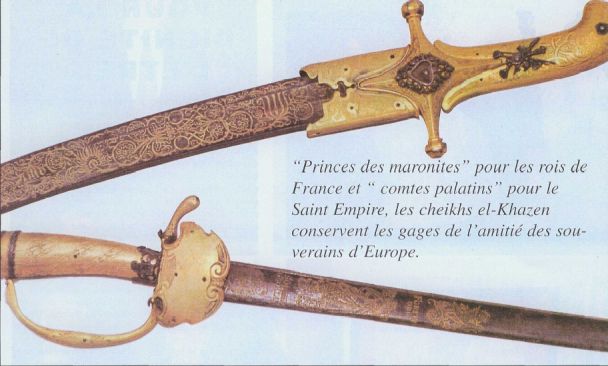
Origins of the "Prince of Maronite" Title
Growing diversity: the Khazin sheiks and the clergy in the first decades of the 18th century
Historical Members:
Barbar Beik El Khazen [English]
Patriach Toubia Kaiss El Khazen(Biography & Life Part1 Part2) (Arabic)
Patriach Youssef Dargham El Khazen (Cont'd)
Cheikh Bishara Jafal El Khazen
Patriarch Youssef Raji El Khazen
The Martyrs Cheikh Philippe & Cheikh Farid El Khazen
Cheikh Nawfal El Khazen (Consul De France)
Cheikh Hossun El Khazen (Consul De France)
Cheikh Abou-Nawfal El Khazen (Consul De France)
Cheikh Francis Abee Nader & his son Yousef
Cheikh Abou-Kanso El Khazen (Consul De France)
Cheikh Abou Nader El Khazen
Cheikh Chafic El Khazen
Cheikh Keserwan El Khazen
Cheikh Serhal El Khazen [English]
Cheikh Rafiq El Khazen [English]
Cheikh Hanna El Khazen
Cheikha Arzi El Khazen
Marie El Khazen