Lebanese Christian majority leader MP Michel Aoun left for Tehran Sunday on his first official visit to Iran, local Ad-Diyar daily reported Monday. Friendship with Iran is not an accusation," Aoun, a former Lebanese army commander and prime minister, said. Asked whether he was seeking money and weapons from Iran, Aoun said that such possibility […]
Sleiman urges Saudi entrepreneurs to boost investments
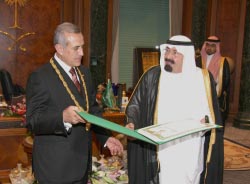 Lebanese President Michel Sleiman on Monday urged Saudi entrepreneurs to invest in his country during his first visit to oil-rich Saudi Arabia since his election in May. Addressing business leaders at the Jeddah Chamber of Commerce and Industry, Sleiman urged them to "boost their investments" in Lebanon, which offers "guarantees and facilities" for investors, the official Saudi Press Agency (SPA) reported. Lebanon has formed a committee to assess the losses incurred by Saudi investors during the political crisis his country went through in the past few years, Sleiman said, thanking Saudi Arabia for what he described as its constant support for Lebanon. Sleiman, a former commander of the Lebanese Armed Forces, was elected president in May after Lebanon’s rival political factions struck an Arab-brokered deal in the Qatari capital, Doha, to end an 18-month political crisis that had brought the country to the brink of civil war.
The president of the Saudi-Lebanese Business Council, Abdel-Mohsen al-Hakir, was quoted by SPA as saying that "many Saudi investments will start flowing back to the Lebanese market." Saudi investments in Lebanon are estimated at nearly 5 billion riyals ($1.3 billion) and are expected to increase, Hakir said. Sleiman told the businessmen that the end of terrorism in the Arab and Islamic worlds was not far away. The president also described media attacks against Saudi Arabia as a blow to Arabism. "Any Lebanese individual who attacks any of his Arab brothers in the media, particularly Saudi Arabia, is moving away from his Arabism," he said. Before heading to Tehran on Sunday, Free Patriotic Movement leader MP Michel Aoun said on Saturday that some Lebanese Christians were being swayed by Saudi petrodollars.
Saudi Arabia is a main financial backer of Lebanon, and Saudi King Abdullah reportedly told Sleiman that it was not true that the kingdom supports only one camp in this country. "I hear that we are accused of being with some people and against others … We are with all sides, and we do not pursue any private interests" in Lebanon, Abdullah told Sleiman, according to a Lebanese official. The official, who requested anonymity, said the Saudi monarch made his remarks when he met Sleiman Sunday after the Lebanese leader arrived in the Red Sea city of Jeddah. "Lebanon must be respected; all countries must respect Lebanon," Abdullah said, stressing that Saudi Arabia was prepared to "help Lebanon in whatever it demands," according to the official.
Pope condemns violence against Christians
Pope Benedict XVI condemned on Sunday violence perpetrated against Christians in India and Iraq. "I invite you to pray for peace and reconciliation as situations cause concern and great suffering…. I think of violence against Christians in Iraq and India," he said after a ceremony in which he canonised India’s first woman saint. The pontiff […]
Lebanese take aim at Israel over hummus
BEIRUT (Reuters Life!) – Lebanese food makers aim to prove that dishes including hummus originated in their country in a campaign to stop Israeli manufacturers from using the names to market the same foods."Our battle is to prove that all these names and specialities and foods are Lebanese, as Greece did with feta cheese," said […]
Missing American journalists under arrest in Syria
American journalists Taylor Luck and Holli Chmela, who were reported missing in Lebanon, are safe and sound in Syria
Sleiman presses Bush on land, Palestinian refugees
WASHINGTON: Lebanese President Michel Sleiman emphasized on Thursday the need to liberate Lebanese territories occupied by Israel and told US President George W. Bush that the future of Palestinian refugees was in their homeland, not in Lebanon. Bush welcomed Sleiman for talks Thursday to underline US support for democratic rule in Beirut free from any undue […]
President Suleiman – United Nations
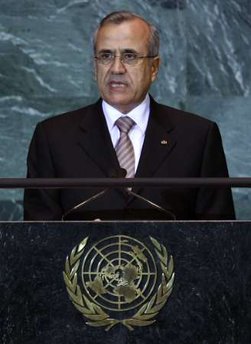 Naharnet, President Michel Suleiman said that Lebanon was fully committed to the implementation of U.N. Security Council Resolution 1701 and added that the nternational community should urge Israel to stop its threats against Lebanon. "Lebanon reiterates its full commitment to Resolution 1701," Suleiman said in a speech Tuesday before the 63rd U.N. General Assembly session in New York. "Lebanon is facing a series of dangers and challenges which require the international community to compel Israel to implement Resolution 1701
Aoun warns he may pull out of dialogue with ‘corrupt people’
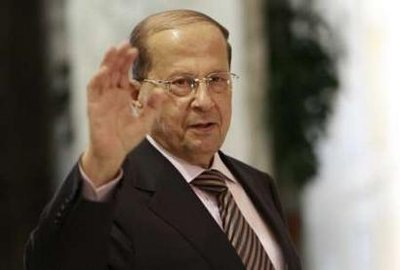 BEIRUT: Reform and Change bloc leader MP Michel Aoun said Monday that he might walk out of the national dialogue because he could no longer deal with "corrupt people." At a news conference following his bloc’s weekly meeting, Aoun said that a conspiracy was being waged against the Lebanese "to buy their votes." Aoun added that the March 14 Forces’ suggestion to have mayors resign six months rather than 24 months prior to running for parliamentary elections constituted "a serious breach of the Constitution." "A mayor who resigns six months before running for elections can still make use of municipal funds to sponsor their electoral campaigns," Aoun said. Aoun also reacted to Lebanese Forces leader Samir Geagea’s speech on Sunday in which the LF leader apologized for "mistakes" committed by his militia during the 1975-1990 Civil War. Aoun said Geagea should have apologized "to [former Prime Minister Omar] Karami, the Chamoun family and [Marada Movement leader Sleiman] Franjieh." Aoun added that Geagea’s speech "influenced only those who are of marginal importance in the Christian community."
Franjieh on Monday accepted the apology made by Geagea, but challenged the LF boss to accept reconciliation. "The apology made by Geagea is accepted although it was not addressed to us," Franjieh told a news conference, adding that he would deal "positively" with it. Geagea is accused of playing a leading role in the assassination of Franjieh’s father Toni Franjieh and dozens of other people in 1978. Addressing Geagea, Franjieh said: "Election results will show who enjoys wider popularity." Franjieh also criticized Maronite Patriarch Nasrallah Sfeir, calling on him to "refrain from dealing with Christians in a biased manner." Responding to Franjieh, LF MP Farid Habib said even after Geagea had declared his openness to other parties and apologized for abuses, Franjieh "is still attacking him and trying to distort the LF’s image." Habib told the reporters on Monday that he was not surprised by Franjieh’s verbal assaults "because anyone who dares to attack the Maronite patriarch will not hesitate to attack any political party.
Meanwhile, Karami said that the LF boss’ speech was important because it "proved that Geagea is a killer, criminal and liar, because he had previously announced that the Syrian regime was responsible for all the crimes." Geagea is also accused of assassinating Karami’s brother, then-Prime Minister Rashid Karami, in 1987. After meeting British Ambassador Frances Mary Guy on Monday, Karami said Geagea was trying to sway public opinion for electoral purposes. He said Geagea was not interested in reconciliation and wanted only to impose himself by force
Geagea apologizes for LF’s ‘mistakes’ Criticizes Hizbullah and Aoun
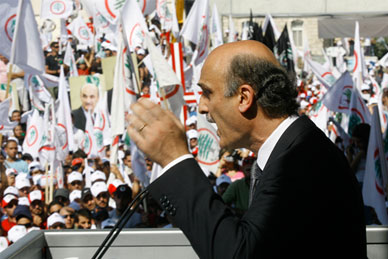 By Hussein Abdallah, BEIRUT: Lebanese Forces (LF) leader Samir Geagea apologized on Sunday for "mistakes" committed by members of his party during the 1975-1990 Civil War. "I fully apologize for all the mistakes that we committed when we were carrying out our national duties during past Civil War years," he said. "I ask God to forgive and so I ask the people whom we hurt in the past," he added. Speaking before tens of thousands of his supporters who gathered in Jounieh, north of Beirut, for a memorial ceremony for LF members killed during political violence in Jounieh, Geagea accused his political rivals of "exploiting past mistakes" that were committed by the LF. "I want to tell those who are exploiting our past mistakes to stop doing so because only God can judge us," he said. Geagea said that Christian unity was not possible in light of sharp differences over political principles and values among Christian leaders, hinting at his main rival, Free Patriotic Movement leader MP Michel Aoun. "I know that every one of you is longing to see Christian unity and reconciliation," he said. "This is also our aim, but the question: Over what values shall we unite?" "Shall we unite over Hizbullah’s possession of arms at the expense of the Lebanese state?" "Shall we unite over investigating the Lebanese Army command for sending the helicopter in which First Lieutenant Samer Hanna was shot in the Sejod Hills?" "Shall we unite over changing Lebanon into the only battlefield in the Arab-Israeli conflict while many others are negotiating with Israel?" Geagea asked as the crowd chanted anti-Aoun, anti-Hizbullah, and anti-Syrian slogans.
However, the LF chief added that Christian unity was the key to saving Lebanon, urging all Christians to take the right decision in next year’s parliamentary elections. "I call on the Christians who are against the Lebanese Forces or against me personally, to put Lebanon’s interests ahead of personal interests," he said. "We can only save Lebanon when the people of Lebanon as a whole and Christians in particular unite over the historic principles of Christians in Lebanon." He accused Christian members of the March 8 alliance of dropping the slogan, "my nation is always right" and replacing it with a slogan that says "Syria and Hizbullah are always right." Geagea said that both the Doha Accord and the ministerial statement of the new government stipulate that the state was the sole authority on defense issues. "We cannot accept that Hizbullah wants to maintain its arms until the liberation of Palestine and the resolution of the Middle East conflict," he said. Geagea also argued against Hizbullah’s claim that it should maintain its arms until the state acquires the necessary capabilities to defend Lebanon. The event was attended by several senior officials, including Finance Minister Mohammad Shatah, representing Prime Minister Fouad Siniora, and former President Amin Gemayel. President Michel Sleiman, who left for New York Sunday, contacted Geagea to offer his condolences. Parliamentary majority leader Saad Hariri also congratulated him for the "success" of the memorial ceremony.
Lebanese rivals hold reconciliation talks
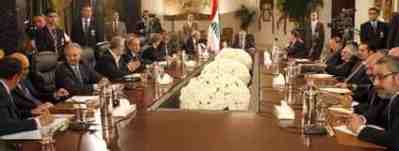 BEIRUT (AFP) Lebanon’s rival factions launched national reconciliation talks on Tuesday to resolve lingering disputes after a crisis that brought the nation to the brink of civil war, with the thorny issue of Hezbollah’s weapons topping the agenda. The talks bring together 14 political figures from the country’s pro- and anti-Syrian camps who agreed to try to mend fences following a Qatari-brokered deal in May that put an end to a damaging 18-month political crisis. "Agreeing to dialogue in and of itself means that all subjects are open to discussion," President Michel Sleiman said as he opened the talks. "The only thing banned here is failure or a reaching a dead-end."
The main focus of the dialogue will be on forging a defence strategy for Lebanon but there is widespread scepticism that an agreement can be reached given deep-seated divisions over Hezbollah’s weapons arsenal. The Shiite Muslim group, considered a terrorist organisation by the United States, has refused to disarm arguing that its weapons and guerrilla army are essential to defend the country against neighbouring Israel. However members of the Western-backed majority in parliament argue that Hezbollah’s weapons undermine the authority of the state which should be the sole decision-maker on matters of defence.
"All Lebanese are hoping that the dialogue will be successful but a real solution will only be found when Hezbollah stops using its weapons to serve regional interests and stops imposing its hegemony by force on the local scene," said an editorial in An-Nahar newspaper, which is close to the anti-Syrian ruling coalition in parliament. Newspapers close to the rival camp backed by Syria and Iran said those taking part in the dialogue face an arduous task given their differences. "The various political camps believe the discussions on the national defence strategy will get bogged down into futile debate and no one will see any results for a long time," the As-Safir newspaper said. The independent Al-Anwar said the closed-door talks were taking place "in a minefield called Lebanon, with the mines produced locally and abroad." The dialogue follows on from a 2006 initiative in which the same 14 factions held several round-table meetings in a bid to forge political unity. But there have been heightened security concerns in the country following the killing last week of a pro-Syrian politician in a car bombing and a number of violent incidents. Six makeshift bombs exploded early on Monday in a mixed Sunni-Shiite area of west Beirut and two similar bombs were defused by the Lebanese army near a church north of the capital. Tuesday’s talks are to set the agenda and timetable for talks, with the next session set to take place after Sleiman returns from a visit to the United States later this month.
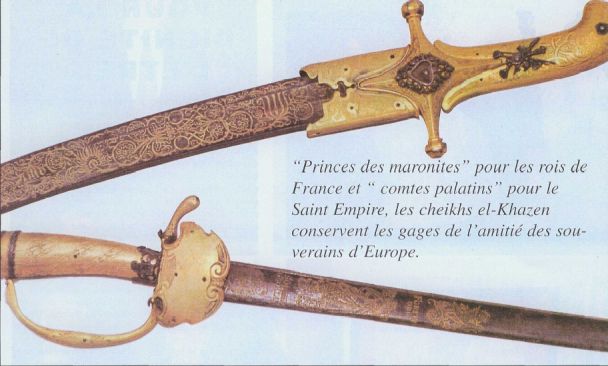
Population Movements to Keserwan - The Khazens and The Maans
ما جاء عن الثورة في المقاطعة الكسروانية
ثورة أهالي كسروان على المشايخ الخوازنة وأسبابها
Origins of the "Prince of Maronite" Title
Growing diversity: the Khazin sheiks and the clergy in the first decades of the 18th century
Historical Members:
Barbar Beik El Khazen [English]
Patriach Toubia Kaiss El Khazen(Biography & Life Part1 Part2) (Arabic)
Patriach Youssef Dargham El Khazen (Cont'd)
Cheikh Bishara Jafal El Khazen
Patriarch Youssef Raji El Khazen
The Martyrs Cheikh Philippe & Cheikh Farid El Khazen
Cheikh Nawfal El Khazen (Consul De France)
Cheikh Hossun El Khazen (Consul De France)
Cheikh Abou-Nawfal El Khazen (Consul De France)
Cheikh Francis Abee Nader & his son Yousef
Cheikh Abou-Kanso El Khazen (Consul De France)
Cheikh Abou Nader El Khazen
Cheikh Chafic El Khazen
Cheikh Keserwan El Khazen
Cheikh Serhal El Khazen [English]
Cheikh Rafiq El Khazen [English]
Cheikh Hanna El Khazen
Cheikha Arzi El Khazen
Marie El Khazen