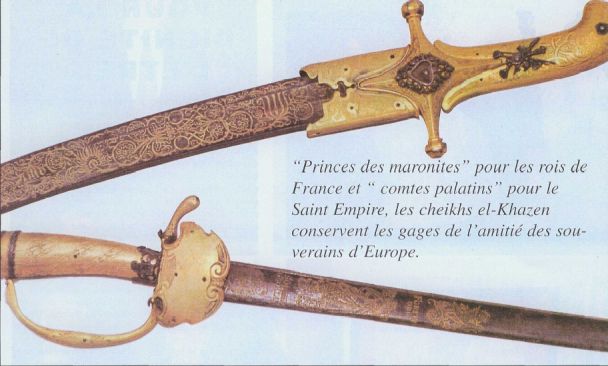
Khazen

Four killed in Lebanon sectarian gunbattles

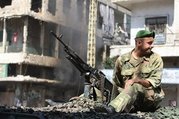
by Omar Ibrahim TRIPOLI, Lebanon (AFP) – Four people were killed and dozens wounded in street battles between rival sectarian camps armed with rockets, sniper rifles and grenades in the north Lebanese city of Tripoli on Wednesday.  Panicked residents were fleeing the scene of the fighting which first erupted late on Tuesday in two districts of northeastern Tripoli, while several roads were blocked and local shops and schools were closed, an AFP correspondent said. A security official said four people were killed and another 58 were wounded in the violence, which followed the eruption of similar battles two weeks ago in the port city that left nine people dead and dozens wounded. The latest fighting comes amid continued efforts by Prime Minister Fuad Siniora to form a national unity government which have been hampered by bickering between rival factions over cabinet posts. Fighting raged on a main road separating the areas of Bab al-Tebbaneh — where most residents are Sunni supporters of the Western-backed premier — and Jabal Mohsen, which is dominated by members of the Alawite community, an offshoot of Shiite Islam.
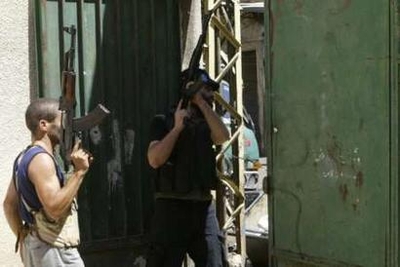
The two sides announced that they had agreed to observe a cease-fire from 8 p.m. and allow the deployment of the army in the two neighborhoods affected by the fighting.  "The army will deploy to maintain security and prevent any armed presence," said a statement released after indirect negotiations between the two sides held under the auspices of the Sunni mufti of North Lebanon, Sheikh Malek al-Shaar.  Later on Wednesday, the Lebanese Armed Forces warned gunmen on both sides that soldiers would fire on them if they were seen on the streets after 9 p.m., security officials said. The army was sending reinforcements to the area.  President Michel Suleiman and other officials have been consulting with Shaar, who has acted as a mediator between the two sides since the fighting broke out several weeks ago.  Panicked residents were fleeing the scene of the fighting which erupted again late on Tuesday in two districts of northeastern Tripoli, while several roads were blocked and local shops and schools were closed.

Read more
هل تخفق النخبةُ &#1603

هل تخفق النخبةُ كما فشِل السياسيون

النهار في 30 حزيران 2008

سجعان قزي

حين يتحدّث البعضُ عن الـنُـخبة يظـنّها جنساً مُجتمعـيّـاً ممـيَّـزاً، ويَضعُها آلـيّـاً في مواجهةِ الشعب (متفوِّقـة عليه) والطاقمِ السياسيّ (أكفأ منه)، في حين أنّ الـنـخبةَ تنتمي إلى كلّ فئات الشعبِ وطبقاته. ولا قيمةَ إضافية للنخبة إلا مِقدار ما تساهمُ في التقدِّم العام وتلتزمُ مسؤوليةَ نهضةِ المجتمع. الـنُـخبةُ ليست طبقةً بل نوعـيّـة، والـنُـخبويّ ليس مُبشِّراً بل قُدوة. 

بين أفضلِ عشرِ شخصيات نُخبويّـة اختارها الفرنسيّـون العامَ الماضي، لم يَرِد اسمُ أيِّ شخصيّـة سياسيّـة مع أنّ السياسيّين الفرنسيّين، عموماً، نخبويّون بامتياز. بَرز طاهٍ وكاتبٌ وموسيقار وتقنيّ ومهندس معماري وفـنّـانٌ تشكيلي ومُخرج سينمائي. وعام 2006، صنّـفت مجلةُ فوربس Forbes العالمية الطاهي الفرنسي ألان دوكاس Alain Ducasse ضُمن أهمِ مئةِ شخصٍ مؤثّرين في العالم.

النخبة إذن متعدِّدةُ الطاقاتِ والمستويات وعابرةُ كلّ المهن: هناك النخبُ الفقيرة والغنـيّـة، الأكاديمـيّـة والنقابيّـة. هناك النخب التقليديّـة والتجديديّـة، الدينـيّـة والعَلمانـيّـة. هناك النخب الشعبيّـة والبورجوازيّـة، المدينيّـة والمناطقـيّـة. هناك النخب اليمينـيّـة واليساريّـة، العسكريّـة والأمنـيّـة. هناك نخبٌ تَستهويها السياسةُ سبيلاً إلى عملٍ وطنيّ، وأخرى تتلـهّـف إلى السياسة شَغفاً بوجاهة. هناك نخبٌ تحبّ الشأن العامَّ كجُزءٍ من عملٍ اجتماعيٍّ وإنساني، وأخرى تُفضِّل الشأن الخاص رافداً يَصبُّ في الازدهار العام. وهناك "نخبٌ" تَجـتَـرُّ أنانـيّـتَها ونرجسيّـتَها وتعيش في عالمٍ آخر: نيرفانا التفاهة.

Read more
Cheikh Farouk El Khazen Profile

                      Cheikh Farouk El Khazen son of Cheikh Chafic El Khazen and Marie Masaad holds a BS in Business Administration and Certificates in Hotel Management mainly from the Swiss "Ecole Hoteliere" Chalet-A-Gobet , Lausanne. In his personal life Cheikh Farouk El Khazen has two daughters Leeza-Maria El Khazen and Lara El Khazen. Leeza-Maria El Khazen […]

Read more
Lebanon expects over 1.3 million tourists in 2008

BEIRUT: Lebanon expects over 1.3 million tourists this year thanks to the positive political atmosphere following the election of a new president, outgoing Tourism Minister Joe Sarkis said Friday. The minister made the remarks during a tour of Rafik Hariri International Airport, adding that most of the hotels in Beirut and the mountain are fully booked.  According to the figures released by Rafik Hariri International Airport, arriving passengers totaled 598,392 in the first five months of the year, while departing passengers amounted to a higher 633,255.
The minister said Lebanon is heading toward a promising tourism season, adding that the Tourism Ministry plans to launch widespread media campaign to encourage foreigners and Arabs to visit Lebanon.  "Once a new government is formed, I expect Lebanon to experience a steady rise in the number of visitors," he said.  In 2007, less than a million visitors arrived in Lebanon and authorities said most of the arrivals were Lebanese working in oil rich Gulf states and Africa.

Read more
Israeli airman missing in Lebanon died 10 years ago

JERUSALEM (AFP) – Israel received a report from Hezbollah hat an Israeli airman reported missing in Lebanon since 1986 has been dead for more than 10 years, the Haaretz daily reported on Friday.  Israel had demanded that the militia provide a report on the fate of navigator Ron Arad as a precondition for a prisoner […]

Read more
President Michel Suleiman has set July 9 as a deadline

Lebanese President Michel Suleiman has set July 9 as a deadline to conclude the formation of a new government in the country, well informed sources were quoted by Xinhua news agency. The president is due to leave for Paris on July 12 to participate in the international conference on Euro-Mediterranean cooperation, the report added, hinting that a new government should be formed before the president leaves. Over five weeks have passed since designated-Prime Minister Fouad Seniora was assigned by the president to form a national unity government, but all efforts were fruitless as Lebanese leaders were unable to reach an agreement on the cabinet line-up.
Sources close to Parliament Speaker Nabih Berri, who is in the opposition camp, told a local daily Star that "Prime Minister Seniora’ s performance with respect to forming the cabinet lacks transparency." Meanwhile, the ruling majority is accusing Christian opposition Leader MP Michel Aoun of being responsible for the cabinet deadlock because of his demands to get certain key portfolios. The Doha agreement reached on May 21 resulted in the election of a new president after six months of vacancy in the seat.
 The second phase of the agreement called for the formation of a national unity government, a step that is not implemented yet.

Read more
Lebanon’s eco-tourism dream survives crisis

KFAR ZABAD, Lebanon (AFP) by Jocelyne Zablit  – A decade ago, it was a glittering vision — a scheme to lure nature lovers to the Lebanese highlands, providing income to local people, nurturing the country’s damaged environment and cementing national unity in one stroke.  Today, after a war, a political crisis and flareups of sectarian violence, Lebanon’s brave experiment in eco-tourism is battered and bloodied but defiantly soldiers on. In the eastern Bekaa region near the Syrian border, financial help from the United States and Europe helped establish a project for encouraging families to come and enjoy the wildlife, staying in local hostels and employing local guides. Ravaged by hunters, the countryside around the village of Kfar Zabad, which straddles the main migration route for African-Eurasian water fowl, was declared a protected area and now teems with birds, along with wildcats and a few river otters. "Before, this place was filled with hunters in the afternoon and all you heard was the sound of gunfire," Mayor Qassem Choker says proudly, pointing to fields near the entrance to the village. "But since the village was designated a protected area in 2004, we can hear the birds chirping again and enjoy our surroundings." The wildlife has emphatically returned. But since the 2005 assassination of ex-premier Rafiq Hariri that marked Lebanon’s new plunge into turmoil, the tourists have become an endangered species.

Foreign tourists and even expatriate Lebanese have been discouraged by fears about safety. The main visitors to the Bekaa are hardy people from Beirut and other regions, who in periods of relative calm grab the chance of a countryside break. "We keep trying to tell people it’s safe but the simple mention of the name Bekaa scares them away," said Dalia Al-Jawhary, of the Society for the Protection of Nature in Lebanon, which is heavily involved in the Kfar Zabad project. Faisal Abu-Izzedin, director of the Lebanon Mountain Trail project, a 440-kilometre (275-mile) path that cuts through 75 villages, many of them in remote areas stretching from the north to the south, says Lebanon offers unique treasures. "Nowhere else can you see this diversity," he said. "Our aim was to revive an ancient heritage which was a trail that connected villages. We hope that the trail and people who walk the trail will shine a light on the importance of keeping Lebanon beautiful." From the beaches along the Mediterranean, to mountains, forests, wildlife, Roman ruins and gorges — all within a few hours’ drive or walk — the country of 10,425 square kilometers (4,170 square miles) indeed has much to offer. "Lebanon has been classified among the 25 top countries in terms of biodiversity," said Pascal Abdallah, who heads Responsible Mobilities, an eco-conscious tour company. "We have 40 kinds of wild orchids, two or three of which are endemic to Lebanon. "We still have wolves in this tiny country, we have a type of hyena that only exists in the eastern part of the Mediterranean — and of course we have the cedars."

Read more
Beirut’s architectural heritage erased by modern towers

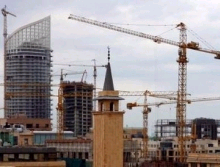
BEIRUT (AFP) – The Ottoman-style mansions, with Venetian windows, arches and lavish gardens that once epitomised Beirut are being levelled one after the other as high-rises mushroom across the capital.  "Now everyone is looking for towers, because they realise that above the tenth floor you can see the sea," says Mona Hallak, an architect and an activist with the Association for the Protection of Sites and Old Buildings. "In 20 years’ time, this won’t be the case because you will have lots of towers everywhere." As a result, landlords are rushing to take advantage of the high prices now being offered for the land on which their ancestral homes are sitting. The pattern is set: the home is demolished, its traditional garden destroyed and the land sold and developed. "Every time an old house goes, a green pocket goes and with it go trees that are often hundreds of years old," says Hallak.
"It’s not only the house. It’s the tree. It’s the bird that follows the tree. It’s the quality of life." The only law on the books that protects old homes in Lebanon dates back to 1933 when the country was under French mandate. It mainly protects buildings constructed before 1700 although younger buildings can be placed on the list of protected sites either by government directive or private initiative. "The law basically focuses on the protection of archaeology and antiquities," Culture Minister Tarek Mitri told AFP. A survey commissioned by the government in 1997 identified about 250 buildings in Beirut that cannot be demolished. "The list is outdated now," Mitri said. "Plus it was done hastily. Some buildings that should be on it aren’t." The list is of little consolation to activists like Hallak, who say the issue is more about preserving the country’s heritage than merely saving a building or a mansion. "It’s important to save an entire street, what we call a cluster… there is a social structure that is completely tied to these buildings," Hallak says.

Read more
Tension runs high in northern Lebanon

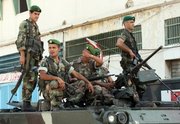
TRIPOLI, Lebanon (AFP) – Tension ran high in north Lebanon’s capital of Tripoli on Sunday even as the army was deployed in force a day after a man died in an apartment block explosion.  A security official told AFP that a tobacco shop run by an Alawite was set ablaze in the mainly Sunni district of Bab al-Tebbaneh, the scene of Saturday’s blast in which 20 people were also wounded and several homes damaged. Civil defence workers put out the fire before it could spread to other businesses, the official said, declining to be named. The latest incident took place despite the deployment over the past week of army and interior ministry forces in the port city since deadly clashes between Sunnis and members of the Alawite community, an offshoot of Shiite Islam.
Armoured vehicles were posted at entrances to Bab al-Tebbaneh and two other densely populated districts, Jabal Mohsen and Al-Qobbe, where nine people were killed in sectarian clashes on June 22 and 23. It was still not publicly known on Sunday what caused Saturday’s explosion which killed a local resident with no known political affiliation. Almost 500 people went to the victim’s funeral which was also attended by dozens of armed militants, some wearing black headbands and chanting Koranic verses in praise of martyrdom. Lebanon’s Sunni mufti, Mohammed Rashid Qabbani, condemned the explosion as a "criminal act aimed at spreading sedition," and urged all politicians to help Prime Minister Fuad Siniora in his protracted efforts to form a new government. Residents of Bab al-Tebbaneh who support the Western-backed majority in parliament have clashed repeatedly with Alawites in the nearby Jabal Mohsen district who backs hizbollah. Later on Saturday, three grenades exploded in Bab al-Tebbaneh over a half-hour period but no one was injured and no buildings were damaged, security officials said.

And two men were wounded on Friday night in Tripoli when a grenade went off, an army spokesman said, adding that one lost a leg in the blast. The Tripoli clashes have raised fears of a nationwide security breakdown amid protracted efforts by Siniora to form a national unity cabinet since a Qatari-brokered deal in May to end an 18-month political crisis. Rival factions continue to bicker over the distribution of key portfolios in a new 30-member government. The deal was struck after at least 65 people were killed in May in sectarian clashes that saw Hezbollah stage a spectacular takeover of mainly Sunni areas of west Beirut.

Read more
Lebanon’s oil slick cleaned but headache continues

BEIRUT (AFP) – Two years after the worst oil spill in the east Mediterranean left thousands of tonnes of crude over three-quarters of Lebanon’s coast, the beaches are almost all clean but the troubles continue.  In July 2006, in the midst of the month-long war between Israel and Lebanon’s Shiite Hezbollah fighters, Israeli aircraft bombed a coastal power plant at Jiyeh, 40 kilometres (25 miles) south of Beirut.Around 15,000 tonnes of oil flooded into the sea and was carried by the current, leaving 150 kilometres (95 miles) of coastline covered with thick black residue.

The once glitzy tourist beaches were covered with a film of filthy discharge and the breathtaking azure sea left blackened with oily deposits. Now after two years’ work dedicated to it, the Mediterranean has recovered its blue and the white sandy beaches are back to their sparkling former glory. Only the Jozor al-Nakhel, or Palm Tree Island, nature reserve, west of the northern town of Tripoli is still being cleaned. But the impact of the spill remains a headache for Lebanon. At Jiyeh beach, more than 800 tonnes of oil-covered rocks and sand sit it huge heavy-duty plastic bags, only metres (yards) from the water’s edge waiting for someone to work out how to get rid of them.

Read more