BEIRUT (AFP) – Lebanon’s ruling parliamentary bloc on Wednesday threatened to walk out of talks aimed at forming a national unity government, an official from the Future Bloc told AFP. The warning came as Prime Minister Fuad Siniora continued efforts to form a new government after a deal last month between rival politicians and as […]

KUWAIT (Reuters) – Syrian President Bashar al-Assad said his country will consider opening an embassy in Lebanon for the first time once its smaller neighbor forms a government able to foster good ties with Damascus. Assad said Syria had raised the issue in 2005, when Syrian troops left Lebanon after a 29-year sojourn, but decided against opening an embassy as ties with Lebanon deteriorated. "Our conditions were that there should be a national unity government firstly and that there be good ties with it…. Obviously, if there is a unity government that represents all the Lebanese parties then our ties with it will be good," he said in comments carried on Kuwait’s state news agency KUNA. "When these conditions are provided for then we will exchange soon, God willing, embassies with Lebanon after studying the situation of the Syrian-Lebanese Supreme Commission." Ties between the two countries have so far been governed by a joint commission in what many Lebanese consider a reluctance on Syria’s part to recognize their country’s sovereignty.
(MENASSAT) — Syrians are paying increasing attention to Lebanon
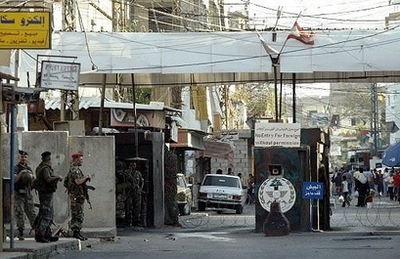 SIDON, Lebanon (AFP) – Lebanese soldiers shot dead a man carrying a hand grenade outside the Palestinian refugee camp of Ein el-Helweh on Saturday, an army spokesman said. "The man was carrying a hand grenade and we are also investigating whether the belt he was wearing contained an explosives charge," the spokesman said, refusing to provide any further details. The man’s body was still at the scene and soldiers prevented journalists and photographers from approaching it, the spokesman said.
Security forces told an AFP correspondent at the scene that they would carry out a controlled explosion involving the body. Eyewitnesses said the man was shot close to an army checkpoint in the Taameer Ein el-Helweh zone, which is controlled by the military, except for a southern part which is considered a bastion of the Islamist group Jund Al-Sham. It was not immediately clear where the man had come from. The incident came just hours after a Lebanese soldier was killed in a blast at an army intelligence post near the northern city of Tripoli and another explosive device was defused, a security official told AFP.
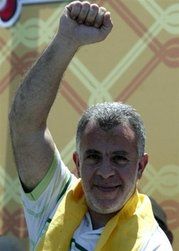 Israel released from prison on Sunday a Lebanese who had completed a six-year jail term on espionage charges and took him to the border with Lebanon for repatriation. Nissim Nasser’s release, announced by Israeli authorities, has raised speculation that it is linked to German mediation efforts to secure a prisoner swap between Israel and Lebanon’s Hezbollah group. Nasser, who was born in Lebanon to a Jewish mother and a Muslim father, was sentenced in 2002 to six years’ imprisonment after being convicted of spying for Hezbollah. "The prisoner was released from Nitzan Prison near Ramle (in central Israel) and is being escorted by police up north to Rosh Hanikra (on the Lebanese border)," police spokesman Micky Rosenfeld said. "Later in the day he will be transferred to the ICRC (International Committee of the Red Cross) and then to Lebanon," he said.
Simultaneously Hezbollah handed over to the ICRC on the Lebanese side what it said were the remains of Israeli soldiers killed in the summer 2006 war. A senior Israeli official confirmed that the army had received a coffin but said tests had to be carried out on the contents to confirm whether the remains were those of Israeli soldiers. "A coffin apparently containing body parts of soldiers killed during the Second Lebanon War has been transferred by Hezbollah to the IDF (Israeli army) as a gesture for the ongoing negotiations on a prisoner exchange," the official said. "The coffin will be examined and the body parts will be examined to determine whether they indeed belong to Israeli soldiers." Israel and Hezbollah
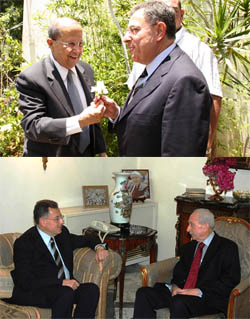 By Hussein Abdallah, Daily star. BEIRUT: Prime Minister Fouad Siniora paid a number of customary visits on Thursday, one day ahead of the mandatory parliamentary consultations that will precede the formation of Lebanon’s new cabinet. Siniora met former premiers Omar Karami, Salim Hoss, Najib Mikati, Rasheed Solh, Amine Hafez and Michel Aoun. After a 45-minute meeting Aoun, who is also the leader of the opposition Free Patriotic Movement, Siniora told reporters that the talks were positive. Aoun became Lebanon’s only Christian prime minister in 1988 after he was asked by former President Amine Gemayel to head an interim government as a result of the Parliament’s failure to meet and elect a new president at the end of Gemayel’s term.
Siniora also contacted Muslim and Christian spiritual leaders on Thursday in advance of the consultations that are due to start on Friday afternoon. The next cabinet will include 16 ministers for the parliamentary majority, 11 for the opposition and three for the president. In a statement on Thursday, the opposition said that the Sunni opposition in Beirut should be represented by a minister in the new cabinet. "The Sunni opposition in Beirut should be represented as it is not acceptable to cross out a big portion of the capital just because one party has managed to monopolize Beirut’s seats in Parliament as a result of an unfair electoral law," the statement said, referring to parliamentary majority leader Saad Hariri’s sweeping victory in Beirut in the 2005 elections.
BEIRUT (AFP) Summer festivals music in Lebanon , which usually attract visitors in their thousands, are back this year after being silenced by war and political instability, organisers announced on Thursday. "What we are seeing today is an expression of the true face of Lebanon after this difficult period and after the dark cloud has […]
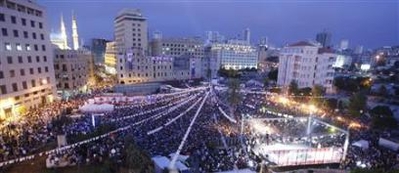 BEIRUT – For three consecutive seasons tourism revenue, once Lebanon’s lifeblood, was reduced to a trickle by violence and political uncertainty. Reservations have begun pouring into this land of sun, sea and mountains, and a bumper tourism season is predicted after years of instability. There was a collective sigh of relief as calm returned last week after Lebanese leaders came to an agreement in Qatar that ended a long-running political crisis. "The ink on the Doha agreement wasn’t dry yet and the phones were ringing off the hook. From the Gulf, from Europe, from everywhere, we’re booked up until the end of the summer," said Mary Shwairy, head of public relations at the upscale Phoenicia Hotel in Beirut. "Tourism is bouncing back in a big way — short stays, long stays, conferences, weddings of returning Lebanese who live abroad," she added. Caretaker Tourism Minister Joseph Sarkis said he expects this year’s figures to be the best for years. Since the Doha agreement there has been "a 30 percent increase in the number of expected tourists compared with last year. Hotels are hiring extra staff and the airlines are adding extra flights," Sarkis said. "Forty percent of the tourists are Arab, 25 percent are European and the rest are of various nationalities," he added. "Of the Arabs, 40 percent are Jordanian who come in large numbers since visa requirements were waived three years ago. They are followed by Saudis, Kuwaitis, Iraqis and Emiratis," he said. Sarkis said Lebanese expatriates spend large sums of money when they return to the homeland. "Nature and a love of life are Lebanon’s greatest attractions. The Arabs come for the refreshing climate, night clubs and restaurants… Europeans for the archaeological sites" such as Baalbek or Tyre. In another sign of recovery kicking in, the popular Beiteddine and Baalbek music festivals, silenced for the past two summers, will return this year in July. The Beiteddine and Baalbek festival organisers are also co-sponsoring a concert by Lebanese-born pop sensation Mika in Beirut on July 27.
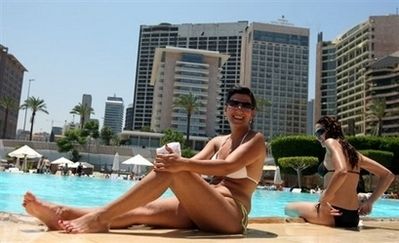 By Yara Bayoumy Thu – Just a week after feuding Lebanese leaders sealed a political deal to end 18 months of conflict, restaurants have re-opened, hotel bookings have soared and tourists have replaced gunmen on the streets of Beirut. "The deal has had an excellent impact. We’ve had a flood of reservations and we’re expecting a very good season," said Nizar Alouf, a member of the Lebanese Hotel Owners Association. It took months of agonizing negotiations — punctuated by bouts of violence that many feared would trigger civil war — to install a new president and form a government, but record time for Lebanon to regain its standing as a top tourist spot. Now where an opposition tent city occupied large squares, paralyzing central Beirut and turning it into a ghost town, restaurants are bustling, open-air concerts are being held and gridlock traffic is back. It’s good to be back" and "It finally feels like people are living" are common utterances among the droves of Lebanese and tourists crowding the Parisian-style pavement cafes. Tourism Minister Joseph Sarkis said he expected between 1.3 million to 1.6 million visitors to Lebanon this year compared to around 1 million in 2007 and 2006 — violent years plagued by political assassinations, bombings and a war with Israel.
نِعمَـــة الله أبــي نصـرْ نـائِــــبْ ـــــــ بعد أن تضمَّن خطاب فخامة رئيس الجمهورية في جلسة القسم وجوب إعطاء المغتربين حقوقهم خصوصاً لجهة تعزيز تواصلهم والتصاقهم بالوطن الأم والإستفادة من طاقاتهم ، حيث هم أحقُّ بالجنسيَّة اللبنانية من الذين أخذوها على غير وجهِ حقّ ، ولما كان في ذلك إحقاقاً للحقِّ […]
Lebanon’s new president General Michel Sleiman has asked outgoing Prime Minister Fuad Saniora to form a new Cabinet despite reservations by the opposition. Lebanon’s president appointed Prime Minister Fouad Siniora on Wednesday to head a national unity government agreed under a deal ending 18 months of political conflict. President Michel Suleiman asked Siniora, who has enjoyed strong […]
The Lebanese interior ministry Tuesday announced an indefinite ban on motorbikes, provocative convoys, slogans or flag waving in the capital Beirut. "Motorbikes will be banned in Beirut effective at 1800 (1500 GMT) on May 27, 2008, until further notice," a statement said. The statement said that politically charged demonstrations such as "marches, regardless of their […]
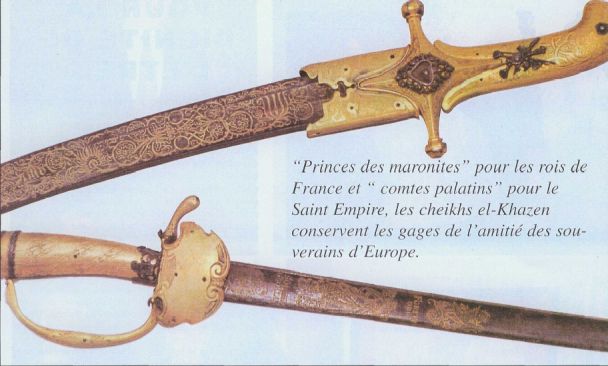
Population Movements to Keserwan - The Khazens and The Maans
ما جاء عن الثورة في المقاطعة الكسروانية
ثورة أهالي كسروان على المشايخ الخوازنة وأسبابها
Origins of the "Prince of Maronite" Title
Growing diversity: the Khazin sheiks and the clergy in the first decades of the 18th century
Historical Members:
Barbar Beik El Khazen [English]
Patriach Toubia Kaiss El Khazen(Biography & Life Part1 Part2) (Arabic)
Patriach Youssef Dargham El Khazen (Cont'd)
Cheikh Bishara Jafal El Khazen
Patriarch Youssef Raji El Khazen
The Martyrs Cheikh Philippe & Cheikh Farid El Khazen
Cheikh Nawfal El Khazen (Consul De France)
Cheikh Hossun El Khazen (Consul De France)
Cheikh Abou-Nawfal El Khazen (Consul De France)
Cheikh Francis Abee Nader & his son Yousef
Cheikh Abou-Kanso El Khazen (Consul De France)
Cheikh Abou Nader El Khazen
Cheikh Chafic El Khazen
Cheikh Keserwan El Khazen
Cheikh Serhal El Khazen [English]
Cheikh Rafiq El Khazen [English]
Cheikh Hanna El Khazen
Cheikha Arzi El Khazen
Marie El Khazen