The Lebanese interior ministry Tuesday announced an indefinite ban on motorbikes, provocative convoys, slogans or flag waving in the capital Beirut. "Motorbikes will be banned in Beirut effective at 1800 (1500 GMT) on May 27, 2008, until further notice," a statement said. The statement said that politically charged demonstrations such as "marches, regardless of their […]
President General Sleiman assumes office
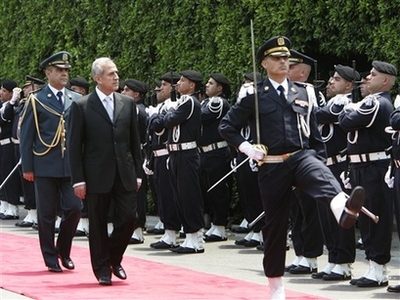
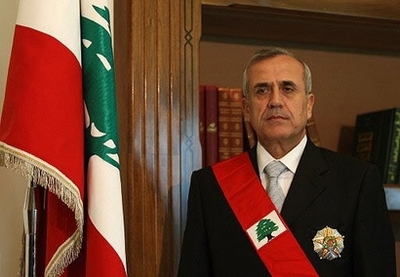 Lebanon’s new President, Michel Suleiman, has arrived at the presidential palace to begin his first full day in office. A military band played the national anthem as Suleiman, who headed the army for a decade, walked on a red carpet into the Baabda Palace which has been empty since Previous President Emile Lahoud left office. Army cannons fired 21 shots to salute Suleiman, 59, as a brass band played Lebanon’s national anthem. Dozens of his staff members erupted into applause. After surveying the republican guard and listening to the national anthem, a smiling Sleiman took his seat in the presidential chair. Earlier Monday, Suleiman bid farewell at Beirut’s airport to the emir of Qatar, who brokered a deal among Lebanese politicians last week which led to the election. Parliament had failed to elect a new president 19 times in the past six months. "I call on you all, people and politicians, for a new beginning," Suleiman said after he was sworn in Sunday. "Let us be united." He set to work immediately, scheduling consultations with lawmakers on Wednesday to begin forming a new governent, an official in the president’s office said on condition of anonymity pending a formal statement. Once parliamentary leaders name a new prime minister, that person would then present a Cabinet lineup for the president’s approval. The cabinet then needs to draft a policy statement to present to parliament for a vote of confidence. The majority is expected to choose the prime minister from its ranks. Saniora or majority coalition leader Saad Hariri are among those mentioned in the media as candidates. Siniora said earlier that he did not want to head the next cabinet, but acknowledged that the parliamentary majority had the final say on this issue. Cabinet posts will be distributed according to the Doha agreement: 16 for the majority, 11 for the opposition and three for the president, who heads the cabinet. The group must also respect an equal split between Christians and Muslims, as required under Lebanon’s power-sharing formula.
 US President George W. Bush Monday invited incoming Lebanese President Michel Sleiman to Washington for talks after congratulating him on taking office, Bush’s spokesman said. "The president invited President Sleiman to come to Washington so the two leaders can meet to discuss issues of strategic importance to both the United States and Lebanon," said national security spokesman Gordon Johndroe. Bush called Sleiman to congratulate him on becoming president and "reiterated his commitment to the government of Lebanon and to a strong and modern Lebanese Armed Forces. The Egyptian president Hosni Mubarak also called President Sleiman to congratulate him and invite him for an official visit. "On the other side of the political divide, Syrian President Bashar Al-Assad telephoned Sleiman to congratulate him and had promised that Damascus was "at Lebanon’s side," according to a report on Lebananese television. The President of Iran Mahmoud Ahmadinejad telephoned Sleiman to congratulate him and Iranian Foreign Minister Manouchehr Mottaki, also welcomed Sleiman’s election. Syria and Iran back Hezbollah, the Shiite group which spearheads the Lebanese opposition. "All countries in the region, be they Arab or Islamic, are overwhelmed with joy and pride at this glorious and blessed agreement," Mottaki said Sunday. UN chief Ban Ki-moon said he hoped the "historic" vote would lead to the "revitalization of all of Lebanon’s constitutional institutions and a return to political dialogue." The Slovenian presidency of the European Union also welcomed Sleiman’s election and pledged its support for Lebanese "unity and stability." "The Presidency of the EU reaffirms its support for Lebanon’s sovereignty, independence, territorial integrity, unity and stability," a statement said. Moscow also welcomed the swearing in of Suleiman, who served as Lebanon’s army chief for the past 10 years. "Moscow sincerely welcomes the election of Lebanon’s president and we hope … that Lebanon will leave behind it this period of crises and blows, [and] find the path to domestic peace and stable democracy," a statement from the Russian Ministry of Foreign affairs said. Former colonial power France was more guarded, saying the arrival of Suleiman would constitute a major change in Paris’ relations with Lebanon’s neighbor, Syria. President Nicolas Sarkozy pledged full support for Suleiman and said he hoped the election would allow Lebanon to take a significant step forward and "confront the challenges that await." But Suleiman’s election constitutes a "new act" and "we are in the process of examining the consequences to be drawn from the situation," the spokeswoman for the French Foreign Ministry, Pascale Andreani, said, when probed by reporters about French-Syrian relations. British Prime minister contacted Sleiman to congratulate him on the new post. British Foreign Secretary David Miliband said the election was "an important step forward," adding: "We look forward to President Suleiman working with a unity government to bring Lebanon out of its current fragility." German President Horst Koehler said he welcomed "this bold step" toward resolving Lebanon’s political crisis and wished Suleiman "good luck in the big challenges that lie ahead of you." Canadian Prime Minister Stephen Harper said his country "stands ready to assist the Lebanese government in any way possible," adding that Suleiman had "tremendous experience and the confidence of the Lebanese people."
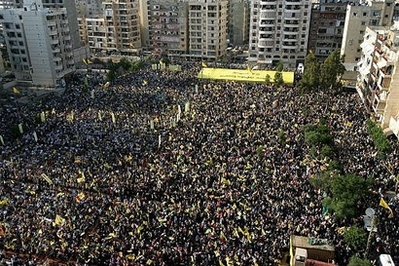 In another event on Monday, Hezbollah chief Hassan Nasrallah said his group wasn’t seeking to control Lebanon or impose its views, in a speech Monday marking the eighth anniversary of Israel’s pullout from the south of the country."Hezbollah does not want power over Lebanon, nor does it want to control Lebanon or govern the country," Nasrallah said via video link to tens of thousands of supporters gathered in his stronghold in southern Beirut. "For we believe that Lebanon is a special, pluralistic country. The existence of this country only comes about through coexistence, and this is what we are demanding," said the leader of the militant Shiite group. Lebanon’s Hezbollah chief Sheikh Hassan Nasrallah said Monday that Lebanese prisoners held in Israel jails would soon return home. "Samir Kantar and his brothers will soon be home among their families," Nasrallah said during a speech to commemorate the eighth anniversary of Israel’s withdrawal from southern Lebanon on May 2000. Releasing the prisoners is our duty and it is our holy mission," Nasarllah said without providing any further details. A Lebanese official close to the negotiations said earlier that another prisoner, Nessim Nisr, was expected to be released soon. He did not give further details. I reaffirm the Doha agreement clause that prevents the use of arms to attain political goals," Nasrallah said. He has also added, "The resistance’s arms are to fight the enemy, liberate lands and prisoners, and defend Lebanon and nothing else," he pledged, referring to his Shiite group’s enmity with Israel which pulled out of south Lebanon in 2000. Nasrallah also ruled out the state’s weaponry being used to settle domestic accounts. "The government’s arms or those of the army or armed forces are to defend the nation, the people and their rights, the government, and to maintain security," Nasrallah said. "The government’s arms cannot be used to settle accounts with a political opponent. The government’s arms cannot be used to target the resistance and its arms," he added. "All arms must remain in the service of the goal they were created for," Nasrallah said. Nasrallah spoke to a crowd of tens of thousands the day after army chief Michel Sleiman was elected Lebanon’s president, ending a long-running political crisis that left the country without a head of state since late November.
For pictures of President General Michel Sleiman please click read more
Lebanon’s Suleiman becomes 12th president
Malek Fady el Khazen founder of khazen.org on behalf of himself and his direct family convey their happiness in this great day and congratulates his Excellency President Of Lebanon General Michel Suleiman and wishes his success in the presidency and prosperity of Lebanon.
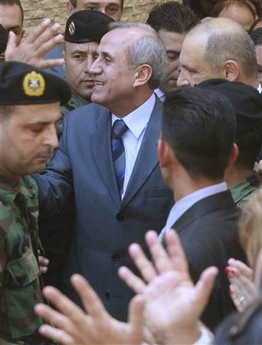 Lebanon’s Parliemanet elected army chief General Michel Suleiman as the country’s 12th president, filling a post left vacant for six months by a political crisis that threatened a new civil war. He was elected with a total of 118 votes and 6 blank copies. He won 118 votes of the 127 living members of the legislature on Sunday. Six cast blank ballots and one voted for slain ex-premier Rafiq Hariri and several MPs killed in Lebanon since 2005. One MP also voted for former MP Jean Obeid and another voted for majority MP Nassib Lahoud. After Suleiman was sworn in, the government of Prime Minister Fouad Siniora resigned in line with the Constitution but will stay on in a caretaker capacity. Suleiman arrived at Parliament shortly after the election accompanied by Speaker Nabih Berri, who left the Parliament building after the vote and returned with the newly elected president in line with protocol. Lebanon’s newly-elected President Michel Suleiman took his oath of office. "I pledge to respect and protect Lebanon’s independence, sovereignty and its constitution," Suleiman, who was greeted with heavy applause from lawmakers and guests, said.President Michel Suleiman’s inauguration speech was very positive. After taking the presidential oath, Suleiman delivered an inaugural address that dealth with several contentious issues. Previous addresses of this sort have tended to be vague, but this one was both comprehensive and specific in detailing the numerous daunting challenges facing this country. It was also forthright in acknowledging the issues that have recently divided Lebanon’s political parties. Perhaps most importantly, the new president clearly indicated – by both his choice of words and his tone of voice – that he intends to take charge of the reconciliation process. In short, Suleiman’s term in office has the potential to be the most important Lebanon has ever seen. The country has just passed through a long moment of high drama and mortal peril, and he will preside over a transition to the next phase. How he does so will help to determine what that phase looks like – and so whether Lebanon can begin at last to provide all of its citizens with the homeland they deserve. Tackling relations with neighbouring Syria, one of the many challenges his presidency will face, Suleiman called for the establishment of formal diplomatic links with Damascus. "We look strongly to brotherly ties between Lebanon and Syria in the context of mutual respect of the sovereignty and borders of each country and diplomatic ties which will bring good for both of them," the new president declared. "Let us unite… and work towards a solid reconciliation," the former army chief said after being sworn in before lawmakers. "We have paid dearly for our national unity. Let us preserve it hand-in-hand." "I call upon all of you, politicians and citizens, to start a new phase called Lebanon and the Lebanese… in order to achieve the interests of the nation," he said. He also added "On this path to salvation, some valiant resistance and some courageous soldiers also offered their lives in order to defeat terrorism, Israeli aggression from south
House Speaker Nabih Berri congratulated Suleiman and said "Reconciliation is an essential step for the revival of Lebanon." He also thanked Qatar for its efforts toward ending the Lebanese crisis. It is today a great day of hope for Lebanon, starting a new process of consolidation of democratic institutions," But he took a swipe at Washington, saying: "I thank the United States nonetheless, seeing that it seems to have been convinced that Lebanon is not the appropriate place for its New Middle East plan." He was referring to comments made by US Secretary of State Condoleezza Rice, who described the plight of Lebanon during Israel’s 2006 war against it as part of the "birth pangs of the New Middle East" Addressing the Lebanese parliament after the election, Al Thani said that Sleiman’s election was part of a process towards a lasting peace in Lebanon."The Lebanese [leadership], with its variety and diversity, acknowledged that there is no alternative but to reach an entente that will safeguard Lebanon’s security and interests," he said."All Arab nations will feel reassured that the dearest countires will be able to embark on a new era based on freedom. "Lebanon is the victor, Lebanon’s crisis is the vanquished." Members of parliament from the ruling majority and the opposition attended a parliamentary session at 5 PM to elect Suleiman as president, as stipulated by the Doha agreement. 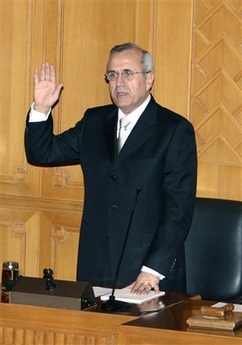 The vote had been postponed 19 times because of the crisis. It defuses a conflict that has stoked sectarian tensions, paralyzed government and battered the economy. Parliament has not met for more than a year and a half. Sunday’s vote was attended by Qatar’s emir and his prime minister, — the driving force behind the Doha agreement — It was also attended by the Prime minister of Turkey and a host of foreign ministers including those of arch-rivals Syria and Saudi Arabia, Foreign Minister from France, Spain, Iran, Italy, Turkey, Oman, Bahrain, Iraq, Kuweit, Jordan, Egypt, United Arab Emirates. A U.S. delegation of congressmen
Beirut restaurants face new challenges as sit-in ends
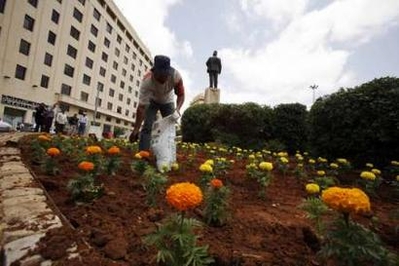 Daily star BEIRUT: As municipality and Sukleen workers removed the remaining concrete barriers and swept the streets in Beirut Central District (BCD), restaurant and shop owners in this fancy commercial area slowly opened their business Thursday. The opposition decision to end the 18-month sit-in near the Grand Serail brought a near immediate boost to the private sector. Stocks in the Beirut bourse climbed to record levels for the second day in a row on Thursday. Tour operators said they already expected Arab tourists to flock Lebanon in big numbers this summer. But for many business owners in the BCD, the problems have just started. "Don’t expect all restaurants to resume operations any time soon. Many of these restaurant owners cannot afford to open their doors for customers," Paul Aryss, the head of the Restaurant Owners Association, told The Daily Star. Aryss said around 30 to 40 restaurants have apparently decided to stay closed this summer because the financial losses they incurred during the 18-month sit-in have been quite heavy. There are a little more than 100 restaurants in the BCD.
"Most of the businesses in the BCD have to pay taxes and municipality fees that accumulated over the past two years. In addition, Solidere will ask the restaurants, shops and offices located in this area to pay all outstanding rents since the opposition pitched their camps," Aryss said. Restaurant rents in the commercial district ranges between $150,000 to $200,000 a year. "These rents are piling up and of course Solidere is going to ask for their money now that the sit-in is over," Aryss said. The government of outgoing Premier Fouad Siniora promised last year to offer relief to businesses in the BCD affected by the long sit-in. Among the promised measures were tax and municipality-fee exemptions to businesses in the BCD.
Israel, Syria acknowledge indirect talks in Turkey
JERUSALEM (CNN) 21 may 2008– Israeli and Syrian officials confirmed Wednesday they are indirectly negotiating a possible peace deal under Turkish mediation.

A U.N. soldier looks out from an observation tower in the largely abandoned city of Quneitra in the Golan Heights.

At a speech in Tel Aviv, Israel, Wednesday night, Israeli Prime Minister Ehud Olmert said the disclosure of the talks was the end of a phase that had been going on for over a year.
He also said that he has no illusions and that the negotiations will be difficult, lengthy and will require difficult concessions.
Earlier, Olmert’s office issued a statement saying: "The two sides stated their intention to conduct these talks in good faith and with an open mind."
It was the first official confirmation of the indirect talks between Israel and Syria. Turkish and Syrian officials also confirmed the talks.
Israel captured the Golan Heights from Syria during the 1967 Six Day War, and the area has been a source of contention since.
The last round of peace negotiations between the two countries broke down in 2000, after Syria demanded a full return of the Golan.
For its part, Israel wants Syria to abandon its support of Palestinian and Lebanese militant groups as part of any peace agreement.
The United States has been informed about the indirect talks, according to Assistant Secretary of State David Welch, who praised Turkey for playing "a good and useful role."
Welch noted that the United States is not playing any role in those talks, adding that President Bush is focused on getting an Israeli-Palestinian peace deal by the end of this year.
"The expansion of the circle of peace would be a good thing and it would be helpful if that includes an agreement with Syria," Welch said.
Wednesday’s announcement comes about a month after Syrian President Bashar Al-Assad admitted his country has been indirectly negotiating with Israel for about a year under the auspices of Turkey.
His admission last month, in an interview with a leading Arabic language newspaper, confirmed long-standing rumors that the two countries were discussing the Golan Heights.
A week after the interview, senior Israeli officials met with their Turkish counterparts and agreed to publicly announce the year-long talks.
R
الاتحاد المسيحي الديمقراطي اللبناني _______ علـم وخبـر 262 / أ.د. ت 20/9/1988 إستقبل النائب نعمة الله أبي نصر رئيس الإتحاد المسيحي الديمقراطي اللبناني في مكتبه السفيرين ؛ غابريال كيكيا سفير إيطاليا وميغيل بنزو سفير إسبانيا بحضور الأمين العام للإتحاد الدكتور عبده جرجس ، تأتي زيارة السفيرين ضمن جولاتهما على بعض الأحزاب والفعاليات المسيحية […]
Neutralite du Liban.
مع شكرنا لكلّ الدول التي سعت وساهمت في إنجاح اجتماعات الدوحة وبصورة خاصة دولة قطر بشخص أميرها ؛ يمكننا أن نستخلص العبر التالية : أثبتت التجارب أننا عاجزون عن الإجتماع والحوار وإستنباط الحلول بدون وسيط أو رقيب أو وصي ؛ إن أسوء ما وصلنا إليه اليوم هو اعتراف اللبنانيين وعلى رأسهم السياسيِّين بعجزهم وتسليمهم بمقولة […]
PROFILE: Army commander Suleiman is Lebanon’s “president of unity”
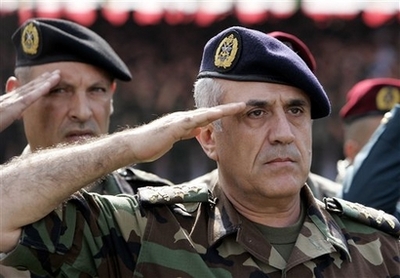 Beirut – Lebanon’s army commander Michel Suleiman will be Lebanon’s ‘unity president’ after rival Lebanese political factions agreed, after talks in Qatar, to end their differences in a deal to resolve the 18-month crisis that has kept the country without a president since November. Suleiman will be Lebanon’s 12th president since the country gained its independence in 1943 and the third after the Saudi-brokered taef-accord. General Suleiman, 59, has held his post as commander since 1998. He is seen as a neutra and strong unifyingl figure in the country. He is credited with keeping the military together in the political upheaval and tensions that Lebanon was affected. The head of Lebanon’s army has been credited with keeping the army on the sidelines. He has called on the 56,000-strong army to ignore politics and "listen to the call of duty". Until relatively recently, Gen Suleiman kept a low public profile. His apparent neutrality has earned him the respect of both the opposition and ruling coalition.
Lebanon’s parliament has failed 19 times to elect a president for the country since the former president Emile Lahoud stepped down at the end of his mandate November 23rd 2007.
Lebanon has given itself a chance to end a miserable, murderous cycle (daily star)
For over 18 months, international efforts to find a solution to Lebanon’s harrowing political crisis seemed a lot like searching for a needle in a haystack. Various teams of Arab and international mediators had tried to prod feuding Lebanese leaders toward compromise, but none of these efforts brought about concrete results. It was only after the crisis escalated to the verge of renewed civil war – and after Qatari Emir Sheikh Hamad bin Khalifa al-Thani thankfully intervened – that the leaders of rival Lebanese factions managed to secure what once seemed like a permanently elusive deal. The brilliance of the Doha accord is that it has resurrected the Lebanese agenda on Lebanese terrain. For far too long that agenda had been both strangled by local players and dictated to the Lebanese in the form of unrealistic demands from foreign capitals. But the Qatari emir successfully brokered an accord that makes Lebanon the priority, and resolves all outstanding political issues, while incorporating mechanisms for strengthening the Lebanese state. The responsibility for ensuring the full success of the Doha initiative now rests with Lebanese leaders – every one of them, from Hizbullah leader Sayyed Hassan Nasrallah to Lebanese Forces boss Samir Geagea. Over the past few days we have witnessed the transformation of the sentiment on the streets from one of tribulation – when Lebanese leaders pushed this nation to the brink – to one of jubilation – when Lebanon’s executioners were summoned away to the dialogue in Doha. The prevailing sense of joy has increased exponentially now that an agreement has been reached and the Lebanese can for the first time in over three years begin to envision new and boundless horizons for their homeland. The possibilities that the resolution of the political crisis allow for are infinite. One can easily imagine how it can pave the way toward economic development and political reform, as well as rapprochement with Damascus, and even an eventual peace deal with Israel if that country is willing to be reasonable (a possibility that is even easier to envision in light of the Turkish-brokered talks between Syria and Israel). The return of a Lebanese state that is at peace with its own citizens will also enable Lebanon to return to its role as an incubator of talent and creative energy that benefits, rather than destabilizes, the entire region.
Please click READ MORE for more pictures
Suleiman joined the Lebanese Military Academy as a student officer in 1976. He graduated from the Military Academy as 2nd Lieutenant in 1970. He holds a Bachelor of Arts in Political and Administrative Sciences from the Lebanese University. He also holds a Masters in English and French. In the early-to-mid 1990s, he commanded an infantry brigade which engaged in violent confrontations with the Israeli army in southern Lebanon. He was appointed as army commander on December 21, 1998, succeeding Emile Lahoud after he was elected president. Gen Suleiman also oversaw the army’s deployment near the border with Israel after Hezbollah fought a war with Israel in 2006. Since then, however, he has distanced himself from Islamist militants. In 2005, he won praise for keeping the army on the sidelines during the political upheaval following the assassination of former Prime Minister Rafik Hariri. He refused to crush the massive anti-Syrian protests that gripped Beirut during the spring of 2005, helping to force the Syrian military out of Lebanon. Two years later, Gen Suleiman rose to national prominence after the army battled and defeated al-Qaeda-inspired militants in the Nahr al-Bared Palestinian refugee camp in the north of the country. At the end of the operation, pictures of a victorious Gen Suleiman graced roadside billboards, with the words: "At your command." The broad backing for the army and its leader helped Gen Suleiman’s emergence as a candidate for the presidency. Gen Suleiman has long argued that the army’s role is to maintain the country’s peace and stability – and not"get muddled in politics". In a recent tour of troop positions in the south of the country, Gen Suleiman stressed his belief that "involving the army in internal clashes only serves the interests of Israel".
One of his major quotes is that ‘the state exists because the army is the guardian of the structure of this state.’ He is married to Wafaa Suleiman and has three children. Amshit, 40 kilometres north of Beirut, where Suleiman is from, was getting prepared Wednesday for festivities connected to the election. Amsheet Mayor Antoin Issa told Deutsche Presse-Agentur dpa, that pictures were being put up ‘of the new leader of the country Michel Suleiman and the son of Amsheet.’ Posters reading ‘the real leader of Lebanon’ were erected across Beirut and some people were already distributing sweets to celeberate the election and the end of the political crisis.
Rival Lebanese sign deal to end crisis
 DOHA – Rival Lebanese leaders signed a deal on Wednesday to end 18 months of political conflict that had pushed their country to the brink of a new civil war. The deal, concluded after six days of Arab-mediated talks in Qatar, paved the way for parliament to elect army chief General Michel Suleiman as president, filling a post vacant since November because of the political deadlock. Lebanese Parliament speaker Nabih Berri said Suleiman would be elected president this week most likely on Sunday May 25th. The deal between the ruling coalition and the opposition resolved a dispute over a parliamentary election law and met the opposition’s long-standing demand to obtain 11 Cabinet seats under the deal. In fact lin a ate night meeting on Tuesday of a six-member committee to discuss the electoral law finally achieved a breakthrough. Following a short session, opposition MP Ali Hassan Khalil told NBN television that a settlement was in the offing. The feuding parties have finally managed to agree on dividing Beirut into three balanced constituencies. The first constituency is a Christian one with five seats, the second is a mixed one with four seats, and the third is a Sunni-dominated one with 10 seats. On the other hand, Reform and Change bloc leader Michel Aoun will have to fight to win the five seats in the Christian district as the Armenian vote will be a deciding factor in the mixed constituency. Up until the last minute, Aoun was reportedly fighting to put six seats in the Christian district, but ended up accepting the 10-5-4 formula. The current ruling coalition will get 16 seats. The remaining seats will be distributed by the incoming president, in the 30-member cabinet. Under the deal, the two sides also agreed on an electoral law, which divides the Mediterranean Sea country into smaller-sized political districts. Parliament Speaker Nabih Berri also will call parliament to session to elect army chief, Gen. Michel Suleiman, as the country new president in the next 24 hours, the Qatari prime minister said.
"The parties agreed that the speaker of parliament will call within 24 hours for the election of General Michel Suleiman as president of the republic," Qatari Prime Minister Sheikh Hamad bin Jassim bin Jabr al-Thani said, reading from the agreement at the signing ceremony in Doha. A few bursts of celebratory gunfire broke out in Beirut’s after the announcement. Lebanese television stations showed Lebanese politicians and their Arab hosts congratulating and hugging one another.
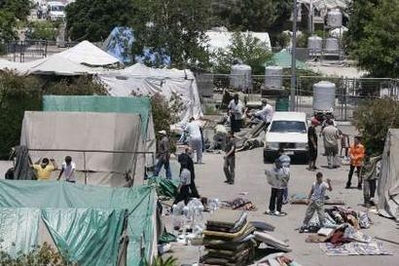
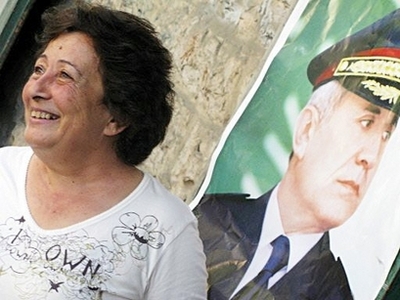 Speaking in Doha at the ceremony, Berri said opposition supporters would also dismantle their "tent city" protest camp.which the opposition has started immediately. The opposition has been camped out for more than a year in downtown Beirut across from the prime minister’s office. Berri said this would be a "gift" from the opposition, hailing the Doha agreement. Saniora, also addressing the ceremony, called on the Lebanese to reject violence and asked Arab states to help support Lebanon’s army, which kept a neutral role during the latest clashes. "We must … pledge never to resort to arms to resolve our political differences," Saniora said. "We should accept each other and hold dialogue to solve the problems. We want to live together and we will continue that. We have no other choice." The Doha-based negotiations came after the Arab League mediated a deal to end the week of deadly violence that paralyzed parts of the country. The Qatar negotiations hit snags from the very start, with neither side willing to give concessions. The agreement was reached after host Qatar stepped up the pressure Tuesday with Qatari Emir Sheik Hamad Bin Khalifa Al-Thani personally intervening. "There are no losers," said Lebanese Telecommunications Minister Marwan Hamadeh, "Lebanon is the winner."
Daily star: Lebanese lawmakers are set to elect the commander of the Lebanese Armed Forces, General Michel Suleiman, as president on Sunday after rival political leaders clinched a deal in Doha on Wednesday to end an 18-month feud that exploded into deadly sectarian fighting and threatened to plunge the nation into all-out civil war. The deal that was reached at Doha after four days of intensive talks will lead to electing Suleiman, forming a national unity cabinet, and drafting a new electoral law for the 2009 parliamentary elections. The agreement was announced by Qatari Emir Sheikh Hamad bin Khalifa al-Thani at noon Wednesday as the rival leaders gathered at a roundtable. "Some of you took to the streets asking your leaders not to return to Lebanon without reaching an agreement … I would like to tell you that your leaders have finally agreed and they will shortly be on their way back," Sheikh Hamad said, addressing the Lebanese people. The rival leaders officially signed the agreement shortly after it was announced. They arrived in Beirut later in the day. As the good news reached Beirut, people in the capital and in different areas of the country could not help but show their content and relief. The feeling of relief was followed by instant action as opposition supporters began to remove tents at the site of their 18-month sit-in in Downtown Beirut after Speaker Nabih Berri declared an end to the protest. Berri said that ending the sit-in was a gift from the opposition to the Doha agreement. The speaker also thanked Qatari and Arab mediators for their role in helping Lebanese parties reach an agreement. The long-awaited deal addressed two key issues of contention between the opposition and ruling majority. As far as forming a national unity government is concerned, the opposition has managed to get its long-demanded veto power. The new cabinet will be made up of 16 ministers for the parliamentary majority, 11 for the opposition, and three for the elected president. The 11 ministers (one third plus one of the 30-member cabinet) are all that it takes for the opposition to block any government decision to which its is opposed. However, the next cabinet is not due to last long as it will resign by default when the parliamentary elections are due next spring. Meanwhile, the most important deal of all was the agreement reached on drafting a new electoral law for the 2009 parliamentary elections. The issue of the electoral law was the major hurdle to the success of the Doha talks after the rival sides, which approved adopting the qada (smaller district) as an electoral constituency, appeared at odds over how to divide seats in Beirut. As the Doha talks were moving close to failure, a late night meeting on Tuesday of a six-member committee to discuss the electoral law finally achieved a breakthrough. Following a short session, opposition MP Ali Hassan Khalil told NBN television that a settlement was in the offing. The feuding parties have finally managed to agree on dividing Beirut into three balanced constituencies. The first constituency is a Christian one with five seats, the second is a mixed one with four seats, and the third is a Sunni-dominated one with 10 seats. The formula is likely to secure for parliamentary majority leader Saad Hariri at least 10 out of Beirut’s 19 seats. On the other hand, Reform and Change bloc leader Michel Aoun will have to fight to win the five seats in the Christian district as the Armenian vote will be a deciding factor in the mixed constituency. Up until the last minute, Aoun was reportedly fighting to put six seats in the Christian district, but ended up accepting the 10-5-4 formula. As for other parts of the country, the two sides agreed on adopting the divisions of the 1960 electoral law. Prime Minister Fouad Siniora described the agreement as a "great achievement in … the history of Lebanon." Speaking shortly after the Qatari emir announced the agreement, Siniora called on all Lebanese parties to condemn violence and pledge not to use arms to settle political disputes. The Doha agreement has committed all parties not to use violence and stated that security was the exclusive responsibility of the Lebanese state. Under the agreement, a dialogue is set to begin in Beirut to address the issue of the state’s relations with political groups in the country. Such dialogue is to be held under the auspices of the new president. The issue of Hizbullah’s possession of arms was not discussed at the Doha talks or mentioned in the agreement as the Arab committee decided to make do with banning the use of violence, a clear reference to the recent clashes in Lebanon between opposition and pro-government militants. The clashes left up to 65 dead and 250 wounded. Hariri also praised the deal. "Today, we are opening a new page in Lebanon’s history," he said
For more details please click read more
Qatar sets Lebanon opposition Wednesday deadline
DOHA – Arab mediators gave Lebanon’s opposition a Wednesday deadline to respond to proposals aimed at resolving a political crisis which brought the country to the brink of civil war. Delegates said the proposals called for the immediate election of a president, a cabinet in which the opposition had veto powers, a pledge to avoid violence […]
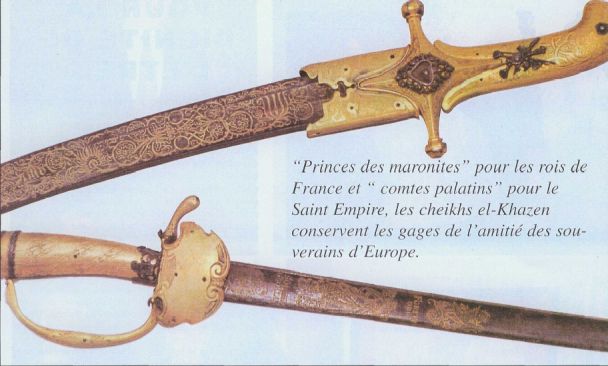
Population Movements to Keserwan - The Khazens and The Maans
ما جاء عن الثورة في المقاطعة الكسروانية
ثورة أهالي كسروان على المشايخ الخوازنة وأسبابها
Origins of the "Prince of Maronite" Title
Growing diversity: the Khazin sheiks and the clergy in the first decades of the 18th century
Historical Members:
Barbar Beik El Khazen [English]
Patriach Toubia Kaiss El Khazen(Biography & Life Part1 Part2) (Arabic)
Patriach Youssef Dargham El Khazen (Cont'd)
Cheikh Bishara Jafal El Khazen
Patriarch Youssef Raji El Khazen
The Martyrs Cheikh Philippe & Cheikh Farid El Khazen
Cheikh Nawfal El Khazen (Consul De France)
Cheikh Hossun El Khazen (Consul De France)
Cheikh Abou-Nawfal El Khazen (Consul De France)
Cheikh Francis Abee Nader & his son Yousef
Cheikh Abou-Kanso El Khazen (Consul De France)
Cheikh Abou Nader El Khazen
Cheikh Chafic El Khazen
Cheikh Keserwan El Khazen
Cheikh Serhal El Khazen [English]
Cheikh Rafiq El Khazen [English]
Cheikh Hanna El Khazen
Cheikha Arzi El Khazen
Marie El Khazen