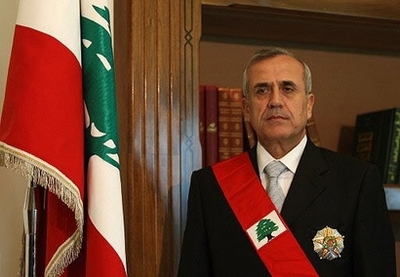
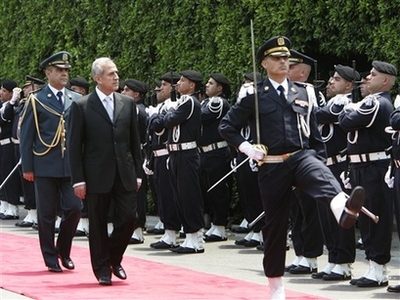
 Lebanon’s new President, Michel Suleiman, has arrived at the presidential palace to begin his first full day in office. A military band played the national anthem as Suleiman, who headed the army for a decade, walked on a red carpet into the Baabda Palace which has been empty since Previous President Emile Lahoud left office. Army cannons fired 21 shots to salute Suleiman, 59, as a brass band played Lebanon’s national anthem. Dozens of his staff members erupted into applause. After surveying the republican guard and listening to the national anthem, a smiling Sleiman took his seat in the presidential chair. Earlier Monday, Suleiman bid farewell at Beirut’s airport to the emir of Qatar, who brokered a deal among Lebanese politicians last week which led to the election. Parliament had failed to elect a new president 19 times in the past six months. "I call on you all, people and politicians, for a new beginning," Suleiman said after he was sworn in Sunday. "Let us be united." He set to work immediately, scheduling consultations with lawmakers on Wednesday to begin forming a new governent, an official in the president’s office said on condition of anonymity pending a formal statement. Once parliamentary leaders name a new prime minister, that person would then present a Cabinet lineup for the president’s approval. The cabinet then needs to draft a policy statement to present to parliament for a vote of confidence. The majority is expected to choose the prime minister from its ranks. Saniora or majority coalition leader Saad Hariri are among those mentioned in the media as candidates. Siniora said earlier that he did not want to head the next cabinet, but acknowledged that the parliamentary majority had the final say on this issue. Cabinet posts will be distributed according to the Doha agreement: 16 for the majority, 11 for the opposition and three for the president, who heads the cabinet. The group must also respect an equal split between Christians and Muslims, as required under Lebanon’s power-sharing formula.
 US President George W. Bush Monday invited incoming Lebanese President Michel Sleiman to Washington for talks after congratulating him on taking office, Bush’s spokesman said. "The president invited President Sleiman to come to Washington so the two leaders can meet to discuss issues of strategic importance to both the United States and Lebanon," said national security spokesman Gordon Johndroe. Bush called Sleiman to congratulate him on becoming president and "reiterated his commitment to the government of Lebanon and to a strong and modern Lebanese Armed Forces. The Egyptian president Hosni Mubarak also called President Sleiman to congratulate him and invite him for an official visit. "On the other side of the political divide, Syrian President Bashar Al-Assad telephoned Sleiman to congratulate him and had promised that Damascus was "at Lebanon’s side," according to a report on Lebananese television. The President of Iran Mahmoud Ahmadinejad telephoned Sleiman to congratulate him and Iranian Foreign Minister Manouchehr Mottaki, also welcomed Sleiman’s election. Syria and Iran back Hezbollah, the Shiite group which spearheads the Lebanese opposition. "All countries in the region, be they Arab or Islamic, are overwhelmed with joy and pride at this glorious and blessed agreement," Mottaki said Sunday. UN chief Ban Ki-moon said he hoped the "historic" vote would lead to the "revitalization of all of Lebanon’s constitutional institutions and a return to political dialogue." The Slovenian presidency of the European Union also welcomed Sleiman’s election and pledged its support for Lebanese "unity and stability." "The Presidency of the EU reaffirms its support for Lebanon’s sovereignty, independence, territorial integrity, unity and stability," a statement said. Moscow also welcomed the swearing in of Suleiman, who served as Lebanon’s army chief for the past 10 years. "Moscow sincerely welcomes the election of Lebanon’s president and we hope … that Lebanon will leave behind it this period of crises and blows, [and] find the path to domestic peace and stable democracy," a statement from the Russian Ministry of Foreign affairs said. Former colonial power France was more guarded, saying the arrival of Suleiman would constitute a major change in Paris’ relations with Lebanon’s neighbor, Syria. President Nicolas Sarkozy pledged full support for Suleiman and said he hoped the election would allow Lebanon to take a significant step forward and "confront the challenges that await." But Suleiman’s election constitutes a "new act" and "we are in the process of examining the consequences to be drawn from the situation," the spokeswoman for the French Foreign Ministry, Pascale Andreani, said, when probed by reporters about French-Syrian relations. British Prime minister contacted Sleiman to congratulate him on the new post. British Foreign Secretary David Miliband said the election was "an important step forward," adding: "We look forward to President Suleiman working with a unity government to bring Lebanon out of its current fragility." German President Horst Koehler said he welcomed "this bold step" toward resolving Lebanon’s political crisis and wished Suleiman "good luck in the big challenges that lie ahead of you." Canadian Prime Minister Stephen Harper said his country "stands ready to assist the Lebanese government in any way possible," adding that Suleiman had "tremendous experience and the confidence of the Lebanese people."
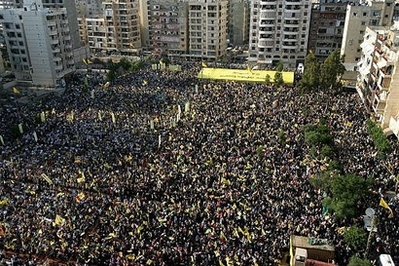 In another event on Monday, Hezbollah chief Hassan Nasrallah said his group wasn’t seeking to control Lebanon or impose its views, in a speech Monday marking the eighth anniversary of Israel’s pullout from the south of the country."Hezbollah does not want power over Lebanon, nor does it want to control Lebanon or govern the country," Nasrallah said via video link to tens of thousands of supporters gathered in his stronghold in southern Beirut. "For we believe that Lebanon is a special, pluralistic country. The existence of this country only comes about through coexistence, and this is what we are demanding," said the leader of the militant Shiite group. Lebanon’s Hezbollah chief Sheikh Hassan Nasrallah said Monday that Lebanese prisoners held in Israel jails would soon return home. "Samir Kantar and his brothers will soon be home among their families," Nasrallah said during a speech to commemorate the eighth anniversary of Israel’s withdrawal from southern Lebanon on May 2000. Releasing the prisoners is our duty and it is our holy mission," Nasarllah said without providing any further details. A Lebanese official close to the negotiations said earlier that another prisoner, Nessim Nisr, was expected to be released soon. He did not give further details. I reaffirm the Doha agreement clause that prevents the use of arms to attain political goals," Nasrallah said. He has also added, "The resistance’s arms are to fight the enemy, liberate lands and prisoners, and defend Lebanon and nothing else," he pledged, referring to his Shiite group’s enmity with Israel which pulled out of south Lebanon in 2000. Nasrallah also ruled out the state’s weaponry being used to settle domestic accounts. "The government’s arms or those of the army or armed forces are to defend the nation, the people and their rights, the government, and to maintain security," Nasrallah said. "The government’s arms cannot be used to settle accounts with a political opponent. The government’s arms cannot be used to target the resistance and its arms," he added. "All arms must remain in the service of the goal they were created for," Nasrallah said. Nasrallah spoke to a crowd of tens of thousands the day after army chief Michel Sleiman was elected Lebanon’s president, ending a long-running political crisis that left the country without a head of state since late November.
For pictures of President General Michel Sleiman please click read more
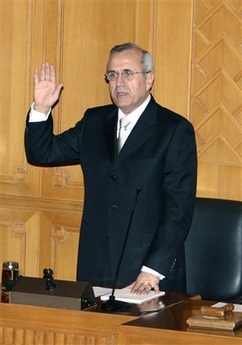
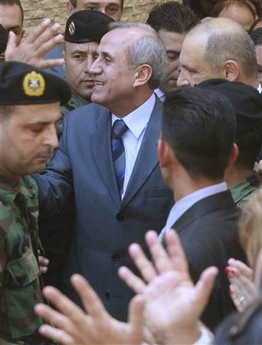 Lebanon’s Parliemanet elected army chief General Michel Suleiman as the country’s 12th president, filling a post left vacant for six months by a political crisis that threatened a new civil war. He was elected with a total of 118 votes and 6 blank copies. He won 118 votes of the 127 living members of the legislature on Sunday. Six cast blank ballots and one voted for slain ex-premier Rafiq Hariri and several MPs killed in Lebanon since 2005. One MP also voted for former MP Jean Obeid and another voted for majority MP Nassib Lahoud. After Suleiman was sworn in, the government of Prime Minister Fouad Siniora resigned in line with the Constitution but will stay on in a caretaker capacity. Suleiman arrived at Parliament shortly after the election accompanied by Speaker Nabih Berri, who left the Parliament building after the vote and returned with the newly elected president in line with protocol. Lebanon’s newly-elected President Michel Suleiman took his oath of office. "I pledge to respect and protect Lebanon’s independence, sovereignty and its constitution," Suleiman, who was greeted with heavy applause from lawmakers and guests, said.President Michel Suleiman’s inauguration speech was very positive. After taking the presidential oath, Suleiman delivered an inaugural address that dealth with several contentious issues. Previous addresses of this sort have tended to be vague, but this one was both comprehensive and specific in detailing the numerous daunting challenges facing this country. It was also forthright in acknowledging the issues that have recently divided Lebanon’s political parties. Perhaps most importantly, the new president clearly indicated – by both his choice of words and his tone of voice – that he intends to take charge of the reconciliation process. In short, Suleiman’s term in office has the potential to be the most important Lebanon has ever seen. The country has just passed through a long moment of high drama and mortal peril, and he will preside over a transition to the next phase. How he does so will help to determine what that phase looks like – and so whether Lebanon can begin at last to provide all of its citizens with the homeland they deserve. Tackling relations with neighbouring Syria, one of the many challenges his presidency will face, Suleiman called for the establishment of formal diplomatic links with Damascus. "We look strongly to brotherly ties between Lebanon and Syria in the context of mutual respect of the sovereignty and borders of each country and diplomatic ties which will bring good for both of them," the new president declared. "Let us unite… and work towards a solid reconciliation," the former army chief said after being sworn in before lawmakers. "We have paid dearly for our national unity. Let us preserve it hand-in-hand." "I call upon all of you, politicians and citizens, to start a new phase called Lebanon and the Lebanese… in order to achieve the interests of the nation," he said. He also added
  The vote had been postponed 19 times because of the crisis. It defuses a conflict that has stoked sectarian tensions, paralyzed government and battered the economy. Parliament has not met for more than a year and a half. Sunday’s vote was attended by Qatar’s emir and his prime minister, — the driving force behind the Doha agreement — It was also attended by the Prime minister of Turkey and a host of foreign ministers including those of arch-rivals Syria and Saudi Arabia, Foreign Minister from France, Spain, Iran, Italy, Turkey, Oman, Bahrain, Iraq, Kuweit, Jordan, Egypt, United Arab Emirates. A U.S. delegation of congressmen
 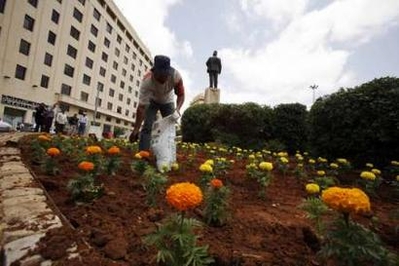 Daily star BEIRUT: As municipality and Sukleen workers removed the remaining concrete barriers and swept the streets in Beirut Central District (BCD), restaurant and shop owners in this fancy commercial area slowly opened their business Thursday. The opposition decision to end the 18-month sit-in near the Grand Serail brought a near immediate boost to the private sector. Stocks in the Beirut bourse climbed to record levels for the second day in a row on Thursday. Tour operators said they already expected Arab tourists to flock Lebanon in big numbers this summer. But for many business owners in the BCD, the problems have just started. "Don’t expect all restaurants to resume operations any time soon. Many of these restaurant owners cannot afford to open their doors for customers," Paul Aryss, the head of the Restaurant Owners Association, told The Daily Star. Aryss said around 30 to 40 restaurants have apparently decided to stay closed this summer because the financial losses they incurred during the 18-month sit-in have been quite heavy. There are a little more than 100 restaurants in the BCD.

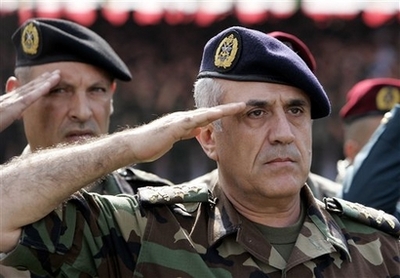 Beirut – Lebanon’s army commander Michel Suleiman will be Lebanon’s ‘unity president’ after rival Lebanese political factions agreed, after talks in Qatar, to end their differences in a deal to resolve the 18-month crisis that has kept the country without a president since November.
  DOHA – Rival Lebanese leaders signed a deal on Wednesday to end 18 months of political conflict that had pushed their country to the brink of a new civil war. The deal, concluded after six days of Arab-mediated talks in
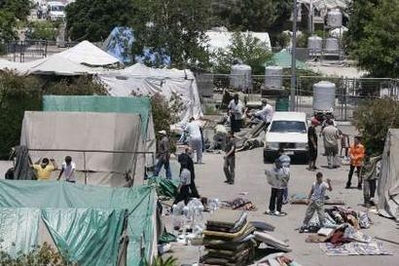
  Speaking in Doha at the ceremony, Berri said opposition supporters would also dismantle their "tent city" protest camp.which the opposition has started immediately. The opposition has been camped out for more than a year in