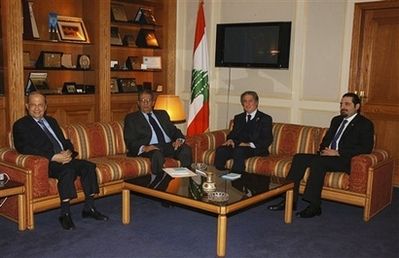
 Top leaders from Lebanon’s parliament majority and the opposition met for the first time in three months Thursday as part of efforts by the head of the Arab League to end Lebanon’s 15-month-old political crisis. Majority leader Saad Hariri and opposition leader Michel Aoun met Thursday at the parliament building in downtown Beirut. They were joined by Arab League Secretary-General Amr Moussa and former Lebanese President Amin Gemayel. Hariri and Aoun held several meetings last year, including one in Paris in October. The opposition recently named Aoun as its representative in any meetings with the majority – a move that was rejected by the anti-syrian group for weeks.
The two leaders met in Parliament Thursday afternoon in the presence of Phalange Party president Amine Gemayel and Moussa himself. "I am optimistic. Holding the meeting is a success. There is still room for agreement, but there are some issues that need to be discussed extensively," Moussa said after the meeting which lasted for almost three hours. "We will meet again when I return from Damascus," he added. Moussa is expected in Damascus on Friday. The Arab chief league refused to discuss the details of the meeting, saying "the crisis will not be solved on newspaper pages," adding: "I will not speak in detail now. The crisis is very complicated and requires more discussions."
Asked about differences over interpreting the second item of the Arab initiative, Moussa said "the second item, relating to the formation of a unity government, is clear. It denies the opposition veto power, while denying the ruling coalition absolute majority in the Cabinet." Asked about his view on internationalizing the Lebanese crisis, Moussa said he preferred "solving the Lebanese crisis on the Arab level."
The three-point Arab plan adopted by Arab foreign ministers during a meeting in Cairo earlier this month calls for the election of the commander of the Lebanese Armed Forces (LAF) General Michel Suleiman as president, the formation of a national unity government, and the drafting of a new electoral law for the 2009 parliamentary elections. The ruling coalition and the opposition are at odds over the interpretation of the Arab plan, namely the item on the formation of a unity government. The plan said the government should be formed in such a way that prevents any party from imposing or blocking Cabinet decisions.
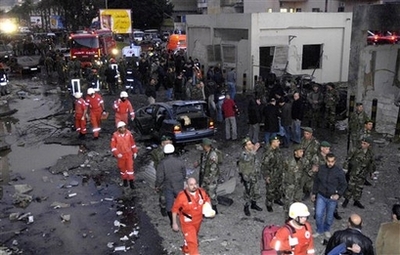 The U.S. State Department says a bomb blast that struck a U.S. Embassy vehicle in Lebanon’s capital, Beirut, has killed four people. Lebanese security officials put the death toll lower, at four. Speaking in the Saudi capital, Riyadh, Secretary of State Condoleezza Rice expressed outrage at the blast and called it a terrorist attack. She said the U.S. will not be deterred in its efforts to help the Lebanese people and the democratic process in that country.
  Nicholas Blanford in Beirut ,
 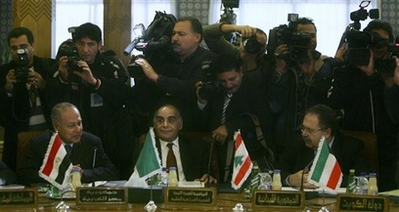 Lebanon’s politicians on Sunday welcomed the decision by Arab nations, including Syria, to back the head of Lebanon’s army as the next president, expressing hope the move would help end the country’s political crisis. Arab foreign ministers issued the endorsement of Gen. Michel Suleiman on Saturday after meeting in the Egyptian capital of Cairo. The opposition requested that it receive representation in the governement porportionally to the distrubution of the parliamentr before allowing Suleiman to be elected.
 naharnet, Hayek Projects a Little Bad News, a Lot of Good for 2008
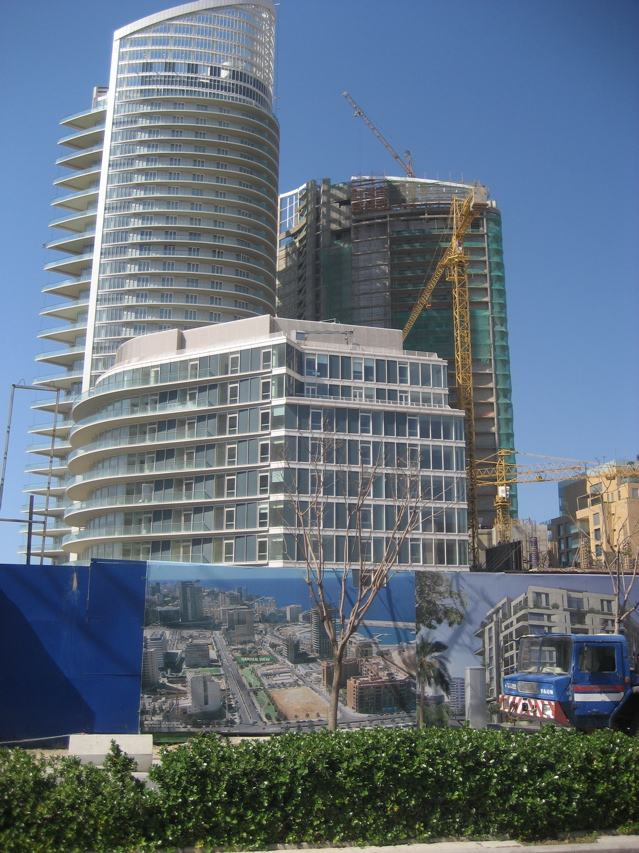 A country going through crazy times, it should have come as no surprise that Lebanon’s real estate prices doubled. "It’s completely ridiculous and against all forecasts of a difficult political situation. No one wants to sell at normal rates, everyone has now doubled their price," said Patrick Geammal, chairman and managing director of ASCOT. Whether real or imagined, such predictions have made their mark on sellers’ expectations and deals have stalled.
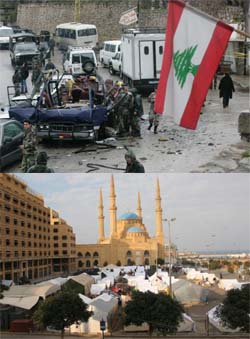 BEIRUT: Politically, 2007 was a year of intense activity in Lebanon, but with few tangible results. It was a year of looming constitutional vacuums, incessant political bickering, and near total legislative inertia, as the doors of Parliament remained shut, and the country was left without a head of state, just a Cabinet whose own legitimacy was questioned. An encampment of opposition supporters in Downtown Beirut laying siege to what they saw as the ruling coalition’s "monopoly on power" is what many will remember of the past year. What began as a resignation of opposition ministers in protest over the path the government was taking snow-balled into a major political crisis as 2006 came to a close. Little did anyone know that the sit-in near the Grand Serail would last for more than a year.
 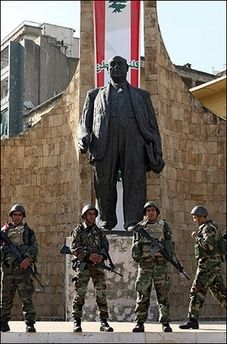 By Robert F Worth, Lebanon may seem an unlikely holiday spot: the government has collapsed, car bombs go off periodically and foreign envoys warn of an impending civil war.And yet, so many people have been streaming into this tiny, embattled country in recent days that the flights are all overbooked, and some well-heeled travelers are driving 18 hours from the Persian Gulf. Beirut’s restaurants, bars and malls are all packed with revelers.