.
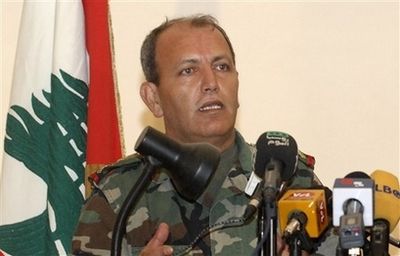 The Khazen family offers its deepest condoleances to the families of the martyrs General Francois Hajj, and Khairallah Hedwan . BEIRUT — A car bomb attack killed one of Lebanon’s top generals and at least two other people Wednesday, the military and state media said, putting even more pressure on the country’s delicate political situation. The target of the attack, Brig. Gen. Francois Hajj, a top Maronite Catholic in the command, was considered a leading candidate to succeed the head of the military, Gen. Michel Suleiman, if Suleiman is elected president. Hajj, 55, also led a major military campaign against Islamic militants over the summer. The blast is the first such attack against the Lebanese army, which has remained neutral in Lebanon’s yearlong political crisis and is widely seen as the only force that can hold the country together amid the bitter infighting between parliament’s rival factions. Syrian Foreign Minister Walid al-Moualem denounced the "criminal attack" on Hajj. "We condemn any action that threatens Lebanon," he said. Hajj helped lead an army onslaught on al Qaedainspired militants at the Nahr al-Bared Palestinian refugee camp in northern Lebanon this year in which 168 soldiers and about 230 Fatah al-Islam fighters were killed.
 The main Christian opposition leader, Michel Aoun told reporters that he had supported Hajj to succeed Suleiman as army commander. Aoun, a former head of the military, praised Hajj and said it was "shameful" for political forces to take advantage of the crime. "We are facing a security catastrophe today," said Christian opposition leader Michel Aoun, calling on the interior minister to resign. Visibly shaken, the former army chief told reporters Hajj had been his preferred candidate for the top military post. Telecommunications Minister Marwan Hamadeh, speaking to AP Television News, accused the "Syrian-Iranian axis" of hitting the military, "the only body in Lebanon who can balance the power of Hezbollah and other militias in the country." But the Shiite Muslim Hezbollah, which has good relations with the army, denounced the killing. It called Hajj’s death a "great national loss" and praised the military’s "great national role" in preserving security. The White House denounced the killing. "We strongly condemn the assassination of Brig. Gen. Francois Hajj. This is a crucial time as Lebanon seeks to maintain a democratically elected government and select a new president," said National Security Council spokesman Gordon Johndroe. "President Bush will continue to stand with the Lebanese people as they counter those who attempt to undermine their security and freedom." Syrian Foreign Minister Walid al-Moualem denounced the "criminal attack" on Hajj. "We condemn any action that threatens Lebanon," he said.
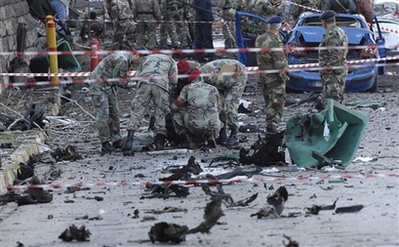
"Once he was nominated for the leadership (of the army), they killed him," Hajj’s father Elias told reporters in the slain officer’s village of Rmeish in southern Lebanon. Villagers raised black flags and army emblems in Rmeish, where schools closed for three days of mourning. Hajj came from a family of tobacco farmers and was the eldest of 12 children.The blast wrecked Hajj’s car, set others on fire and damaged nearby buildings. Charred metal littered the blackened streets. The slaying of Hajj and its timing amid the deadlock over the presidency raised immediate speculation over who was behind the bombing, which blasted Hajj’s SUV as he drove through a busy street of Baabda district. Security sources said 35 kg (77 lb) of explosives packed into an olive-green BMW car were detonated by remote control as Hajj’s four-wheel-drive vehicle drove by. The army and the Lebanese people will not succumb to terrorism," Suleiman was quoted as saying in a statement. "(Hajj’s) martyrdom strengthens us and reinforces our belief in victory and confidence in Lebanon’s future." Arab and Western states fear a prolonged vacuum in the presidency could further destabilize Lebanon, where rival camps have accused each other of rearming and training fighters. Hajj, a father of three, will be buried at his hometown on Friday.
Please click read more for more pictures
 By Challiss McDonough, A political stalemate in Lebanon that started at the end of 2006 has dragged on through the entire year, culminating in a crisis that has left the country without a president. VOA Middle East Correspondent Challiss McDonough reports from our bureau in Cairo.
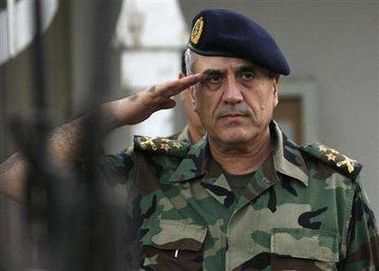 BEIRUT (AFP)–Lebanon’s presidential election was postponed for a ninth time Monday, to December 22, despite intense international efforts to convince rival parties to strike a deal and end a dangerous political vacuum. "The parliament session that was scheduled today has been postponed to Saturday December 22 at 12:30 p.m. (1030 GMT)," Mohamed Ballout, spokesman for parliament speaker Nabih Berri, told reporters.
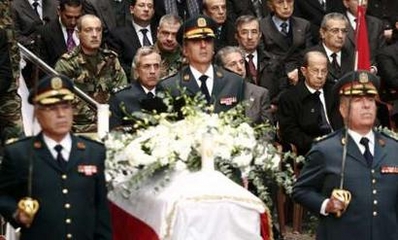 Lebanon – Lebanese politicians and military officers bade a mournful farewell to the martyr one of the top generals’ Francois el Hajj and his bodyguard Khairallah Hadwane Friday in a funeral that briefly united the deeply divided country. Hundreds of grieving Lebanese stood in a downpour along the route of Maj. Gen. Francois Hajj’s flag-draped casket from his home in a Beirutsuburb to the Maronite Catholic basilica in the Christian mountain heartland north of the capital.
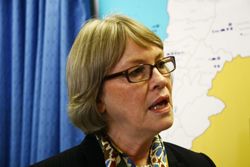 BEIRUT, 2007 (IRIN) – Rebuilding Nahr al-Bared, the northern Palestinian refugee camp devastated by a three-month conflict between the army and Islamist militants, will be one of the largest humanitarian projects ever undertaken by UNRWA, the UN
 By Alistair Lyon, Special Correspondent, SIDON, Lebanon (Reuters) – Every day bulldozers pile more garbage on to a mountain of waste on the Sidon seafront in a symbol of Lebanon’s environmental problems, aggravated, activists say, by politics, mismanagement and greed. The dump, towering about 20 meters (60 feet) high near schools, hospitals and apartment blocks in Lebanon’s third biggest city, has partially collapsed into the Mediterranean at least twice, prompting complaints from Cyrpus, Syria and Turkey after currents swept rubbish on to their beaches.
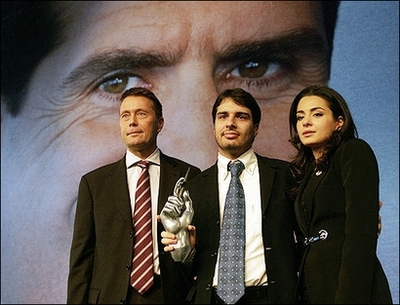 BEIRUT – The World Association of Newspapers on Sunday awarded the Gibran Tueni prize, named after the martyr MP and newsman, to a Lebanese journalist for writings focused on the freedom of expression. The award went to Michel Hajji Georgiou, senior political analyst at the French-language daily L’orient-le-jour, at a ceremony ahead of the second anniversary of Tueni’s assassination.
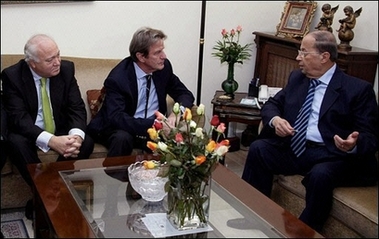 Beirut – Rival Lebanese leaders strived on Thursday to finalise a deal to have the army chief elected as president, but problems over amending the constitution persisted, despite the intervention of the French foreign minister. Parliament is due to convene Friday to elect a president. Army commander general Michel Suleiman has emerged as a candidate acceptable to the rival camps.