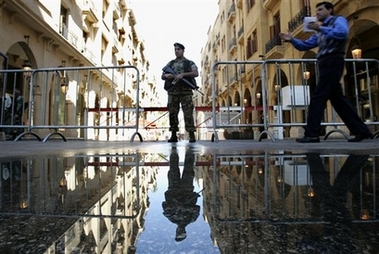
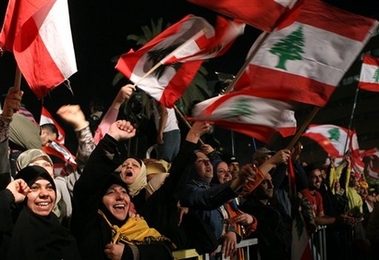
 by Nayla Razzouk, The opposition, made up of Shiite and Christian factions, has held demonstrations outside Prime Minister Fuad Siniora’s offices in central Beirut. Deep political tensions in Lebanon and a number of street fights that have killed at least one Shiite sympathizer have raised concerns of a resurgence of sectarian strife in a country still reeling from the 1975-1990 civil war.
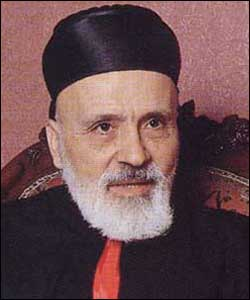
Some newspapers even hinted that the opposition may be planning to paralyze the airport, ports, and roads in a civil disobedience action that could be launched Monday.Opposition officials refused to comment.Hezbollah leader Hassan Nasrallah pledged in a fiery speech late Thursday that the opposition will not "surrender," but he also said "the doors of negotiation are still open."Nasrallah hailed a proposal for a solution made by the influential Maronite Archbishops’ Council which called Wednesday for the formation of an "accord government" .The proposal "has a lot of positive elements and is worth considering," Nasrallah said in his televised speech to thousands of protestors who have been camping outside Siniora’s offices since last week.And on Friday, a Hezbollah delegation, lead by the head of the Hezbollah parliamentary bloc MP Mohammed Raad, visited Bkerke, the seat of the Maronite patriarchate northeast of Beirut, said a Hezbollah spokesman."They will of course discuss what Sayyed Nasrallah talked about when he mentioned the archbishops’ proposal," he told AFP. The Free patriotic movement lead by General Aoun also embraced the Archbishops’ Council, and accepting it fully.
The "March 14" ruling majority also backed the archbishops’ proposal in an overnight statement that called for resolving the crisis through dialogue."We hail the statement by the Maronite archbishops… which reflects the spirit of national unity," it said."We reject any kind of violence and confrontations and we believe that strikes and ongoing sit-ins will not help resolve the Lebanese problem."
 Daily star
  By Crispian Balmer ,
 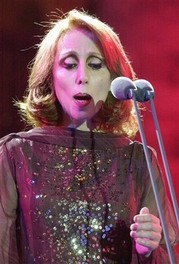 By DONNA ABU-NASR, Associated Press Writer , BEIRUT, Lebanon – Her voice brought together under one roof both supporters of the beleaguered government and opponents trying to topple it. Yet in this tense country, sharp disputes break out even at a performance by Fairouz, Lebanon’s premier diva and the star of a musical about a corrupt government. Last weekend’s three-night run of "Sah el-Nom," loosely translated as "A Good Night’s Sleep," was supposed to open an annual summer festival in the ancient city of Baalbek. Israel’s July-August offensive on Lebanon forced organizers to postpone until December, hoping that by then calm would prevail.But opening night coincided with a new crisis that many fear could tear apart the country
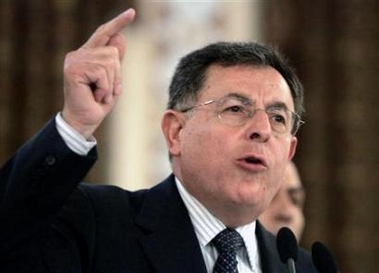
 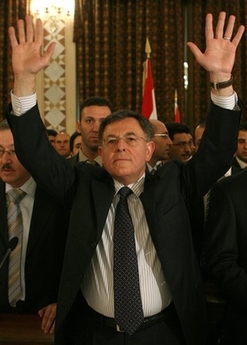 In a televised message to the nation on Thursday night, Prime Minister Fuad Saniora affirmed that his government
 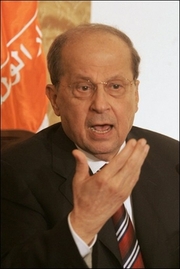 by Salim Yassine BEIRUT (AFP) – Lebanese leader Michel Aoun has vowed that the opposition will escalate its street protests if the Western-backed government fails to accept demands for a unity cabinet. "If the prime minister (Fuad Siniora) and his camp continue to monopolize power, there will be an escalation of popular pressure," Aoun, 71, told AFP in an interview Wednesday.
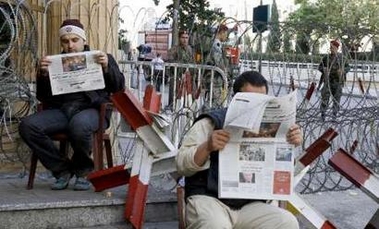 by Michel Toum, L
 December 2006
 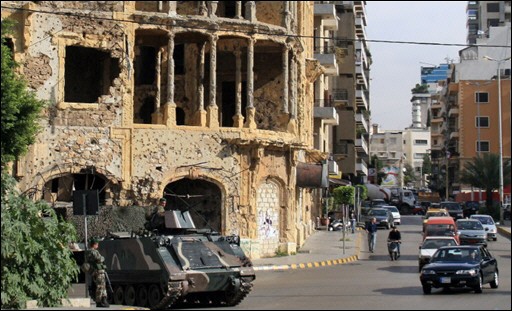 By Daniel Williams, Dec. 4 (Bloomberg) — The shooting death of a Shiite Muslim youth in Beirut increases the risk of converting Lebanon’s political power struggle into a sectarian conflict. Portraits of Ali Ahmed Mahmoud, 20, who died during a Shiite-Sunni Muslim street fight yesterday, hung at downtown plazas occupied by Hezbollah, the Shiite party that is campaigning to topple Lebanon’s pro-Western government. Placards declared Mahmoud a martyr.
  AP, Dec 4, 2006 Nearly two months after the rest of its army left southern Lebanon, Israel agreed yesterday to pull its few dozen remaining soldiers from the Lebanese part of a village divided by the border, yielding control to U.N. peacekeepers. The move came as Israel’s Cabinet discussed the three-day-old siege of Lebanese Prime Minister Fouad Siniora’s government by pro-Hezbollah demonstrators in Beirut. Commentators here called the troop pullout a diplomatic gesture aimed at shoring up Siniora’s position, but some said it would be of little help.



