 The United Nations AP- on Thursday outlined a "robust" mandate for thousands of international peacekeepers to be deployed in Lebanon and urgently called on member states to pledge troops. UN Deputy Secretary General Mark Malloch Brown said the force would be "robust" but not offensive and set out draft rules of engagement.
The peacekeeping force is the keystone in UN Resolution 1701, which outlines the ceasefire and a deployment of Lebanese and international troops to the south of the country to fill the vacuum left by withdrawing Israeli units.
Under the resolution, the UN Interim Force in Lebanon (UNIFIL) is to swell from its current 1 990-strong force. The United Nations hopes an initial deployment of more than 3 000 troops for the strengthened UN force can be in place within two weeks.
Here is a provisional breakdown of countries prepared to contribute troops:
 BEIRUT, Lebanon AP
 YABOUS BORDER CROSSING, Syria, August 14 (UNHCR)
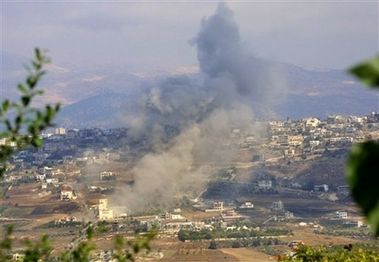 By RAMIT PLUSHNICK-MASTI, aug 13, Associated Press Writer ,
 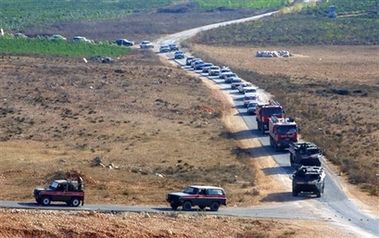 Anthony Shadid, Washington Post Foreign Service, Sunday, August 13, 2006; Page A01, HASBAYA, Lebanon, Aug. 12, Israeli troops entered Marjayoun at 3:30 a.m. Thursday. They had first seized Burj al-Molouk. Next was Qleia. The last, along a road stretching from the border, was the capital of the province, a faded, once-prosperous town that unfurls up a hill overlooking a valley carpeted in olive trees and the imposing, wizened peaks of Mount Hermon, known here as Jebel al-Sheikh."They came with the tanks, of course," said Fouad Hamra, the town’s mayor.
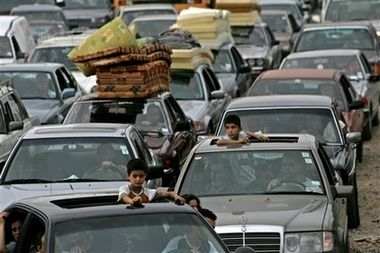
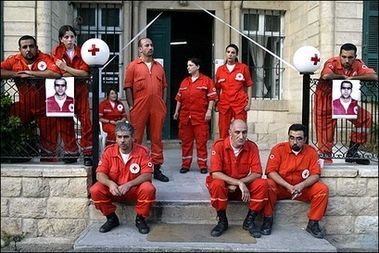 Michael Winfrey BEIRUT, Aug 13 (Reuters) – Relief agencies sent convoys towards southern Lebanon on Sunday, hoping a planned truce between Israel and Hizbollah guerrillas would mean rapid improvement in the humanitarian crisis there. Frustrated by heavy fighting and a ban on movement imposed by Israel’s army, aid workers say they have been unable to bring food, water and medicine to an estimated 100,000 people trapped south of Lebanon’s Litani River. But they said they could reach the area on short notice if a truce resulting from last week’s U.N. Security Council resolution to end the war takes place on Monday as planned.
 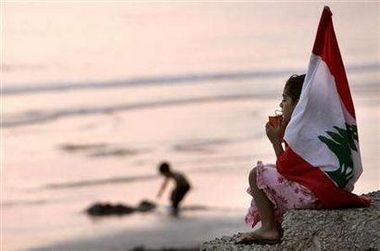 Published: Thursday, August 10, 2006, Sonia Verma reports from Beirut on how violence has caused thousands of young, university-educated professionals to leave Lebanon, possibly for good. BEIRUT – These are the trades 28-year-old Ziad Hawwa is willing to make to leave Lebanon: His swanky Beirut bachelor pad for an indefinite couch surf; the company of his elderly mother for a secure paycheque so he can support her from afar; his brand new Honda Civic for a one-way cab ride out of the country at a cost of $1,500."If I look to the future I see black," said Mr. Hawwa, nursing a bottle of mineral water in an eerily empty cafe near the pharmaceutical company where he still shows up for work in pressed khakis and a blue button-down shirt.
 By Sam Knight and agencies,



