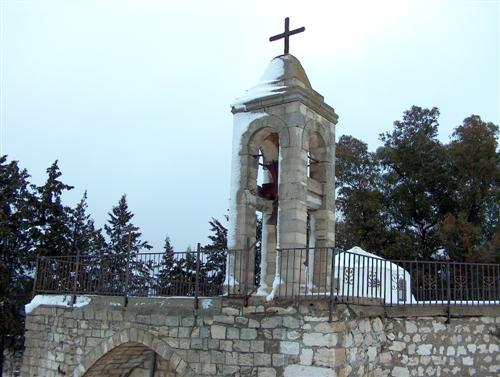
 Anthony Shadid, Washington Post Foreign Service, Sunday, August 13, 2006; Page A01, HASBAYA, Lebanon, Aug. 12, Israeli troops entered Marjayoun at 3:30 a.m. Thursday. They had first seized Burj al-Molouk. Next was Qleia. The last, along a road stretching from the border, was the capital of the province, a faded, once-prosperous town that unfurls up a hill overlooking a valley carpeted in olive trees and the imposing, wizened peaks of Mount Hermon, known here as Jebel al-Sheikh."They came with the tanks, of course," said Fouad Hamra, the town’s mayor.
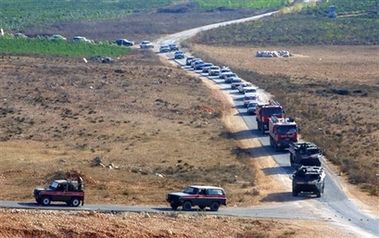
Residents said the 400 or so families in the town of Marjayoun stayed indoors, some too fearful to look out their windows to the street. Even a loud voice might draw notice, they said. The Israeli presence was ghostly — some heard voices, a few saw the soldiers themselves, most knew of their presence by word of mouth, news broadcasts and the sound of fighting that went on outside their doors."People didn’t dare leave their homes," said Hikmat Farha, a 53-year-old resident now staying in a Beirut suburb.Nearly everyone has now departed the Christian town, where houses of cream stone and red-tiled roofs sit tucked in a southern corner of Lebanon, perched unfortunately along the Israeli border. Some left in the early days of the month-long war, when Israeli forces laid siege to Khiam, a Shiite Muslim town across the valley, where fighting still raged Saturday. Most, like Hamra, left Friday in a harrowing convoy of hundreds of cars that plied a moonlit road and was attacked by Israeli aircraft. Six people were killed and more than 30 wounded
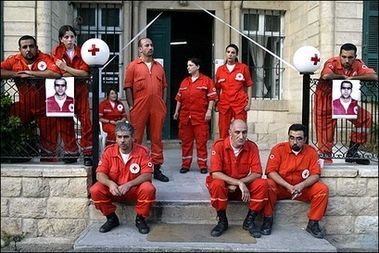 Michael Winfrey BEIRUT, Aug 13 (Reuters) – Relief agencies sent convoys towards southern Lebanon on Sunday, hoping a planned truce between Israel and Hizbollah guerrillas would mean rapid improvement in the humanitarian crisis there. Frustrated by heavy fighting and a ban on movement imposed by Israel’s army, aid workers say they have been unable to bring food, water and medicine to an estimated 100,000 people trapped south of Lebanon’s Litani River. But they said they could reach the area on short notice if a truce resulting from last week’s U.N. Security Council resolution to end the war takes place on Monday as planned.
 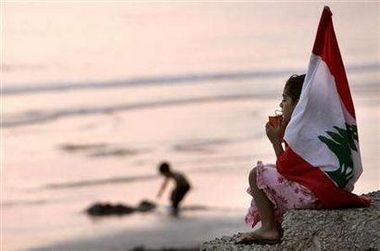 Published: Thursday, August 10, 2006, Sonia Verma reports from Beirut on how violence has caused thousands of young, university-educated professionals to leave Lebanon, possibly for good. BEIRUT – These are the trades 28-year-old Ziad Hawwa is willing to make to leave Lebanon: His swanky Beirut bachelor pad for an indefinite couch surf; the company of his elderly mother for a secure paycheque so he can support her from afar; his brand new Honda Civic for a one-way cab ride out of the country at a cost of $1,500."If I look to the future I see black," said Mr. Hawwa, nursing a bottle of mineral water in an eerily empty cafe near the pharmaceutical company where he still shows up for work in pressed khakis and a blue button-down shirt.
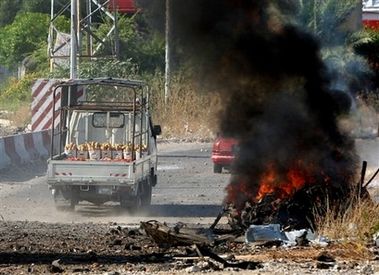 By Sam Knight and agencies,
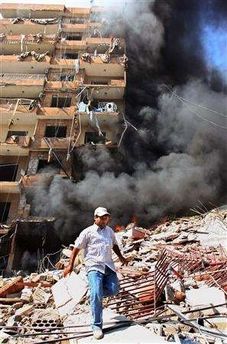 BEIRUT (Reuters) – Sunday August 6, Hizbollah killed 10 Israeli soldiers on Sunday in its deadliest rocket strike yet and Israeli bombs killed 11 Lebanese civilians as Lebanon rejected a draft U.N. resolution to end the 26-day-old war. The soldiers were killed and nine were wounded, medics said, when a rocket struck a group of reservists called up for the Lebanon offensive in the north Israeli village of Kfar Giladi. Soldiers near the scene held their heads and one wept as a military ambulance pulled away. Helicopters landed nearby to fly the badly wounded to hospitals further from the war front.
 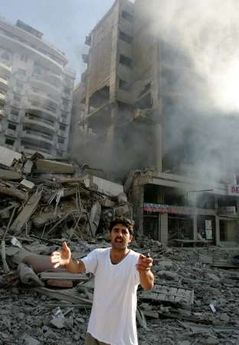 BEIRUT, Lebanon – Israeli jets fired six missiles into Beirut’s southern suburbs Sunday afternoon, Lebanese security officials said. Loud explosions shook the capital, and a column of white smoke rose over the horizon.Hezbollah and its allies rejected the U.S.-French text of the U.N. resolution, saying its terms for a halt in fighting did not address Lebanon’s demands
 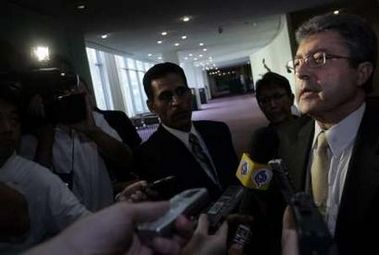 BEIRUT (XFN-ASIA) – The Lebanese government has rejected a draft UN Security Council resolution on the Hezbollah-Israel conflict, saying it would not end hostilities and asking for the text to be amended.
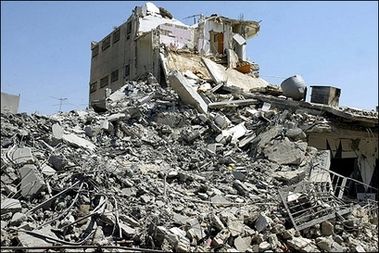 By Tom Perry, Reuters, BEIRUT (Reuters) – Ali Bajouk set off to deliver supplies to elderly relatives in the village of Aita al-Shaab thinking Israel had suspended its aerial bombardment of southern Lebanon.He was wrong. Bajouk now lies in a hospital bed in Beirut, his body, head and face wrapped in bandages to cover the burns caused by an air strike which scorched half his skin.
 ABC, The Lebanese Government says three weeks of Israeli bombardment has inflicted $US2 billion ($2.6 billion) of damage on Lebanon’s infrastructure. As Australians in Lebanon are urged to get on board what will possibly be the last government-chartered evacuation ship from Beirut, Lebanon’s Transport and Public Works Minister has detailed the damage to infrastructure which has impeded the refugees’ escape.