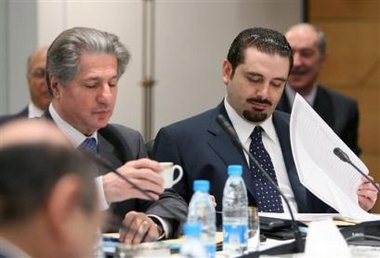
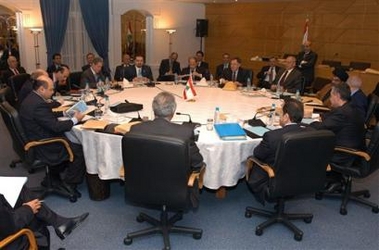
 By Henri Mamarbachi – BEIRUT Lebanon’s leaders held fresh talks on Monday focusing on one of the most contentious issues dividing supporters and opponents of Syria – the fate of President Emile Lahoud whom the parliamentary majority wants to oust.
The talks, which resumed after a five-day break, are aimed at ending Beirut’s political paralysis which set in after Syria pulled out its troops after dominating life in its tiny neighbour for some three decades. "Talks focused on one essential subject, that of the presidency of the republic … and this point remains on the agenda for the next session, next Monday," parliamentary speaker Nabih Berri told journalists after the meeting which lasted fewer than three hours. Earlier at the start of the talks, Samir Geagea, head of the former Christian militia, the Lebanese Forces,, told journalists: "We do not expect that the remaining problems will be resolved during Monday’s session." The Lebanese newspapers al-Balad and as-Safir both suggested that the question of the presidency would have to wait for decisions taken at the Arab summit in Khartoum this week.
 The United Nations has said it did not expect
  T
T The purpose of this gathering is to brief you on the case you read about in the news, i. e. my prosecution before the military court, Beirut, by reason of the testimony I gave on the conditions of human rights in Lebanon, at the European Parliament, Brussels, on November 4, 2003, i. e. two and a half years ago.
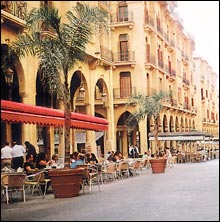 BEIRUT, 21 March (IRIN) – Beirut’s impressive downtown district reflects much of the wealth and development that Lebanon has enjoyed since the end of the civil war in 1990. But a few minutes’ drive to the capital’s southern and northern fringes reveals a vastly different reality, featuring extreme poverty and underdevelopment. Residents and NGOs working to alleviate poverty put much of the blame for the shabby condition of the suburbs on government inaction. "We’re second class citizens," said Youssef Hassan, a 48 year-old resident of the southern suburb of Hay al-Selom. "Officials forget we exist below the poverty line."
 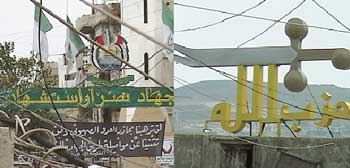 By Marwan Kanafani and Elizabeth Schiffrin, WALKING through the unpaved streets of Ain el-Helweh
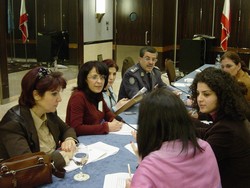 BEIRUT, 13 March (IRIN) – BEIRUT, 13 March 2006 (IRIN)
 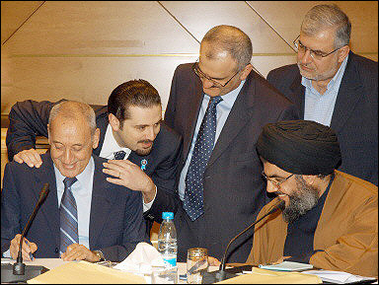 EIRUT, March 14 (Reuters) – Lebanese leaders agreed at national talks on Tuesday to disarm Palestinian factions outside refugee camps within six months and called for full diplomatic ties with Syria. But the officials meeting to end a political crisis that has paralysed the country did not agree on the two hottest issues: disarming the pro-Syrian Hizbollah guerrilla group and the fate of pro-Syrian president Emile Lahoud.
  y HUSSEIN DAKROUB ,