(CNN) — Two people were wounded late Monday when an explosion rocked a commercial center in a Christian suburb north of Beirut, according to a Lebanese security source and local media reports.The blast went off in a parking lot adjacent to the Hotel Promenade in Zalka and about 60 feet from a Starbucks cafe, the security source said.However, the Lebanese Broadcasting Corporation cited another source who said the bomb had been placed inside a building in the Cite Moussa commercial center.The blast happened just before 11 p.m. (4 p.m. ET). Video from the LBC showed army troops cordoning off the area and ambulance crews responding to the scene.The blast appeared to have caused extensive damage to the outside walls of a building. Just last month a powerful explosion rocked a Christian area of Beirut. Hours after U.S. Secretary of State Condoleezza Rice paid a surprise visit, the second major blast in two weeks shook the Lebanese capital on July 22. No deaths were reported.On July 12 Lebanon’s outgoing deputy Prime Minister Elias Murr was among 12 people wounded by a blast that tore through a Christian neighborhood in northern Beirut. At least two people were killed.
 BEIRUT, 21 August (IRIN) – As Lebanese trucks started to cross the border into Syria last week, following several months of being stranded at checkpoints, fears remain that the crisis is far from over. Stricter Syrian customs inspections starting last June resulted in a massive backup of trucks carrying Lebanese products out of the country in July. According to Prime Minister Fouad Siniora, however, the problem is now resolved. “It has been confirmed that the situation is fine,” said Mahmoud Fawaz, the prime minister’s press officer. “There are routine checks but that is normal.” Privately, though, officials say the flow of traffic has yet to return to normal and there are still often delays. “Sometimes it is fine and the trucks and cars are passing through, but other times, it is just like before with the restrictions and hours of waiting,” said a Lebanese security source. “The situation is definitely not like it used to be between the two countries.” Many Lebanese claimed Syria implemented the stricter inspection regime for political reasons. Lebanon’s only land outlet to export products to the rest of the Arab markets is through Syria since the border with Israel remains closed. According to officials, land exports make up some 60 percent of Lebanon’s entire exports and by slowing the trucks, Syria severely damaged the economy. Lebanese officials, truckers, unions and associations remain angry at the losses already amassed and Damascus’ failure to produce a valid excuse for what they say are violations of the trade agreements between the two countries. The president of the Federation of Agricultural Producers in Lebanon Antoine Howayek said that direct losses had been “between $300,000 and $500,000 per day, but it is the indirect losses that are worse. The prices have dropped and that is a long-term disadvantage.”
 (UPI) The Palestinian Hamas movement in Lebanon said Saturday the factions were working on forming a special Palestinian authority in Lebanon.The Hamas representative in Lebanon, Osama Hamdan, said in the Rashidiya refugee camp in southern Lebanon — during a rally celebrating the Israeli withdrawal from Gaza — that a meeting was held among all the Palestinian factions to form such an authority in the country.He said that relations with Lebanon have never been properly organized, adding he hoped that the relationship between Beirut and Palestinian refugees would be organized in the next few days in order for our people to live with dignity until we return to Palestine.Almost 400,000 Palestinian refugees live in camps in Lebanon, where they have been prevented from working in the country since 1982. The government cites the threat of settlement and losing their right to return to their original homes they were forced to flee during the 1948 Middle East war when the Jewish state was established.
 KABUL (AFP) – Taliban rebels freed a Lebanese hostage and two US soldiers were killed by a roadside bomb in southern Afghanistan, exactly one month before the country’s landmark parliamentary polls. Both incidents involved reconstruction projects, highlighting the threat that the former Islamic regime still poses to Afghanistan’s fragile road to democracy and its recovery from decades of war.The new US ambassador to Kabul pledged that the militants, who were ousted by American-led forces in late 2001, would not be allowed to disrupt the historic elections despite a rise in violence.The Taliban had threatened to kill hostage Safieddine Mohammad Rida, who was abducted on Sunday while working for a Lebanese company that sells diesel engines, if his employers did not pull out of Afghanistan. He was freed early Thursday and handed over to authorities in the southeastern province of Zabul, officials and the rebels themselves told AFP.It was unclear if the firm had yielded to the Taliban’s demands, although Lebanon‘s foreign ministry said Wednesday the firm’s owner had agreed with the hostage’s family that he was willing to withdraw from Afghanistan.Rida told the BBC his kidnappers had talked about a deal but he was unable to confirm it. “I am not sure what deal the company has made with the Taliban. I haven’t spoken to the company yet”, the BBC quoted him as saying.Afghanistan’s Interior Minister Ali Ahmed Jalali denied reports of a deal. “Nothing was paid. No deal was done,” he told reporters in Kabul.
 KESROUAN: The Lebanese Heritage Museum celebrated its second anniversary on Tuesday. The museum, the first in Lebanon to cover so many different eras and facets of Lebanese heritage, was inaugurated on September 5, 2003, and has since become a compulsory feature of the national history curriculum, as well as an essential site for school visits.
It has also been listed as a “first class museum” by the Culture, Education, and Tourism ministries.
The anniversary celebration consisted of a guided tour of the country’s eight historical eras, including Phoenician, Hellenistic, Roman, Byzantine, Islamic, Ottoman and today’s 20th century era, displayed across the five halls of the museum.
“The Lebanese Heritage Museum gathers historic, heritage and artistic symbols from Lebanese history,” said Michel Meiki, vice president of the museum’s founding committee.
“We had things that should have been exposed earlier,” said John Raidi, the president of the founding committee, explaining there had been rare documents not on display for the students to see, but that these were now out.
“We want to give Lebanese students an overall view of all the different eras,” he said.
Culture Minister Tareq Mitri began his celebratory speech by saluting the efforts that went into establishing the museum.
“What caught my attention was that the exhibition did not bias any period of Lebanese history over another. On the contrary, the museum tried to help visitors get introduced to different stages of our country’s history,” he said.
Emphasizing the importance of the role memory plays in uniting or dividing a people, Mitiri said: “Invented memories ignited conflicts between groups,” insisting that “nations cannot be built unless their citizens agree on what should be remembered together and what should be forgotten together.”
Commenting on the importance of the museum, he said “its contents are a renovated reading of our diverse history and its successive stages.”
Secretary general of the museum Sheikh Simon Khazen said there are plans to start a Lebanese contemporary art museum, once the museum is included in the Culture Ministry’s budget.
 17 August 2005 DAMASCUS
 Syria and Lebanon discussed Sunday the joint cooperation and implementation of in the electricity network cooperation.
During a meeting with Lebanese Minister of Energy Mohammed Fneish, Electricity Minister Moneib Sa’em al-Dahr described the cooperation between the two states in field of electricity energy as “productive and it brings benefit to both Syrian and Lebanese people.” “Syria has been committed to every item in every agreement particularly of this agreement with Lebanon,” the minister said.
 AFP, August 16, 2005 BEIRUT — The Lebanese economy is showing signs of recovery six months after the assassination of ex-premier and construction tycoon Rafiq Al Hariri and the ensuing political crisis that shook the country, analysts say. Hariri had spearheaded Lebanon’s post-war economic revitalization and his death in a February bomb blast on the Beirut seafront delivered a fresh blow to an economy already battered by a long-running civil war that ended in 1990. “The disappearance of a man whose name had been linked since 1992 to the reconstruction of Lebanon, which was emerging from 15 years of destruction and war, had a negative psychological impact on investment, production and consumption, although that impact only lasted a limited time,” said analyst Marwan Barakat of Audi Bank. The five-time prime minister’s sudden death led to political upheaval, international pressure for change in Lebanon and the eventual April withdrawal of Syrian troops after a presence of nearly three decades. However analysts say damaging economic consequences of the turmoil have been lessened by a smooth political transition and promises of reform by a newly elected parliament. “Despite negative indicators in the first half of 2005 compared to those of the preceding year, the Lebanese economy has emerged with relatively limited damage in light of the tragedy,” Barakat said.
BEIRUT, Lebanon, Aug. 14 (UPI) — A Lebanese opposition Parliament member warned Sunday that four more leaders, including himself, will face assassination attempts The Lebanese al-Balad daily quoted former exiled Gen. Michel Aoun, head of the Free Patriotic Movement, as saying the “assassination of these figures will create a security problem and internal sedition in […]
 BEIRUT (Reuters) – A United Nations investigator intends to question Syrian officials directly as part of a probe into the killing six months ago of Lebanese former prime minister Rafik al-Hariri, a U.N. official said on Saturday. Detlev Mehlis will also probably ask for more time than the designated three months to complete his findings, the official said. “Detlev Mehlis needs to directly interview Syrian officials concerned. He needs to visit Syria for this purpose,” U.N. spokesman Najib Friji told Reuters. “The Syrians have agreed in principle to cooperate with Mehlis but he has yet to receive an official Syrian response to visit the country.” Mehlis, a veteran German prosecutor, is leading a 50-member team investigating the February 14 bombing that killed Hariri and 20 others in Beirut, throwing Lebanon into its worst crisis since the end of the 1975-1990 civil war. Many Lebanese hold Syria, which controlled Lebanese politics and security in the 15 years following the end of the civil war, at least indirectly responsible for Hariri’s killing. Damascus denies any role but withdrew its troops from Lebanon in April, ending a 29-year military presence amid mass anti-Syrian street protests and intense international pressure. The U.N. Security Council ordered the investigation, which began in mid-June, after a U.N. fact-finding mission found Lebanon’s own inquiry to be “seriously flawed.”
Population Movements to Keserwan - The Khazens and The Maans
ما جاء عن الثورة في المقاطعة الكسروانية
ثورة أهالي كسروان على المشايخ الخوازنة وأسبابها
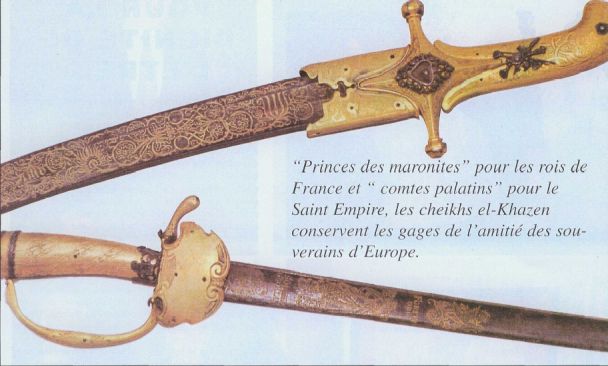
Origins of the "Prince of Maronite" Title
Growing diversity: the Khazin sheiks and the clergy in the first decades of the 18th century
Historical Members:
Barbar Beik El Khazen [English]
Patriach Toubia Kaiss El Khazen(Biography & Life Part1 Part2) (Arabic)
Patriach Youssef Dargham El Khazen (Cont'd)
Cheikh Bishara Jafal El Khazen
Patriarch Youssef Raji El Khazen
The Martyrs Cheikh Philippe & Cheikh Farid El Khazen
Cheikh Nawfal El Khazen (Consul De France)
Cheikh Hossun El Khazen (Consul De France)
Cheikh Abou-Nawfal El Khazen (Consul De France)
Cheikh Francis Abee Nader & his son Yousef
Cheikh Abou-Kanso El Khazen (Consul De France)
Cheikh Abou Nader El Khazen
Cheikh Chafic El Khazen
Cheikh Keserwan El Khazen
Cheikh Serhal El Khazen [English]
Cheikh Rafiq El Khazen [English]
Cheikh Hanna El Khazen
Cheikha Arzi El Khazen
Marie El Khazen