Before the big meeting in Germany, the youths have been invited to visit their country of origin to discover the message inherent in cohabitation between Muslims and Christians. Beirut (AsiaNews)
 By JOE PANOSSIAN, Associated Press Writer, BEIRUT, Lebanon — Lebanese police have arrested Omar Bakri, the Islamic cleric who is being investigated in Britain for his remarks on the London bombings, security officials said Thursday. The officials refused to say when and where Bakri was arrested. But the local Future TV channel reported that he was arrested Thursday as he left after giving an interview at its building in western Beirut. The station said Bakri was told that the General Security department wants to question him about “information regarding his entry into Lebanon.” In London, the Foreign Office said there was no British connection to the detention and no warrant for Bakri’s arrest. Britain’s Home Office declined to say whether it had lodged an extradition request. However, such a move was considered unlikely as the government had been considering how to deport or bar Bakri from Britain. Bakri is regarded as an Islamic extremist in Britain, where he has lived for 20 years. He left on Saturday and flew to Lebanon to see his mother. “Enjoy your holiday — make it a long one,” British Deputy Prime Minister John Prescott said Tuesday when asked about Bakri at a news conference. Bakri had told the British Broadcasting Corp. that he plans to return after six weeks, but he would not return if the government told him he would not be welcome. “Good,” Prescott said when told that. The cleric founded the now-disbanded radical Islamic group al-Muhajiroun, which came under scrutiny in Britain, particularly after some of its members praised the Sept. 11, 2001, attacks on the United States.
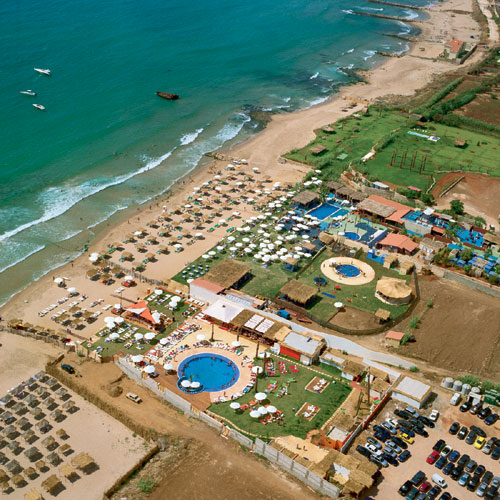 Lebanon’s tourism minister has said that the security situation this year had scared off tourists just rediscovering the former war zone. Joseph Sarkis said the number of visitors was down by up to 20% so far this year, after the killing of former Prime Minister Rafik al-Hariri in February sent
Dubbed the
BEIRUT (Reuters) – Lebanon’s new government has set up a national commission to draw up a new election law in a move widely seen as a crucial step toward political reform after the withdrawal of Syrian forces from the country. The cabinet approved on Monday night the formation of the 12-member half-Muslim half-Christian committee headed by Fouad Butros, a widely respected former foreign minister. The United States, European Union and the United Nations have urged Lebanon to press ahead with political and economic reforms after Syria ended its 29-year military presence in April under pressure after the February killing of ex-premier Rafik al-Hariri.Elections in May and June were conducted on the basis of a law adopted in 2000 which had been drawn up to help local allies of Damascus retain their positions in the political status quo.In a statement issued after Monday’s meeting, the government said the commission was charged with “preparing an election law in line with the constitution and the national consensus accord that ensures the best possible and fairest representation.” Before submitting its draft proposal, it will hold talks with the country’s party leaders, political, intellectual and spiritual figures as well as international bodies.Many Lebanese leaders had criticized the 2000 law but said there was no time to change it before the elections. The vote, which ended on June 19, brought forward an anti-Syria majority to the 128-member parliament for the first time.
 By Farid Elias El Khazen, The recent parliamentary elections held in Lebanon in May and June came at a time of drastic change in postwar Lebanese politics. It was the first parliamentary election held after the withdrawal of Syrian troops, and it followed the international community’s renewed interest in Lebanese politics embodied in the passing of United Nations Security Council Resolution 1559 on September 2, 2004. The elections were also the culmination of events that marked Lebanese politics following the prolongation of President Emile Lahoud’s term for three years in violation of Resolution 1559. The status quo that had prevailed in Lebanese politics since the end of the war in 1990 was shattered by the assassination of former Prime Minister Rafik Hariri on February 14, followed by approval of Resolution 1595, which established an international independent investigation commission to look into Hariri’s assassination; and by the “Independence Intifada” that brought together over a million Lebanese on March 14, from all communities, to demand a withdrawal of Syria’s military and intelligence apparatus. Notwithstanding these momentous developments, the electoral law that governed the recent elections was the same one used in the 2000 elections, and differed little from the electoral laws of the two previous elections in 1992 and 1996, both dictated by Syria. These laws, which created large constituencies and involved extensive gerrymandering, were designed to influence the outcome of elections so that they targeted specific political groups and communities, notably the Christian communities.
 BEIRUT (AFP) – The UN Human Rights Committee has asked Damascus to investigate the disappearances of Lebanese nationals in Syria and the practice of arbitrary detention, a Paris-based rights group said. Syria “should… take immediate steps to establish an independent and credible commission of inquiry into all disappearances,” said a UNHRC statement published by a group called Support for Arbitrarily Detained Lebanese (SOLIDA).Syria “should give a particularized account of Lebanese nationals and Syrian nationals, as well as other persons, who were taken into custody or transferred into custody in Syria,” said the committee during its annual meeting in Geneva, which ended July 29.Lebanese groups estimate that 440 Lebanese have disappeared in Syria, including some women and people who were minors at the time they disappeared.In 2000, 54 Lebanese were freed from Syrian prisons.The Lebanese government established a government commission in 2001 to investigate the cases of Lebanese prisoners, but the commission was dissolved before it could publish its findings.
LONDON, August 5 (IranMania) – Lebanese Hizbollah Secretary General Seyyed Hassan Nasrollah in a meeting here Wednesday with Iran’s Secretary of Supreme National Security Council (SNSC) Hassan Rowhani said, “Hizbollah has a national objective which is supporting Lebanon’s sovereignty against Israel threats”, according to IRNA. In the meeting, Nasrollah emphasizing Hizbollah’s efforts and tireless campaign […]
 By Michael Young, year after the fall of Baghdad, I asked a senior U.S. official involved in planning the Iraq war whether the whole thing was a Shiite-centered project. He insisted it was not, and that Saddam Hussein had engaged in “equal opportunity repression” against both Sunnis and Shiites. No doubt he meant what he said, but today, among Iraq’s Arab communities, it is the Shiites (objectively at least) who are on the Americans’ side, and the Sunnis who are leading the insurgency. Though the Sunni-Shiite rivalry seems most acute in Iraq, it is being felt throughout the Middle East where the communities live together, most recently in Lebanon. Following the Syrian military withdrawal last April, Sunnis and Shiites have been locked in an understated, mostly peaceful, yet very real contest to fill the ensuing political vacuum and put their stamp on Lebanon’s future. Lebanon is unlikely to go the violent way of Iraq. However, what is taking place is not limited to domestic politics; it reflects concentric, overlapping circles of competition between various actors – not just Shiites and Sunnis – at the local and regional levels, motivated by sometimes different, sometimes parallel interests.Inside Lebanon, Syria’s recent departure (though Syrian intelligence agents continue to be active) effectively left two powerful political forces facing one another: the Sunni-dominated Hariri camp, led by Saad Hariri, the son of former Prime Minister Rafik Hariri, whose assassination set in motion the disintegration of the Syrian order in Lebanon; and the Shiite Hezbollah, which is close to Syria and which Damascus allowed to retain its weapons after the end of the war in 1990, in order to fight Israeli forces occupying south Lebanon.As far back as the early 1980s, but starting even sooner, the Syrians began a strategic relationship with Lebanon’s Shiites, partly because the minority Alawite regime in Damascus sought to contain its own majority Sunni community by developing a counterweight to Sunnis in next-door Lebanon. Hariri, who with Saudi backing became prime minister in 1992, always threatened this balance, while Syria also disliked his close relations with France and the United States. Lebanese politician Walid Jumblatt has argued that Hariri was killed precisely because the Syrians wanted to avoid facing “the project of a strong Sunni.”
 TEHRAN (AFP) – Iranian supreme leader Ayatollah Ali Khamenei praised the Lebanese Shiite Muslim group Hezbollah for its military and political performance as the militant faction’s chief held talks in Tehran. “Hezbollah has shown it is skillful and wise in politics as it is powerful and displays initiative in the field of Jihad and resistance,” Khamenei told Hezbollah chief Hasan Nasrallah, the student agency ISNA reported.Khamenei said Hezbollah, formed in 1982 by the Iranian Revolutionary Guards after the Israeli invasion of Lebanon, was a source of pride for the Islamic world.”Today, the United States has really become weak in the region,” Khamenei said. “This is proved by its failure in Iraq and defeat of its plans in Lebanon and Iran.”Touching on Mahmood Ahmadinejad’s upset victory in Iran’s June presidential election, Khamenei said the United States had been “shocked and stunned” by the result. “They were forced to retreat a long way.”Hezbollah was among the first to hail Ahmadinejad’s win, describing it as a slap in the face for the United States.
 This image made from Saudi TV shows sons of the late Saudi King Fahd carrying his body, wrapped in a plain brown cloth on a wooden plank, into the Imam Turki bin Abdullah mosque in Riyadh for his pre-burial service Tuesday, Aug. 2, 2005. Heads of state from the Islamic world and Saudi princes and Islamic clerics prayed for the late King Fahd, who died Monday, in the packed mosque Tuesday, bidding farewell to this oil-rich country’s ruler for almost a quarter of a century. (AP Photo/Saudi TV)
 To view More pictures pls click “READ MORE“
Population Movements to Keserwan - The Khazens and The Maans
ما جاء عن الثورة في المقاطعة الكسروانية
ثورة أهالي كسروان على المشايخ الخوازنة وأسبابها
Origins of the "Prince of Maronite" Title
Growing diversity: the Khazin sheiks and the clergy in the first decades of the 18th century
Historical Members:
Barbar Beik El Khazen [English]
Patriach Toubia Kaiss El Khazen(Biography & Life Part1 Part2) (Arabic)
Patriach Youssef Dargham El Khazen (Cont'd)
Cheikh Bishara Jafal El Khazen
Patriarch Youssef Raji El Khazen
The Martyrs Cheikh Philippe & Cheikh Farid El Khazen
Cheikh Nawfal El Khazen (Consul De France)
Cheikh Hossun El Khazen (Consul De France)
Cheikh Abou-Nawfal El Khazen (Consul De France)
Cheikh Francis Abee Nader & his son Yousef
Cheikh Abou-Kanso El Khazen (Consul De France)
Cheikh Abou Nader El Khazen
Cheikh Chafic El Khazen
Cheikh Keserwan El Khazen
Cheikh Serhal El Khazen [English]
Cheikh Rafiq El Khazen [English]
Cheikh Hanna El Khazen
Cheikha Arzi El Khazen
Marie El Khazen