BEIRUT, Lebanon – A bomb exploded on a narrow street crowded with bars and restaurants late Friday, wounding 12 people just hours after U.S. Secretary of State Condoleezza Rice visited the area, officials said. The blast, from a bomb placed near a car parked in front of a restaurant, panicked the hundreds of people dining or smoking water pipes in the bustling sidewalk cafes on popular Monot Street. Lebanese families and Arab tourists, including black-veiled women visiting from the Gulf, scattered.Three cars were damaged by the 50-pound bomb. Security and hospital officials said 12 people were wounded.Lebanon has seen a string of bomb assassinations of politicians and other figures in recent months
BEIRUT (Reuters) – A loud explosion in the Lebanese capital Beirut wounded seven people near a busy street of restaurants and bars on Friday, security sources said. Security forces first reported the blast, which came hours after a short visit by Secretary of State Condoleezza Rice, had killed one person.The blast was caused by a […]
 By ANNE GEARAN, BEIRUT, Lebanon – Secretary of State Condoleezza Rice made a surprise visit to volatile Lebanon under heavy guard Friday to encourage a new democratic government outside Syrian control. Rice was meeting with officials of the new government that emerged from a season of political change following the assassination of an anti-Syrian politician.”This will be an opportunity first of all to congratulate the Lebanon people on their incredible desire for democracy,” Rice said en route to Beirut.Rice’s visit comes three days after formation of a new Cabinet led by Prime Minister-designate Foud Saniora.”They keep pressing forward and they have now formed a government,” Rice said. “I look forward to meeting and see how the international community and the United States in particular can be supportive.”Rice is the first senior U.S. official to visit Beirut in more than two years. Official sources said she would meet the country’s top officials, including President Emile Lahoud. Her visit comes three days after a new Lebanese government was formed following last month’s parliamentary elections.She arrived from Jerusalem, home base for a long weekend of talks with Israeli and Palestinian leaders that included a meeting with Israeli Prime Minister Ariel Sharon at his desert ranch Friday morning.The Lebanese opposition blamed Syria and its agents for the assassination of former Prime Minister Rafik Hariri in February.
 By Nicholas Blanford, BEIRUT, LEBANON – After weeks of protracted wrangling, Lebanon has formed its first government free from foreign interference in almost three decades, but the challenges ahead are formidable. Among them:
 By ZEINA KARAM, Associated Press Writer BEIRUT, Lebanon – Lebanon’s prime minister-designate announced his new Cabinet on Tuesday, a government dominated by opponents of Syria, although it includes a member of the militant Hezbollah group, which Washington brands a terrorist organization. The 24-member Cabinet, the first since Syria withdrew its troops from Lebanon, omits prominent Christian representation of followers of former Gen. Michel Aoun.The formation of the new Cabinet brings to an end almost three weeks of political squabbling over key posts. Pro-Syrian President Emile Lahoud repeatedly demanded changes in Prime Minister-designate Fuad Saniora’s suggested lineups.Aoun, the former army commander who returned to Lebanon from 14 years of exile in France, wanted the Justice portfolio but was refused. It went instead to Lahoud ally Charles Rizk.Hezbollah’s Mohammed Fneish received the power and hydraulic resources ministry, while the militant group’s ally, Tarrad Hamadeh, retained the post of labor minister.The key Foreign Ministry went to Shiite Fawzi Salloukh after negotiations with Hezbollah and its rival Amal movement. Salloukh is a former veteran diplomat who served for more than three decades with the foreign corps. He does not belong to either group, but was acceptable to both.Saniora said he was “proud” of Fneish’s participation and promised that the Cabinet will work on improving relations with Syria, which have suffered since the withdrawal.The new administration also includes ministers close to Lahoud, including his son-in-law, former Defense Minister Elias Murr, who survived an assassination attempt on June 12. He retains the Defense portfolio.Most other posts in the Cabinet, which includes 12 Christians and 12 Muslims per Lebanon’s sectarian political system, went to members of lawmaker Saad Hariri’s Future Movement and his allies.Cardinal Nasrallah Sfeir, head of the influential Maronite Church, on Sunday refused to bless Saniora’s list because it included no Aoun supporters, Lahoud media adviser Rafik Shalala said.
 MASNAA BORDER POST, Lebanon – Sheltering from the searing heat in the shade of his truck, a red-faced and sweating Ali Bakri glared angrily at the endless line of cargo trucks stranded on the Lebanese-Syrian border. “We are being treated like animals. We have no food, no water to wash. How long can this go on?” the 35-year-old Jordanian trucker said Monday.Fresh fruits are turning to mush as customs officials carry out excruciatingly thorough searches, spending up to an hour with each vehicle. Previously, Syrian officials gave only cursory searches and often simply waved drivers through. Truckers now wait in line a week or more.The drivers and their cargo are a casualty of the souring relations between Lebanon and Syria since Damascus was forced to relinquish its three-decade-long military grip on Lebanon three months ago.Many Lebanese say Syria has clamped what amounts to a land and sea siege on its tiny neighbor to exact revenge following the withdrawal of thousands of troops. But the Syrians say the strict measures are aimed at catching saboteurs and militants.France, a close Lebanese ally, has criticized the Syrian border actions. U.N. envoy Terje Roed-Larsen briefed European Union foreign ministers on the dispute Monday and urged Lebanon and Syria to end the impasse.Lebanon’s only land outlet is via its shared border with Syria, through which 60 percent of Lebanese exports pass on their way to other Arab and Gulf markets, officials say. The dispute is estimated to be costing Lebanon over $300,000 a day.
Lebanon’s parliament has approved an amnesty for Christian militia leader Samir Geagea, who is currently serving a life sentence. He is the only Lebanese warlord to be punished for crimes during the long civil war which ended in 1990. A campaign for his release has gathered strength since the assassination of former PM Rafik Hariri, […]
 BEIRUT (AFP) – Lebanon’s prime minister designate proposed forming a mixed cabinet of MPs and unelected figures after he got backing from Shiite militant group Hezbollah and its allies, and his own supporters rejected a government solely of techocrats. Fuad Siniora, speaking after a meeting with President Emile Lahoud on Friday, said “such a cabinet, composed of deputies and non-deputies, has received the support of more than 100 deputies, or 78 percent of parliament.”He said he was waiting for the president’s response.Siniora described what is the fourth proposed lineup since he was designated on June 30 to form a government as a “homogeneous working team qualified to face the political, economic and security challenges facing the country”. “We face a political vacuum and a deterioration of the security situation, as well as various attempts, at home and abroad, to demonstrate that the Lebanese are not capable of governing themselves.” He said his proposed line-up was the “best possible formula for a reformist cabinet.” It also had the “agreement” of Hezbollah and its Shiite ally Amal, although not that of Christian firebrand Michel Aoun. Any role for Hezbollah in the new government is likely to complicate international demands for the disarmament of its military wing, which still exclusively patrols the formerly Israeli-occupied south, in accordance with a UN Security Council resolution passed last September.Earlier, Druze leader Walid Jumblatt spoke out strongly against Siniora’s previous proposal, only made on Thursday, which called for an entirely non-party government. “We refuse to discuss a government of technocrats,” Jumblatt told the Al-Mostaqbal daily, owned by the family of the bloc’s leader Saad Hariri.
 While commending Lebanon for taking impressive steps to promote gender equality, members of the Committee on the Elimination of Discrimination against Women urged the country to eliminate discrimination in marital and family relations, as well as citizenship, combat persistent gender stereotypes, and focus more attention on violence against women, as it took up that country
 BEIRUT, July 14 (Reuters) – Lebanon’s prime minister said on Thursday he would seek to form a government of technocrats after failing to win agreement on a cabinet drawn from political groups no longer forced to bend to Syria’s will.Fouad Siniora, a member of a coalition that pushed for Syria’s pullout from Lebanon, made the announcement after talks with pro-Syrian President Emile Lahoud confirmed that squabbles had scuppered his proposed cabinet of politicians.The next government, the first since Syria ended its 29-year military presence in Lebanon in April, faces many challenges including reestablishing stability after a series of bombings and assassinations, political reform and tackling a huge debt. It also has to deal with a U.N. Security Council resolution demanding the disarming of anti-Israeli Hizbollah guerrillas. “I agreed with his excellency the president that we go ahead with preparing a government line-up from outside parliament, from people who have political know-how but are not members of parties,” the prime minister-designate told reporters. He indicated the cabinet would be made up of 24 ministers. Political sources said Siniora would now have to come up with a team of technocrats with political links so that they would win the backing of the various parties.
Population Movements to Keserwan - The Khazens and The Maans
ما جاء عن الثورة في المقاطعة الكسروانية
ثورة أهالي كسروان على المشايخ الخوازنة وأسبابها
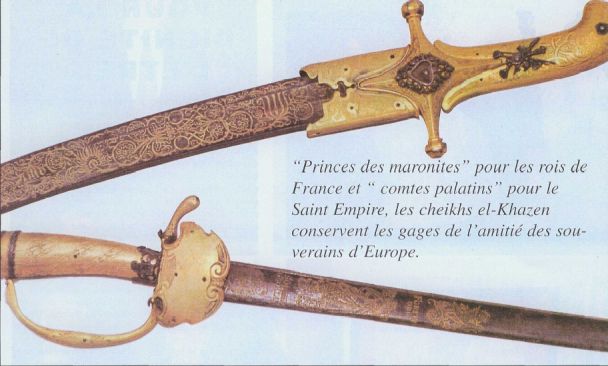
Origins of the "Prince of Maronite" Title
Growing diversity: the Khazin sheiks and the clergy in the first decades of the 18th century
Historical Members:
Barbar Beik El Khazen [English]
Patriach Toubia Kaiss El Khazen(Biography & Life Part1 Part2) (Arabic)
Patriach Youssef Dargham El Khazen (Cont'd)
Cheikh Bishara Jafal El Khazen
Patriarch Youssef Raji El Khazen
The Martyrs Cheikh Philippe & Cheikh Farid El Khazen
Cheikh Nawfal El Khazen (Consul De France)
Cheikh Hossun El Khazen (Consul De France)
Cheikh Abou-Nawfal El Khazen (Consul De France)
Cheikh Francis Abee Nader & his son Yousef
Cheikh Abou-Kanso El Khazen (Consul De France)
Cheikh Abou Nader El Khazen
Cheikh Chafic El Khazen
Cheikh Keserwan El Khazen
Cheikh Serhal El Khazen [English]
Cheikh Rafiq El Khazen [English]
Cheikh Hanna El Khazen
Cheikha Arzi El Khazen
Marie El Khazen