by - hyperallergic.com
Recognition came later in life to Saloua Raouda Choucair, a Lebanese artist working from Beirut, in relative isolation, throughout the second half of the 20th century. Her first international debut — several decades after a number of gallery exhibitions in Paris during the post-war period — was a major retrospective held at Tate Modern in 2013, after curators from Tate discovered her work in a gallery in Lebanon. Choucair was 97 years old at the time. (She stopped producing art sometime in the 1990s, after five decades of work.) In the summer of 2016, the recently reopened Sursock Museum in Beirut celebrated Choucair’s 100th birthday, and in January 2017, the artist passed away peacefully in her Beirut home. A number of obituaries highlighting her achievements appeared in the Western press.
Her life’s work was kept almost intact in her apartment in the Kantari neighborhood of Beirut, having only rarely been sold. In recent years, a number of her seldom discussed sculptures — modular structures formed in calculated, irregular shapes — have found their way to Western institutions, but as far as reception is concerned, Choucair is still a rather obscure footnote. Most reviews are confined to some superficial observations on her paintings, and the sculptures, albeit mentioned, are nowhere offered any serious treatment.
This situation hardly comes as a surprise. A number of artists, particularly those from the post-colonial world, who have been discovered and rediscovered by curators in recent years, have shared the same fate: discovery followed by institutionalization and then, if not oblivion, a suspended state. In this state, curators cannot decide whether the artist should be shown as part of the Western canon, or in carefully labeled ethnographic boxes such as “Islamic art,” “women artists,” or “modernism” — the last which is a category that today seems to cover almost an entire century when applied to art produced outside of the West.

by dailystar.com.lb
This week promises to be crucial with regard to Lebanon's Cabinet’s endorsement of the 2017 draft budget and the launching of legislative Parliament sessions to debate and ratify a host of draft laws, including the public sector’s controversial salary hike bill that has been listed on the agenda. Meanwhile, Foreign Minister Gebran Bassil has said his Free Patriotic Movement would unveil a new initiative Monday aimed at breaking the monthslong deadlock over a new electoral law to replace the disputed 1960 majoritarian system, amid uncertainty on whether the FPM leader’s latest hybrid vote proposal would be accepted by all the parties. “Hopefully, the Cabinet will wrap up its discussions on the draft budget tomorrow [Monday] and finally endorse the fiscal plan before sending it to Parliament,” Youth and Sports Minister Mohammad Fneish told The Daily Star Sunday.
Fneish, one of two Hezbollah ministers in the Cabinet, said deliberations over the past three weeks have focused on budget provisions and allocations for each ministry amid demands by some ministers for increased budgets. Cabinet is set to meet under Prime Minister Saad Hariri at the Grand Serail at 4 p.m. Monday to wind up discussions on the 2017 draft budget and approve the country’s long-awaited fiscal plan for the first time in 12 years. However, the Cabinet’s deliberations have not touched on the public sector’s salary scale bill that were examined and approved by joint parliamentary committees last Thursday. The bill has been referred to Parliament’s general assembly for final ratification. The committees’ discussions focused on the cost of the salary scale bill, revenues and proposed taxes to cover it. Speaker Nabih Berri has called for a legislative session at 10:30 a.m. Wednesday to discuss and approve a raft of draft laws and proposals, including the salary scale motion.
The Parliament session on the salary scale bill comes amid escalating protests by lawmakers, labor unions, banks and private businesses against a string of taxes proposed by Finance Minister Ali Hasan Khalil to cover the cost of the bill, estimated at LL1.2 trillion ($800 million). It also comes amid frustration expressed by some teachers’ unions over what they viewed as low salary increases proposed in the bill that fell short of their expectations.

by Martin Jayia Sputnik news - The views expressed in this article are solely those of the author and do not necessarily reflect the official position of khazen.org
In the last few days, both Israel and Lebanon’s Hezbollah movement exchanged threats, reviving the specter of another Israeli invasion of Lebanon. Even the Western mainstream media admits the root cause of the tension could be Mr. Trump’s threats to garbage the nuclear agreement with Iran, Hezbollah’s longtime supporter. No one could take the ensuing threats more seriously than the people in Lebanon. Lebanon has faced war so many times that the people here regard the black dog almost as an old friend, such is their despondency when faced with it once again. After the official end of the civil war in 1989, Lebanon survived several bombing campaigns by Israel (the biggest one in 2006, which decimated the country’s infrastructure for years to come). Now Lebanon is home to 1.5 million refugees from neighboring Syria, becoming the most densely populated “refugees’ safe haven” in the world.
Hezbollah's Attraction: Natural in Lebanon, Fatal in the US
In this situation, it is natural that the militant group Hezbollah, which was born as a response to the Israeli occupation in 1982 and which helps the Syrian government to fend off the Islamic State’s extremists – it is natural that this group enjoys some popularity in Lebanon. Hezbollah also has a strong faction in the Lebanese parliament, and the group’s charity work is visible everywhere.
Unfortunately, it is not visible to the American government which continues to view Hezbollah through the prism of hostility, as if Hezbollah’s leader Hassan Nasrallah continued to shout ‘Death to Americans!” – despite these slogans having been dropped by Hezbollah decades ago.

By Nicholas Blanford - BEIRUT - Article represents view of Author
Recent visits by US civilian and military officials to Beirut come amid concerns that the administration of US President Donald Trump could reduce financial assistance to the Lebanese Army, which is playing a vital role in defending Lebanon against the Islamic State (ISIS) and other extremist groups. Lebanese President Michel Aoun caused a diplomatic and political stir in February when he said the militant Shia Hezbollah, Iran’s most prized proxy force, was a “complement” to the Lebanese Army in helping defend the tiny Mediterranean country against Israeli aggression.
Aoun’s comments raised questions in the United States about the continued funding of a military that is said to collude with what Washington classifies as a “terrorist” organisation.“Lebanon’s new president is legitimising Hezbollah’s military role, which is independent of control by the Lebanese state,” wrote Elliott Abrams, senior fellow for Middle East Studies at the Council for Foreign Relations and former US deputy national security adviser. “If it is true that LAF (Lebanese Armed Forces)-Hezbollah cooperation is increasing, the United States should demand that the trend be halted and reversed,” he wrote.
Aoun’s comments also earned a retort from the top UN diplomat in Lebanon who said Hezbollah was required to disarm under UN Security Council resolutions rather than serve as a defence force for Lebanon. Saudi King Salman bin Abdulaziz Al Saud was also reported to have postponed a planned visit to Beirut to protest the comments by Aoun, a Christian who was backed by Hezbollah to become president. Saudi Arabia is one of several Arab countries that classify Hezbollah as a “terrorist” organisation.
In February, US Army General Joseph Votel, the head of the US military’s Central Command, visited Beirut to discuss the military assistance programme and the war against ISIS. Several hundred militants from ISIS and Jabhat Fateh al-Sham, considered an al-Qaeda affiliate, are holed up in barren mountains near the town of Arsal in Lebanon’s north-eastern corner adjacent to the Syrian border.
Population Movements to Keserwan - The Khazens and The Maans
ما جاء عن الثورة في المقاطعة الكسروانية
ثورة أهالي كسروان على المشايخ الخوازنة وأسبابها
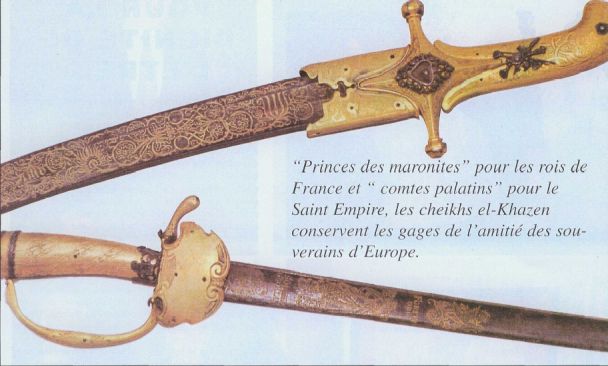
Origins of the "Prince of Maronite" Title
Growing diversity: the Khazin sheiks and the clergy in the first decades of the 18th century
Historical Members:
Barbar Beik El Khazen [English]
Patriach Toubia Kaiss El Khazen(Biography & Life Part1 Part2) (Arabic)
Patriach Youssef Dargham El Khazen (Cont'd)
Cheikh Bishara Jafal El Khazen
Patriarch Youssef Raji El Khazen
The Martyrs Cheikh Philippe & Cheikh Farid El Khazen
Cheikh Nawfal El Khazen (Consul De France)
Cheikh Hossun El Khazen (Consul De France)
Cheikh Abou-Nawfal El Khazen (Consul De France)
Cheikh Francis Abee Nader & his son Yousef
Cheikh Abou-Kanso El Khazen (Consul De France)
Cheikh Abou Nader El Khazen
Cheikh Chafic El Khazen
Cheikh Keserwan El Khazen
Cheikh Serhal El Khazen [English]
Cheikh Rafiq El Khazen [English]
Cheikh Hanna El Khazen
Cheikha Arzi El Khazen
Marie El Khazen