By PHILIP ISSA BEIRUT (AP) — Clashes erupted in a densely-packed Palestinian refugee camp in southern Lebanon on Tuesday, wounding at least …

Image Luis Vazquez
by -Dr Joseph A. Kechichian - Gulfnews
The Lebanese seldom trust each other, especially at the political level. And while the country is nominally a democracy, its unique power-sharing formula allocates influence to most communities in a more-or-less harmonious fashion. That’s the theory of the consociationalism mechanism that determines Maronite, Sunni and Shiite authority. In reality, the parliamentary democratic republic is hostage to itself, and while the 1989 Ta’if Accords, that suspended the 1975-1990 Civil War, removed the built-in majority previously enjoyed by Christians and brought parity between Christians and Muslims, the parliament’s 128 seats are all confessionally distributed.
Because of the country’s demographic make-up, each religious community has an allotted number of seats, even if candidates must receive a plurality of the total vote cast, which includes followers of all confessions. This deliberately-designed system is meant to minimise inter-sectarian competition and maximise cross-confessional cooperation. In other words, and while every candidate is theoretically opposed by a coreligionist [for example, two or more Sunnis competing over a Sunni seat must seek support from outside of their own faith in order to win], the process produces the mother-of all gerrymandering loads.
Over the years, multi-member constituencies emerged, which “secured” most of the 128 seats, irrespective the person who filled the post. In the Baabda-Aley district, for example, the predominantly Druze area of Aley (in the Chouf Mountains) were combined in 2000 with the predominantly Christian area of Baabda, into a single constituency. Likewise, while several seats in the South are allocated to Christians, they have to appeal to a predominantly Shiite electorate, which means the latter chose Christian parliamentarians.
Christian politicians have claimed that constituency boundaries were extensively gerrymandered in the elections of 1992, 1996, 2000, 2005 and 2009. They insisted that past rearrangements favoured the election of Shiites, for example, from Shiite-majority constituencies (where Hezbollah is strong and can prevent the opposition to challenge it), while allocating many Christian members to Muslim-majority districts.
by Daily star.com.lb BEIRUT: A General Security officer was sentenced to life in prison with hard labor on Wednesday for the murder …

This article represents author views -
By Josh Wood - The National
BEIRUT// Every day, the electronic messages of support filter in. "Happy Valentines day, we love you Donald J Trump (Mr strong President)", reads one. "Trump is my idol", says another. Such professions of adulation are not uncommon among Mr Trump’s fans, both before and after his shock win in the US presidential election. But these messages are not coming from those who voted for him, they’re coming from the Arab world — from Lebanon, posted to the Friends of Donald J Trump in Lebanon Facebook group. Just over a month into his presidency, Mr Trump’s relationship with the Middle East has had a rocky start. An offhand remark about how the US could get another chance to "take" Iraq’s oil, his cosying-up to Israel, the constant portrayals of refugees as likely terrorists and an attempt to ban citizens of seven predominantly Muslim countries from entering the US have set an adversarial tone for many in the region.
But in Lebanon, the controversial and outspoken president is finding friends. It is impossible to gauge how much support Mr Trump has here, but the Friends of Donald J Trump in Lebanon Facebook group has so far attracted more than 60,000 likes. For Christians made anxious by the demographic change in their country caused by the addition of more than a million mostly Sunni Syrian refugees in recent years, some find reassurance in Mr Trump’s statements about confronting Christian marginalisation. For those who want a Lebanon that is not ruled by lifetime politicians or a government compromised by corruption, Mr Trump’s outsider status and "drain the swamp" message resonates.
Those who oppose the continued domination of Lebanon by the Shiite party and Iran ally Hizbollah ae encouraged by the Trump administration’s promised tougher line on Tehran. And, paradoxically, supporters of Syrian strongman and Iran ally Bashar Al Assad see Mr Trump’s ambiguity on the Syrian civil war and his suggestions that Damascus, Moscow and Washington could work together as signs of a shifting tide. For some, support for Mr Trump is much more simplistic, and has nothing to do with the geopolitics of a Middle East complicated by war, or with marginalisation or corruption.
Population Movements to Keserwan - The Khazens and The Maans
ما جاء عن الثورة في المقاطعة الكسروانية
ثورة أهالي كسروان على المشايخ الخوازنة وأسبابها
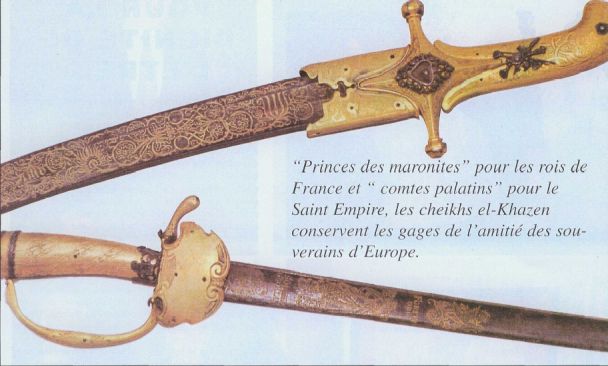
Origins of the "Prince of Maronite" Title
Growing diversity: the Khazin sheiks and the clergy in the first decades of the 18th century
Historical Members:
Barbar Beik El Khazen [English]
Patriach Toubia Kaiss El Khazen(Biography & Life Part1 Part2) (Arabic)
Patriach Youssef Dargham El Khazen (Cont'd)
Cheikh Bishara Jafal El Khazen
Patriarch Youssef Raji El Khazen
The Martyrs Cheikh Philippe & Cheikh Farid El Khazen
Cheikh Nawfal El Khazen (Consul De France)
Cheikh Hossun El Khazen (Consul De France)
Cheikh Abou-Nawfal El Khazen (Consul De France)
Cheikh Francis Abee Nader & his son Yousef
Cheikh Abou-Kanso El Khazen (Consul De France)
Cheikh Abou Nader El Khazen
Cheikh Chafic El Khazen
Cheikh Keserwan El Khazen
Cheikh Serhal El Khazen [English]
Cheikh Rafiq El Khazen [English]
Cheikh Hanna El Khazen
Cheikha Arzi El Khazen
Marie El Khazen