Published in NYT - Beirut: There was once a nice sea view at the Al Jazira beach club, and umbrellas of palm fronds sticking from the sand are reminders of nicer days. Nowadays, the place is surrounded by an ever-growing garbage dump. “It used to be a beach,” said Hassan, a Syrian man who works as a caretaker at the club and insisted on being identified only by his first name because of a lawsuit concerning the city. “There was sea. There were rocks. I used to fish.”
Just up the shoreline, Mohammad Jradi, who has been fishing the waters of the Mediterranean off Beirut for 20 years, said the trash had driven even the fish away. “All over the world, they have solutions for this, but not here,” he said. There is no end, it seems, to Lebanon’s trash crisis, a potent symbol of the dysfunctional, sect-based politics that define this tiny country. When trash piles built up across this city two years ago, enveloping Beirut in a nasty stench, they spawned a protest movement, called ‘You Stink,’ against the political class. Now, the latest episode of the crisis has become a uniquely Lebanese story, entwining bird migration, civil aviation, mysterious gunmen and the long story of Lebanon’s struggle to become a functioning state that can at least take care of its trash, more than 25 years after emerging from a long civil war.
Last year, as a Band-Aid solution to the garbage crisis, the municipality opened the Costa Brava landfill on the shoreline, not far from Beirut’s Rafic Hariri International Airport. And so for many visitors to Beirut, a city whose shabby-chic architecture, great cuisine and French colonial influences are otherwise enchanting, the first thing to greet them was a strong whiff of garbage.

BEIRUT (Reuters) - Lebanese President Michel Aoun said on Friday world powers must work with Damascus to create safe zones in Syria so refugees can return to their country. It was the first time the Beirut government had lent its support to such a plan. At least a million people have fled the Syrian civil war since 2011 into Lebanon, which has an estimated total population of less than six million. Lebanon would not force unsafe return on any refugees, but the international community must make their return possible, Aoun's office quoted him as saying in a meeting on Friday with U.N. High Commissioner for Refugees Filippo Grandi.
He said it was "important to achieve a political solution" to the conflict. Aoun is an ally of Lebanon's Hezbollah group which is fighting in Syria in support of President Bashar al-Assad. U.S. President Trump said last week he would "absolutely do safe zones in Syria" for refugees fleeing violence and that Europe had made a mistake by admitting millions of refugees.. According to a document seen by Reuters, Trump is expected to order the Pentagon and the State Department to craft such a plan, a move that could ratchet up U.S. military involvement in Syria.
The Syrian government said on Monday that any attempt to create so-called safe zones for refugees without coordinating with Damascus would be "unsafe" and violate Syria's sovereignty.
Rebel backers including Qatar have welcomed Trump's support for safe zones, and Turkey says it is waiting to see the outcome of the U.S. president's pledge.

By Pamela Engel - Business Insider
President Donald Trump reportedly issued a surprise warning to Israel on Thursday to stop announcing settlements that "undermine" his administration's efforts to create peace in the Middle East. A White House official told The Jerusalem Post that Trump is committed to a two-state solution to the Israel-Palestine conflict and that the White House was surprised by Israel's announcement of thousands of new settlement housing units in the West Bank.
"As President Trump has made clear, he is very interested in reaching a deal that would end the Israeli-Palestinian conflict and is currently exploring the best means of making progress toward that goal," the official reportedly said. "With that in mind, we urge all parties to refrain from taking unilateral actions that could undermine our ability to make progress, including settlement announcements. The administration needs to have the chance to fully consult with all parties on the way forward." The official, according to the report, also elaborated on the two-state solution Trump envisions. "The United States remains committed to advancing a comprehensive final-status agreement between Israel and the Palestinians that results in two states living side-by-side in peace and security," the official told the newspaper.
By Matt Hadro
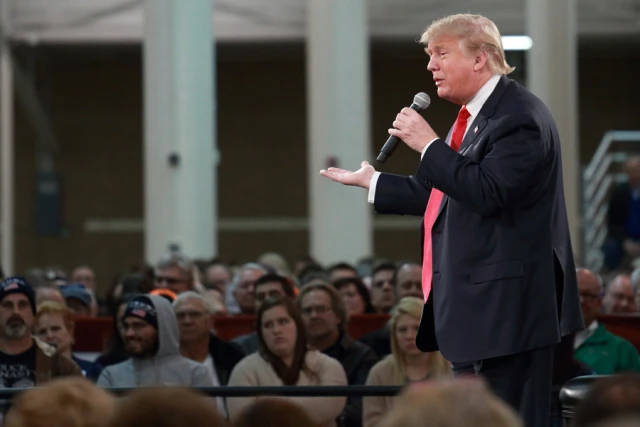
.- President Donald Trump on Thursday insisted that protecting religious freedom is a U.S. priority, while defending his recent halt of refugee admissions as a necessary step to protect that freedom. “Freedom of religion is a sacred right, but it is also a right under threat all around us, and the world is under serious, serious threat in so many different ways, and I’ve never seen it so much and so openly since I took the position of President,” President Trump stated at the National Prayer Breakfast on Thursday morning.
“There are those who would seek to enter our country for the purpose of spreading violence or oppressing other people based upon their faith or their lifestyle. Not right,” he said. “We will not allow a beachhead of intolerance to spread in our nation.” Last week, Trump ordered a halt to refugee admissions for 120 days – indefinitely for Syrian refugees – and a temporary ban on immigration from seven countries in the Middle East and Africa. The order was met with criticism from the U.S. bishops and humanitarian organizations.
On Thursday, the president spoke at the annual National Prayer Breakfast at the Washington Hilton Hotel, a tradition that dates back to 1953. Each year on the first Thursday of February, religious and civic leaders gather in prayer for the country. Vice President Mike Pence was in attendance as well as King Abdullah II of Jordan.
Michael Wear, former director of faith outreach for Obama 2012 campaign, said that according to a "trusted source," at least half a dozen people who were invited to the prayer breakfast were unable to attend due to the new travel restrictions. President Trump emphasized the global threat of religious violence, citing “acts of wanton slaughter against religious minorities,” and noting that “terrorism is a fundamental threat to religious freedom.”
“We have seen peace-loving Muslims, brutalized, victimized, murdered, and oppressed by ISIS killers. We have seen threats of extermination against the Jewish people,” he said. “We have seen a campaign of ISIS and genocide against Christians where they cut off heads.” He pledged to stop such violence and “to defend and protect religious liberty in our land,” insisting that Americans must live in “a tolerant society” where they “can feel safe and secure.” “In recent days, we have begun to take necessary action to achieve that goal,” he continued.

Population Movements to Keserwan - The Khazens and The Maans
ما جاء عن الثورة في المقاطعة الكسروانية
ثورة أهالي كسروان على المشايخ الخوازنة وأسبابها
Origins of the "Prince of Maronite" Title
Growing diversity: the Khazin sheiks and the clergy in the first decades of the 18th century
Historical Members:
Barbar Beik El Khazen [English]
Patriach Toubia Kaiss El Khazen(Biography & Life Part1 Part2) (Arabic)
Patriach Youssef Dargham El Khazen (Cont'd)
Cheikh Bishara Jafal El Khazen
Patriarch Youssef Raji El Khazen
The Martyrs Cheikh Philippe & Cheikh Farid El Khazen
Cheikh Nawfal El Khazen (Consul De France)
Cheikh Hossun El Khazen (Consul De France)
Cheikh Abou-Nawfal El Khazen (Consul De France)
Cheikh Francis Abee Nader & his son Yousef
Cheikh Abou-Kanso El Khazen (Consul De France)
Cheikh Abou Nader El Khazen
Cheikh Chafic El Khazen
Cheikh Keserwan El Khazen
Cheikh Serhal El Khazen [English]
Cheikh Rafiq El Khazen [English]
Cheikh Hanna El Khazen
Cheikha Arzi El Khazen
Marie El Khazen