While the Eastern Mediterranean is well known for its major (and underexploited) gas reserves, Lebanon is the latest country in the region to join the oil rush, after Egypt’s fitful entry into the market and Israel’s more straightforward path to exporter status. Seismic surveys in 2013 estimated Lebanon’s offshore fields to hold 96 trillion cubic feet of gas and 850 million barrels of oil. On January 27th, the government finally opened the bidding for five offshore blocks in a first licensing round, after a three-year delay brought upon by political instability.
The fractious Lebanese government hopes that these energy reserves and the wealth that should come with them will alleviate the country’s notorious power shortages and budget deficits. But, history is littered with examples of fragile countries going completely off the rails because of the warping effects oil has on their economies – will Lebanon follow suit or can Beirut dodge the resource curse? Michel Aoun, who was elected President at the end of October, after a grueling 29-month standoff, vowed to use the fund for the good of the Lebanese people, financing development projects and revamping ailing infrastructure. In this, his government wants to follow the example of developed economies that have the advantage of better governance and economic planning, greater regional security, and long-established transparency practices. However, even if Lebanon’s estimated reserves turn out to be as substantial and as profitable as its leaders predict, replicating that success won’t be an easy feat.
For the time being, the government is off to a good start. To send a message that it will handle the future proceeds from exploiting its reserves responsibly, Beirut is pushing a plan that would require all oil-generated proceeds be deposited into a national sovereign wealth fund (SWF), which emulates the path followed by Norway and more recently by Saudi Arabia. Norway, the country that manages the world’s largest wealth fund, sets the gold standard when it comes to transparency. The Norwegian Government Pension Fund Global (GPFG) publishes online details of every investment it makes to uphold its culture of political trust. As former fund supervisor Martin Skancke put it, the trust the fund enjoys comes down to “relatively high levels of equality and cultural homogeneity.” Even with unexpected bumper profits, Nordic frugality and trust in government meant the public has thus far been content to put hundreds of billions into the fund and let the money stay there.

(CNN)Syria's leader has praised Donald Trump's rhetoric on terror, saying the new US President's pledge to prioritize the fight against terrorism, including ISIS, was "promising." "Trump during the campaign and after the campaign is promising regarding the priority of fighting terrorists, and mainly ISIS, that's what we've been asking for during the last six years," Assad said. "It's still early to expect anything practical. It could be about the cooperation between the US and Russia, that we think is going to be positive for the rest of the world, including Syria." It's not the first time the Syrian leader has praised Trump. In an interview with state media agency, SANA, last December, Assad said the then President-elect would be a "natural ally" if he held fast to his hard line on terrorists.
tradearabia A bike-sharing station seen in downtown Beirut, Lebanon on February 7. According to the media office of Beirut Municipality which installed …

Source:The961 blog
A Daesh-linked Lebanese has been arrested yesterday. He is suspected of plotting to carry out a terrorist attack in downtown Beirut.The Solidere employee was recruited by Daesh to monitor surveillance cameras in downtown. A judicial source told The Daily Star Tuesday the suspect, identified by authorities as 26-year-old Sidon native Mustapha Safadi A judicial source, as well as authorities, identified the suspect as 26-year-old Sidon native Mustapha Safadi.
The Solidere employee monitored the construction firm’s security cameras that watch almost the entirety of Downtown Beirut. Many public institutions, major businesses, tourist attractions and homes of influential figures including Prime Minister Saad Hariri are based in the district. The Solidere employee was chosen due to his access to “sensitive information” because of his job. The family is known as a conservative working-class household. One of Safadi’s brothers works for an Islamic social institution while his sister works for an Islamic teaching organization.
Although the family has a reputation for being conservative, there is no indication that family members hold extremists views, except for one of Safadi’s brothers. Mustapha’s brother is reportedly in Syria fighting alongside Daesh. When Safadi’s brother in Syria found out he had married a Shiite woman, he branded him an apostate and refused to speak to him.
Population Movements to Keserwan - The Khazens and The Maans
ما جاء عن الثورة في المقاطعة الكسروانية
ثورة أهالي كسروان على المشايخ الخوازنة وأسبابها
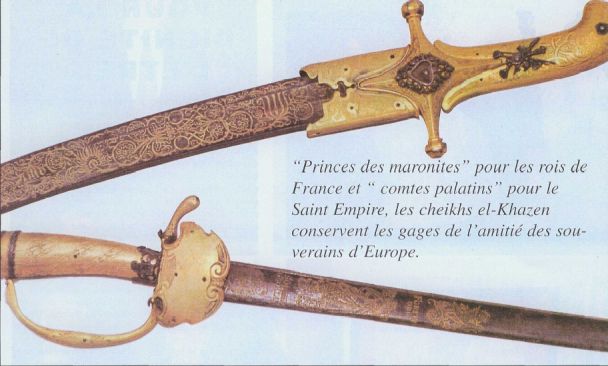
Origins of the "Prince of Maronite" Title
Growing diversity: the Khazin sheiks and the clergy in the first decades of the 18th century
Historical Members:
Barbar Beik El Khazen [English]
Patriach Toubia Kaiss El Khazen(Biography & Life Part1 Part2) (Arabic)
Patriach Youssef Dargham El Khazen (Cont'd)
Cheikh Bishara Jafal El Khazen
Patriarch Youssef Raji El Khazen
The Martyrs Cheikh Philippe & Cheikh Farid El Khazen
Cheikh Nawfal El Khazen (Consul De France)
Cheikh Hossun El Khazen (Consul De France)
Cheikh Abou-Nawfal El Khazen (Consul De France)
Cheikh Francis Abee Nader & his son Yousef
Cheikh Abou-Kanso El Khazen (Consul De France)
Cheikh Abou Nader El Khazen
Cheikh Chafic El Khazen
Cheikh Keserwan El Khazen
Cheikh Serhal El Khazen [English]
Cheikh Rafiq El Khazen [English]
Cheikh Hanna El Khazen
Cheikha Arzi El Khazen
Marie El Khazen