The Economist
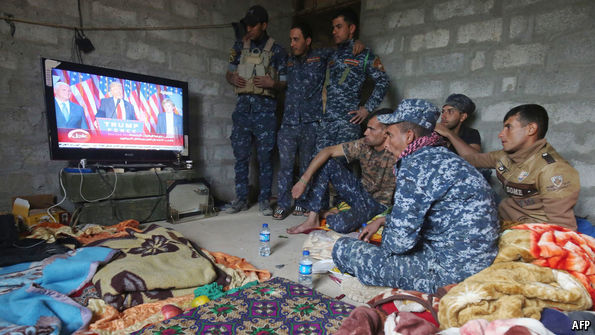
EXCEEDING all expectations,” was how Donald Trump described his luxury golf club in Dubai. If only his Middle East plans were as smooth as his putting greens. Far from marking a break with President Obama’s inclination to isolationism, Gulf rulers fear that President Trump could increase the distance. Instead of greater intervention, protection and the permanent troop presence in Iraq they hoped Mrs Clinton would deliver, they now fear Mr Trump will shy from long-standing Arab allies and abandon the region to others’ devices. “The honeymoon is over when it comes to relations with the US,” says a palace insider in Riyadh.
Maintaining a foothold, Mr Trump will probably let the Pentagon finish the job against Islamic State in Mosul if it has not fallen by January 20th. He might, he says, create safe zones in Syria, to prevent refugees from heading west. But unlike Mrs Clinton (though like Mr Obama) he opposes supplying more arms to Syria’s Sunni rebels or enforcing a no-fly zone to protect them. And he scorns intervention for ideological causes, such as regime-change, democracy and foreign nation-building, preferring to concentrate on America’s national self-interest instead. “I don’t think that was a very helpful thing,” he said of America’s overthrow of Saddam Hussein while on the campaign trail. “Iraq is a disaster right now.”
That is doubtless a relief for the region’s warring tyrants, like Bashar al-Assad in Syria, and strongmen, such as Abdel-Fattah al-Sisi in Egypt. In September Mr Trump promised Egypt’s president a “loyal friendship”, and unlike Mrs Clinton, did not bother him with talk of human rights. Both men not only endorse torture and the detention of dissidents, but also share a penchant for spreading conspiracy theories. Mr Sisi was one of the speediest world leaders to congratulate Mr Trump.
washington examiner The status of the Iran nuclear deal is uncertain after Donald Trump was elected president Tuesday night in a massive …

On the second day of his official visit to Lebanon, Zarif stressed after talks with Prime Minister Designate Saad Hariri at the Center House that "we are fully ready to cooperate with the brotherly Lebanese people and all its sects and components." He expressed to Hariri Tehran's "determination to cooperate and show openness towards Lebanon in all fields, during the current government's term as well as under the next government's term."
As for regional development, Zarif said he discussed with Hariri about various regional conflicts and pointed out the need to "reconcile political viewpoints among the various regional forces in order to find appropriate political solutions." Earlier in the day, Zarif met with caretaker Prime Minister Tammam Salam and called for a speedy formation of the new government. And, after meeting with Speaker Nabih Berri in Ain el-Tineh, the top Iranian diplomat described the speaker's role as "essential and constructive." "We support his national approach and we hope that the Lebanese government will be formed soon," he added. Zarif arrived in Lebanon for an official visit heading a prominent political and economic delegation, and has met with President Michel Aoun on Monday. Aoun was elected last week as Lebanon's 13th president, ending a presidential vacuum of around two and a half years which began with the end of former President Michel Suleiman's six-year tenure in May 2014.
Bzoummar #Khazen #LiveLoveLebanon




Population Movements to Keserwan - The Khazens and The Maans
ما جاء عن الثورة في المقاطعة الكسروانية
ثورة أهالي كسروان على المشايخ الخوازنة وأسبابها
Origins of the "Prince of Maronite" Title
Growing diversity: the Khazin sheiks and the clergy in the first decades of the 18th century
Historical Members:
Barbar Beik El Khazen [English]
Patriach Toubia Kaiss El Khazen(Biography & Life Part1 Part2) (Arabic)
Patriach Youssef Dargham El Khazen (Cont'd)
Cheikh Bishara Jafal El Khazen
Patriarch Youssef Raji El Khazen
The Martyrs Cheikh Philippe & Cheikh Farid El Khazen
Cheikh Nawfal El Khazen (Consul De France)
Cheikh Hossun El Khazen (Consul De France)
Cheikh Abou-Nawfal El Khazen (Consul De France)
Cheikh Francis Abee Nader & his son Yousef
Cheikh Abou-Kanso El Khazen (Consul De France)
Cheikh Abou Nader El Khazen
Cheikh Chafic El Khazen
Cheikh Keserwan El Khazen
Cheikh Serhal El Khazen [English]
Cheikh Rafiq El Khazen [English]
Cheikh Hanna El Khazen
Cheikha Arzi El Khazen
Marie El Khazen