By Brooke Anderson | Catholic News Service

AL-QAA, Lebanon — Boulos al-Ahmar had just driven the ambulance to the scene of the explosion when more bombs detonated, killing him. When Majed Wehbe heard the first explosions near his home, he ran to the scene to help, only to arrive in time for the next set of explosions.
These men died as heroes, unafraid to run toward disaster to help others, and their Christian village wants to honor their memory by shunning the fear these explosions were designed to instill. The Lebanese frontier village is mourning the loss of five residents to a series of explosions in late June. But within two weeks, the people were showing their determination to bring back life.
"We will continue to have culture, activities and late-night celebrations. We're not just going to survive. We're going to live our lives," said Bashir Mattar, the mayor of al-Qaa, a village of about 15,000, predominantly Melkite Catholic, with some Maronite Catholic and Orthodox. They share the village with nearly 30,000 Syrian refugees who have fled war in their country, about three miles away.

By RFI
French Foreign Affairs Minister Jean-Marc Ayrault told Lebanon's rival politicians to come to an agreement on a new president after two years of stalemate. On a two-day visit to the country he promised that France would maintain its troops in the UN peacekeeping force on the border with Israel.
"A solution must be found and it is up to the Lebanese political parties to find a way to compromise," Ayrault said on Monday. Divisions among Lebanon's Christian, Sunni-Muslim, Shia-Muslim and Druze leaders have prevented decision on a president since May 2014, when Michel Sleiman's mandate expired, and parliament has extended its own mandate twice since 2009. With 1.1 million refugees from the Syrian war on its soil, the tiny country's institutions are under stress.
Its government is split between a bloc led by the Shia movement Hezbollah, which has sent fighters to support Syrian President Bashar al-Assad, and one led by former prime minister Saad Hariri, of the 14 March movement, which is hostile to Syria.

By Michel Abu-Najm: english.aawsat.com
Paris- French Foreign Minister Jean-Marc Ayrault is scheduled to visit Beirut next Monday to compel Lebanese officials into ending the country’s political crisis by electing a new president.
The minister, who is set to make a two-day official visit to Beirut, “does not carry new ideas,” foreign ministry sources said. However, he has the ability “to talk to everyone” inside Lebanon and abroad.
Paris believes that “complications” in Lebanon should not be a reason for an end to French diplomatic action towards the presidential crisis. On the contrary, French authorities believe there is an urgent need to “mobilize their efforts” to end Lebanon’s deadlock. Yet, they have admitted that France “does not have the magic wand” to resolve Lebanon’s political crisis.
French diplomatic sources said that Ayrault, who has lately discussed the Lebanese file with his Iranian counterpart Mohammed Javad Zarif and Saudi Deputy Crown Mohammed bin Salman, in separate meetings held in Paris, has come out with the impression that the two sides do not object to a political settlement in Lebanon.
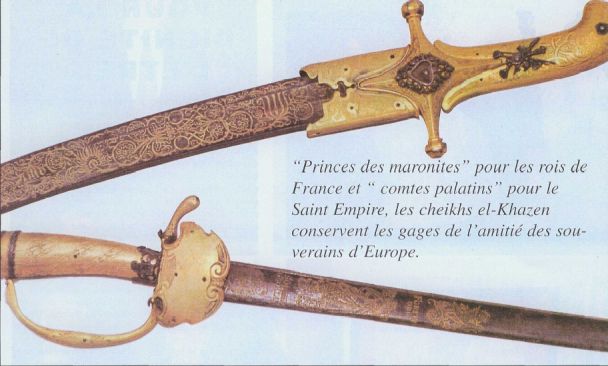
Population Movements to Keserwan - The Khazens and The Maans
ما جاء عن الثورة في المقاطعة الكسروانية
ثورة أهالي كسروان على المشايخ الخوازنة وأسبابها
Origins of the "Prince of Maronite" Title
Growing diversity: the Khazin sheiks and the clergy in the first decades of the 18th century
Historical Members:
Barbar Beik El Khazen [English]
Patriach Toubia Kaiss El Khazen(Biography & Life Part1 Part2) (Arabic)
Patriach Youssef Dargham El Khazen (Cont'd)
Cheikh Bishara Jafal El Khazen
Patriarch Youssef Raji El Khazen
The Martyrs Cheikh Philippe & Cheikh Farid El Khazen
Cheikh Nawfal El Khazen (Consul De France)
Cheikh Hossun El Khazen (Consul De France)
Cheikh Abou-Nawfal El Khazen (Consul De France)
Cheikh Francis Abee Nader & his son Yousef
Cheikh Abou-Kanso El Khazen (Consul De France)
Cheikh Abou Nader El Khazen
Cheikh Chafic El Khazen
Cheikh Keserwan El Khazen
Cheikh Serhal El Khazen [English]
Cheikh Rafiq El Khazen [English]
Cheikh Hanna El Khazen
Cheikha Arzi El Khazen
Marie El Khazen