By
For 34 days in the summer of 2006, the world’s attention turned to Lebanon, where a bloody war erupted between the country’s militant group Hezbollah and longtime enemy Israel. But for Habib Haddad, who was hundreds of miles away from family at the University of Southern California, searching for local-language updates was almost impossible because he did not have access to an Arabic keyboard. Enter Yamli, the online transliteration service he invented that allows searches in Arabic using phonetic English.
When, in 2012, Yahoo acquired the company’s licensing rights, Haddad joined the ranks of an impressive group of industrious Lebanese entrepreneurs who have dominated multiple global companies across industries — telecoms, logistics, automobiles. In total, the 35-year-old Haddad has been involved as an engineer, angel investor or founder in no fewer than 10 companies in the Middle East. “Things that don’t work excite me,” says Haddad, speaking over the phone from Beirut. “It’s the same reason I live in Lebanon. A lot of things are broken in this country.”

by Vivian Haddad
Beirut-Under the sponsorship of the United Nations in Beirut, singer Tania Kassis has launched a new song called “Al-Ard lel Jamii” (Land for All). The event was hosted by ABC Ashrafieh Mall and was attended by a number of ambassadors, politicians, and media figures.
A chorus of 100 vocalists from four musical bands participated in this song, which speaks about the land of peace, that all people dream about and that it can be reached through unity and love.
Speaking during the event, Kassis pointed that the song is a peace appeal from Lebanon to the world in the midst of disappointment and frustration that control today’s generation.
She said that she wanted this appeal to be universal and to address the frustrated youth that is concerned about its future as a result of the terrorist attacks worldwide. “Land for All”, which will be sang by Kassis on July 9 at the United Nations headquarters in Geneva, is composed by Fadi al-Rai and distributed by Michel Fadel. The song is taken from the international music “Vorto Carmina Burana” mixed with an eastern rhythm. The song has been played by Kiev Orchestra led by Maestro Vladimir Cerinco.

By Roberto de Mattei
rorate-caeli.blogspot.com
The British referendum of June 23rd (Brexit) has sanctioned the definitive collapse of a myth: the dream of “a “Europe without frontiers”, built on the ruins of its national States.
The “Constitution” project worked on by the Convention on the Future of Europe between 2002 and 2005, was rejected by two popular referendums, in France on May 29th 2005 and in Holland on June 1st of the same year. Nevertheless, the Eurocrats never gave up. After two years of “reflection”, the Lisbon Treaty, which should have been ratified exclusively through parliament, was approved by the EU Heads of State and Government on December 13th 2007. The only country called upon to voice their opinion on the referendum, Ireland, rejected the Treaty on June 13th 2008, but unanimity being necessary from the signatory States, a new referendum was imposed on the Irish, which thanks to very strong economic and media pressure, finally gave the positive result.

By Phyllis Chesler
Before dawn Monday, four suicide bombers killed five and wounded at least a dozen in the Lebanese Christian town of al-Qaa. Later that night, as townspeople prepared to bury their dead, four more suicide bombers hit.
The attacks underscored just how endangered are Christians who live in today’s Muslim world. As the United States debates how many Mideast refugees to accept and who should get priority, the answer is staring us in the face: Those most in need of refuge are Christians and Yazidis who live among Muslims.
On June 19, a suicide bomber killed three people as he detonated himself at a memorial to massacred Christians in Qumishi, Syria. On June 9, a Pakistani Muslim mob badly beat a man merely because he was a Christian. On June 5, two people were killed when Islamists targeted a church with rockets in Syria; the same day, a Christian man was hacked to death at his shop by Islamists in Bangladesh. On June 2, in Nigeria, Muslim youths beheaded a Christian woman for allegedly insulting Mohammed.
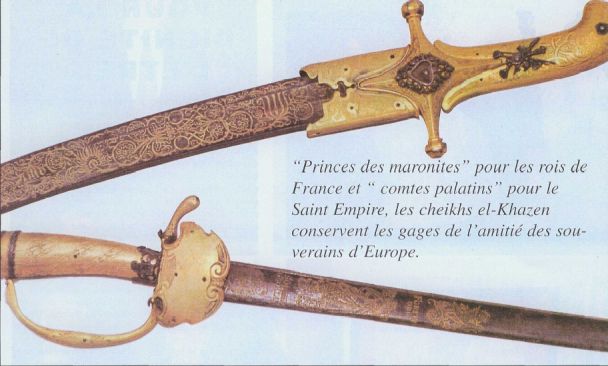
Population Movements to Keserwan - The Khazens and The Maans
ما جاء عن الثورة في المقاطعة الكسروانية
ثورة أهالي كسروان على المشايخ الخوازنة وأسبابها
Origins of the "Prince of Maronite" Title
Growing diversity: the Khazin sheiks and the clergy in the first decades of the 18th century
Historical Members:
Barbar Beik El Khazen [English]
Patriach Toubia Kaiss El Khazen(Biography & Life Part1 Part2) (Arabic)
Patriach Youssef Dargham El Khazen (Cont'd)
Cheikh Bishara Jafal El Khazen
Patriarch Youssef Raji El Khazen
The Martyrs Cheikh Philippe & Cheikh Farid El Khazen
Cheikh Nawfal El Khazen (Consul De France)
Cheikh Hossun El Khazen (Consul De France)
Cheikh Abou-Nawfal El Khazen (Consul De France)
Cheikh Francis Abee Nader & his son Yousef
Cheikh Abou-Kanso El Khazen (Consul De France)
Cheikh Abou Nader El Khazen
Cheikh Chafic El Khazen
Cheikh Keserwan El Khazen
Cheikh Serhal El Khazen [English]
Cheikh Rafiq El Khazen [English]
Cheikh Hanna El Khazen
Cheikha Arzi El Khazen
Marie El Khazen