By Theguardian.com
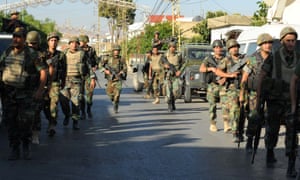
The Lebanese government has warned of a heightened terrorist threat after eight suicide bombers attacked a Christian village on the border with Syria, in the latest spillover of its conflict into Lebanon.
The village of al-Qaa was targeted on Monday in two waves of suicide attacks that killed five people. The first group of bombers attacked before dawn and the second later at night, two of them blowing themselves up near a church. Security officials believe Islamic State militants were behind the attack. There has been no claim of responsibility.
In reference to the number of assailants, the Lebanese government said the attack and the unfamiliar way it was carried out represented a new phase of “confrontation between the Lebanese state and evil terrorism”. The prime minister, Tammam Salam, “expressed his fear that what happened in Qaa is the start of a new wave of terrorist operations in different areas of Lebanon”, the information minister, Ramzi Jreij, said in televised comments after a cabinet meeting.

By Mona Helmi - english.aawsat.com
Tripoli has been linked over the past years with conservative movements and many extremist cells that were dismantled in northern regions like Akkar and Daniye. The Islamic scene in the city has long been influenced by the local complicated politics and the adversity toward al-Assad regime, which led to many terroristic attacks against the so-called Hezbollah that supports Assad’s troops in Syria.
Speaking about the conservative Islamic movements in Lebanon, Dr. Abdul Ghani Imad, expert in Islamic movements’ affairs explains that Sheikh Salem al-Shahhal established the first conservative Islamic group during the forties. His movement was missionary and aimed to amend the wrong practices of Muslims. On the political side, Shahhal didn’t have a clear position. He stood for the parliamentary elections in 1972, but he withdrew in favor of the “Jamaa Islamiya” (Islamic Group).
Many other extremist schools emerged in the region, like the school of Salem el-Rafei, who was among the first voices calling for “Jihad” in Syria, Bilal Dekmak , Sheikh Nabil Raheem or Sheikh Mohammad Khidr, along with radical Islamic movements like “Al-Tawhid” (Islamic Unification Movement) established by Sheikh Saeed Shaaban.

By sarah el deeb, associated press
A prominent dual British-Lebanese journalist who hosted a talk show critical of the government of Egyptian President Abdel-Fattah el-Sissi arrived in Beirut on Tuesday after authorities in Cairo briefly detained her and then deported her, her lawyer said.
Lilian Daoud, a former BBC reporter, could not immediately be reached for comment. Her lawyer, Zyad el-Elaimy, wrote on his Twitter account that her first comment after landing in Beirut was that she will challenge the decision to deport her.
There was no formal explanation for Daoud's deportation from Egypt. An Egyptian security official, speaking Monday on condition of anonymity because he was not authorized to speak to reporters, said Daoud's residency permit expired after her contract with the private ONTV station in Egypt was terminated.
"It's the first time someone is deported in this fashion in Egypt," el-Elaimy told The Associated Press, speaking by telephone from Cairo. He said even criminals are asked to leave, not taken from their homes.

BEIRUT (AP) — Lebanese troops detained 103 Syrians for illegal entry into the country in a security sweep Tuesday, a day after a series of deadly bombings struck a village near the Syrian border, the military said.
The government warned of a mounting challenge in tiny Lebanon, which abuts the war-torn Syria, underlining the magnitude of Monday's attack that saw nine bombings, eight of them from suicide attackers, strike in the small Christian village of Qaa, killing five people.
"The attack on the Lebanese national security and the unfamiliar manner in which it was executed usher in a new kind of phase in the state's confrontation with the dark forces of terrorism," a Cabinet statement said.
The bombings triggered fear and panic among Qaa's residents and a deepening sense of foreboding in Lebanon, which has grappled for over five years with spillovers from Syria's civil war.




Population Movements to Keserwan - The Khazens and The Maans
ما جاء عن الثورة في المقاطعة الكسروانية
ثورة أهالي كسروان على المشايخ الخوازنة وأسبابها
Origins of the "Prince of Maronite" Title
Growing diversity: the Khazin sheiks and the clergy in the first decades of the 18th century
Historical Members:
Barbar Beik El Khazen [English]
Patriach Toubia Kaiss El Khazen(Biography & Life Part1 Part2) (Arabic)
Patriach Youssef Dargham El Khazen (Cont'd)
Cheikh Bishara Jafal El Khazen
Patriarch Youssef Raji El Khazen
The Martyrs Cheikh Philippe & Cheikh Farid El Khazen
Cheikh Nawfal El Khazen (Consul De France)
Cheikh Hossun El Khazen (Consul De France)
Cheikh Abou-Nawfal El Khazen (Consul De France)
Cheikh Francis Abee Nader & his son Yousef
Cheikh Abou-Kanso El Khazen (Consul De France)
Cheikh Abou Nader El Khazen
Cheikh Chafic El Khazen
Cheikh Keserwan El Khazen
Cheikh Serhal El Khazen [English]
Cheikh Rafiq El Khazen [English]
Cheikh Hanna El Khazen
Cheikha Arzi El Khazen
Marie El Khazen