Reuters, The Lebanese army said on Wednesday its naval forces returned to shore a boat carrying 53 people trying to leave the country illegally from the northern coastal city of Tripoli. More than half the people returned were Palestinians, as well as 14 Syrians and eight Lebanese. "There were 53 people on a boat that fits 15 people. The boat has been returned - with all people on board - to the Lebanese shore and an investigation has been opened," the army said in a statement.
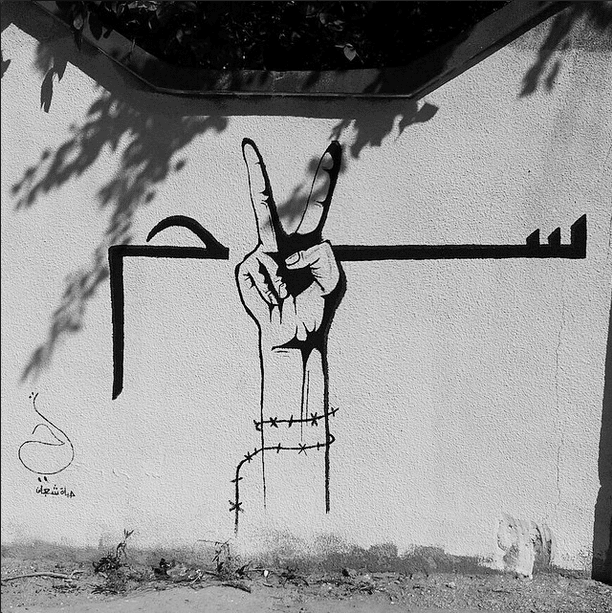
By Christine Petré wagingnonviolence.org . A black-and-white mural with the text “Salam,” peace in Arabic, with a hand wrapped in barbed wire making the peace sign, covers a wall in one of Tripoli’s more troubled areas. Its artist, Hayat Chaaban, who has lived in Lebanon’s second largest city her whole life wants to put art to the battered facades of Tripoli and defy the violence. By doing so she is not only challenging the city’s rough reputation, but also the perception that graffiti is a male-oriented activity.

AFP Washington: A day trip to a crowded State Department office full of unfamiliar faces and smells might have upset some dogs, but then Astra’s day job is itself pretty terrifying.
The seven-year-old German Shepherd mine-clearance expert ignored the defused weaponry arrayed on the conference table, but perked up when a box of donuts was opened.
Over the past five years she and her handler, Lebanese army sergeant Ahmad Solh, have scoured the battlefields of Lebanon for land-mines and unexploded bombs.
Named by anti-landmine group the Marshall Legacy Institute as the champion mine-clearers of the year, they came to the US capital to promote their work.

International Business Times
TRIPOLI, Lebanon -- For the first time in her three short years, Hanan didn’t wake up in a country at war. The night before, on Saturday evening, Hanan’s parents bundled her up to execute their escape from the ruins of Aleppo in northwestern Syria. The little girl took only what she considered essentials: white, gemstone-encrusted shoes, earphones and purple polka-dotted sunglasses. By the morning, she was listening to music with her parents, sitting at a pink plastic table at a makeshift cafe outside the port in Lebanon’s second city, Tripoli.
Many Syrians have fled war-torn cities before them. But unlike the 1.7 million Syrians who have settled in for a long stay in Lebanon, Hanan’s family is just stopping in Tripoli for one day before joining the mass exodus of refugees taking ferry boats to Turkey, hoping to reach northern Europe.
Since January, more than 640,000 refugees and migrants have arrived in Europe, more than half of whom are Syrians “moving from host countries in the region or from Syria transiting through host countries in the region,” with a “spike” in refugees coming from Syria directly, according to the United Nations High Commissioner for Refugees.




Population Movements to Keserwan - The Khazens and The Maans
ما جاء عن الثورة في المقاطعة الكسروانية
ثورة أهالي كسروان على المشايخ الخوازنة وأسبابها
Origins of the "Prince of Maronite" Title
Growing diversity: the Khazin sheiks and the clergy in the first decades of the 18th century
Historical Members:
Barbar Beik El Khazen [English]
Patriach Toubia Kaiss El Khazen(Biography & Life Part1 Part2) (Arabic)
Patriach Youssef Dargham El Khazen (Cont'd)
Cheikh Bishara Jafal El Khazen
Patriarch Youssef Raji El Khazen
The Martyrs Cheikh Philippe & Cheikh Farid El Khazen
Cheikh Nawfal El Khazen (Consul De France)
Cheikh Hossun El Khazen (Consul De France)
Cheikh Abou-Nawfal El Khazen (Consul De France)
Cheikh Francis Abee Nader & his son Yousef
Cheikh Abou-Kanso El Khazen (Consul De France)
Cheikh Abou Nader El Khazen
Cheikh Chafic El Khazen
Cheikh Keserwan El Khazen
Cheikh Serhal El Khazen [English]
Cheikh Rafiq El Khazen [English]
Cheikh Hanna El Khazen
Cheikha Arzi El Khazen
Marie El Khazen