Residents young and old gathered to inaugurate a new park in Beirut’s southern suburb of Shiyah Wednesday evening. The gated …
The U.S. Embassy in Beirut has denied reports circulated by some newspapers on Thursday morning regarding Washington’s stance on the presidential …
By , Staff writer / May 28, 2014
Clinching months of tactical victories for the Syrian regime, next week's presidential election kicks off today with advance voting for Syrians living overseas.
Leading the ballot is President Bashar al-Assad, who has led the country through a three-year civil war that has killed an estimated 160,000 people, caused an exodus of 3 million, and displaced internally many more.
The official election date is June 3. International observers have criticized the vote as illegitimate and impossible to hold during a civil war, The New York Times reports.
Mr. Assad is seeking a third seven-year term after taking over from his father, Hafez, in 2000. Neither of his little-known opponents, Hassan el-Nuri and Maher al-Najjar, is considered to have any chance of winning. The United States and the Syrian opposition have dismissed the election as a sham which, analysts said, is apparently intended to impart a sense of legitimacy to a government that tolerated no real dissent before the uprising and has cracked down unrelentingly on its opponents since the first stirrings of revolt in March 2011.
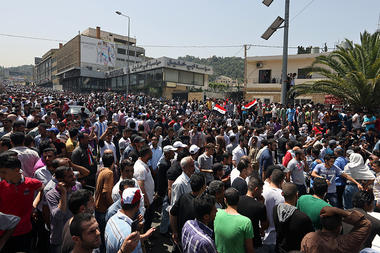
That hasn’t slowed the momentum. Today thousands of Syrian exiles in Lebanon jammed the streets outside the Syrian embassy in Beirut to cast their ballot on the first day of expatriate voting. Most of those gathered said they were voting for Assad. “My blood type is Bashar,” Ahmed al-Ali, a restaurant worker from Aleppo told the Times. “I eat bread Bashar brings to Syria. Every country has mistakes.
By , Staff writer / May 28, 2014
Clinching months of tactical victories for the Syrian regime, next week's presidential election kicks off today with advance voting for Syrians living overseas.
Leading the ballot is President Bashar al-Assad, who has led the country through a three-year civil war that has killed an estimated 160,000 people, caused an exodus of 3 million, and displaced internally many more.
The official election date is June 3. International observers have criticized the vote as illegitimate and impossible to hold during a civil war, The New York Times reports.
Mr. Assad is seeking a third seven-year term after taking over from his father, Hafez, in 2000. Neither of his little-known opponents, Hassan el-Nuri and Maher al-Najjar, is considered to have any chance of winning. The United States and the Syrian opposition have dismissed the election as a sham which, analysts said, is apparently intended to impart a sense of legitimacy to a government that tolerated no real dissent before the uprising and has cracked down unrelentingly on its opponents since the first stirrings of revolt in March 2011.
That hasn’t slowed the momentum. Today thousands of Syrian exiles in Lebanon jammed the streets outside the Syrian embassy in Beirut to cast their ballot on the first day of expatriate voting. Most of those gathered said they were voting for Assad. “My blood type is Bashar,” Ahmed al-Ali, a restaurant worker from Aleppo told the Times. “I eat bread Bashar brings to Syria. Every country has mistakes.

Population Movements to Keserwan - The Khazens and The Maans
ما جاء عن الثورة في المقاطعة الكسروانية
ثورة أهالي كسروان على المشايخ الخوازنة وأسبابها
Origins of the "Prince of Maronite" Title
Growing diversity: the Khazin sheiks and the clergy in the first decades of the 18th century
Historical Members:
Barbar Beik El Khazen [English]
Patriach Toubia Kaiss El Khazen(Biography & Life Part1 Part2) (Arabic)
Patriach Youssef Dargham El Khazen (Cont'd)
Cheikh Bishara Jafal El Khazen
Patriarch Youssef Raji El Khazen
The Martyrs Cheikh Philippe & Cheikh Farid El Khazen
Cheikh Nawfal El Khazen (Consul De France)
Cheikh Hossun El Khazen (Consul De France)
Cheikh Abou-Nawfal El Khazen (Consul De France)
Cheikh Francis Abee Nader & his son Yousef
Cheikh Abou-Kanso El Khazen (Consul De France)
Cheikh Abou Nader El Khazen
Cheikh Chafic El Khazen
Cheikh Keserwan El Khazen
Cheikh Serhal El Khazen [English]
Cheikh Rafiq El Khazen [English]
Cheikh Hanna El Khazen
Cheikha Arzi El Khazen
Marie El Khazen