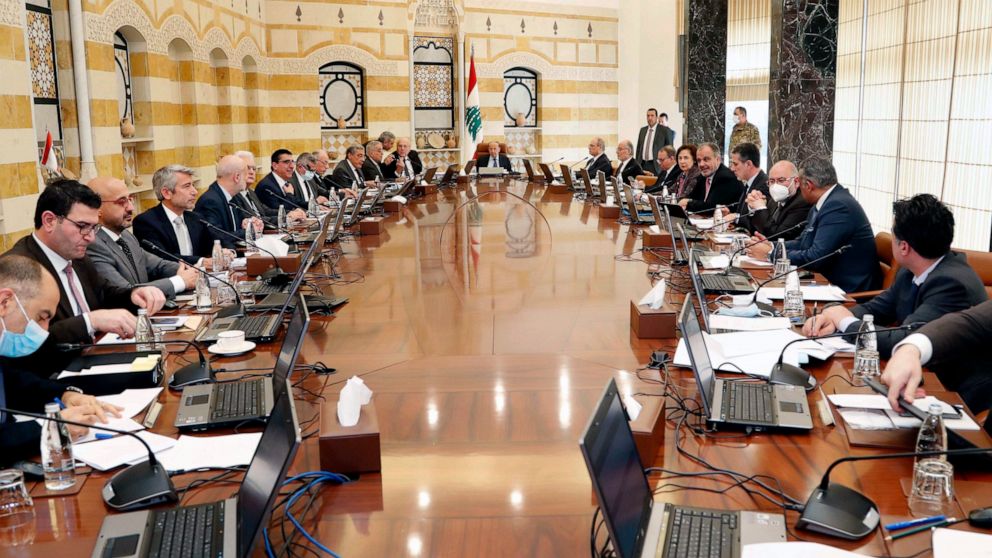
By Najia Houssari -- arabnews.com -- BEIRUT: A Cabinet meeting was convened on Saturday to address judicial actions against seven banks in Lebanon. The meeting conducted a review of the conflict between banks and the judiciary. The extraordinary session was held under the title “The higher interest of the state.” The Cabinet concluded with Mikati affirming that the council of ministers had agreed that the law would take its course based on the principle of cooperation between the authorities without any discrimination or discretion. It also agreed that judicial matters would be resolved according to laws by the staff of the judicial authority. A ministerial source who took part in the session told Arab News that the ministers saw that it was not allowed for judges to use depositors’ money to achieve a certain populism. The judge should not be a populist and tweet on Twitter, some ministers reportedly felt. “The banks are indeed mistaken and there is indeed a major crisis, but it should be addressed in a balanced and non-random manner,” they suggested. In response to what it described as a “judicial attack on banks,” the Association of Banks has called for the issuance of the capital control law as soon as possible.
In addition to the strike, the association warned that it might “take other steps that may be necessary to preserve the national economy and the supreme Lebanese interest.” The decision on a set of lawsuits filed by activist groups against some major banks in Lebanon to recover depositors’ money coincided with investigations on charges against the central bank governor on suspicion of illegal enrichment and money laundering. The judicial procedures resulted in the execution of the seizure of Fransabank’s assets, shares, and real estate and of the Creditbank and the branches of Blom Bank in Tripoli. The Association of Depositors indicated its intention “to file more executive lawsuits against banks in the coming days.”
In a related development, the brother of Central Bak Gov. Raja Salameh, was arrested by the appeal public prosecutor in Mount Lebanon, Ghada Aoun, after he appeared before her as a witness. Salameh’s attorney, Marwan Issa El-Khoury, said the allegations of “illicit enrichment and money laundering” were unfounded and the case was “media speculation without any evidence.” The governor of the central bank had refrained from coming to Judge Aoun’s office more than a week ago as a witness, as he had filed a lawsuit to respond to Judge Aoun about the case in which he was investigated. Aoun has also issued a travel ban against Salameh. She said that the possibility of the political authority putting pressure on the judiciary was an “unacceptable attack on judges who perform their professional duty, if some people did not like this or that prosecution.”
khazen.org offers its condolences to the Mecattaf family – BEIRUT — Michel Mecattaf, CEO of Mecattaf company, specializing in foreign exchange transactions …
Lawyer for Lebanon’s Raja Salameh, brother of Central Bank governor, says evidence in case against him is “media speculation without any evidence“-statement. …
by reuters -- BEIRUT — Raja Salameh, the brother of the head of Lebanon’s central bank, was arrested on Thursday following his interrogation at a court house east of Beirut, judge Ghada Aoun told Reuters. A judicial source separately said that Aoun had charged Salameh with “complicity in illicit enrichment” that also involved his brother, central bank governor Riad Salameh. Riad Salameh has not been charged with a crime and has denied all accusations against him. He did not immediately respond to a request for comment. Reuters could not immediately reach legal representatives for his brother for comment.
by arabnews.com -- Najia Houssari -- BEIRUT: A Lebanese judge has issued a travel ban against Creditbank Chairman Tarek Khalife and frozen the bank’s assets, including properties and vehicles, as part of an investigation into alleged money laundering. Mount Lebanon Public Prosecutor Judge Ghada Aoun issued the order after activists filed a lawsuit against several Lebanese banks. Creditbank is the sixth lender Aoun has taken action against after Bank of Beirut, SGBL, Bankmed, Bank Audi and Blom Bank. It is the second judicial measure taken within 24 hours against banks in Lebanon.
Earlier, Judge Miriana Anani, head of the Enforcement Department in Beirut, seized all the shares, properties and assets of one of Lebanon’s largest banks, Fransabank. The assets will be auctioned if the bank fails to return a deposit belonging to Ayad Garbawy Ibrahim, an Egyptian national who is among hundreds of depositors unable to access his funds at Fransabank. Ibrahim is taking legal action against the bank to recover the $35,000 he claims is owing. Judge Aoun on Thursday also issued an arrest warrant for Raja Salameh, brother of the governor of the central bank, Riad Salameh, following an investigation. The Pioneers of Truth activist group said that Salameh had been arrested on the basis of a complaint it filed 10 days ago accusing him of money laundering through fake companies.
The judicial proceedings have angered the banking sector, and the Association of Banks is expected to discuss strike action at a general assembly on Friday. Prime Minister Najib Mikati described the judges’ decisions as “arbitrary and irrational judicial proceedings.” “With all due respect to the judiciary, there is a general impression that some of what is happening does not conform with the judicial norms,” he said. “The rights of depositors are our priority. However, the exaggerated way through which the judicial rights and issues related to banks are being tackled is dangerous and could undermine the remaining confidence in the banking system.” Mikati said: “The depositors will, once again, pay the price, and I am afraid things will escalate if defects are not addressed.”




Population Movements to Keserwan - The Khazens and The Maans
ما جاء عن الثورة في المقاطعة الكسروانية
ثورة أهالي كسروان على المشايخ الخوازنة وأسبابها
Origins of the "Prince of Maronite" Title
Growing diversity: the Khazin sheiks and the clergy in the first decades of the 18th century
Historical Members:
Barbar Beik El Khazen [English]
Patriach Toubia Kaiss El Khazen(Biography & Life Part1 Part2) (Arabic)
Patriach Youssef Dargham El Khazen (Cont'd)
Cheikh Bishara Jafal El Khazen
Patriarch Youssef Raji El Khazen
The Martyrs Cheikh Philippe & Cheikh Farid El Khazen
Cheikh Nawfal El Khazen (Consul De France)
Cheikh Hossun El Khazen (Consul De France)
Cheikh Abou-Nawfal El Khazen (Consul De France)
Cheikh Francis Abee Nader & his son Yousef
Cheikh Abou-Kanso El Khazen (Consul De France)
Cheikh Abou Nader El Khazen
Cheikh Chafic El Khazen
Cheikh Keserwan El Khazen
Cheikh Serhal El Khazen [English]
Cheikh Rafiq El Khazen [English]
Cheikh Hanna El Khazen
Cheikha Arzi El Khazen
Marie El Khazen