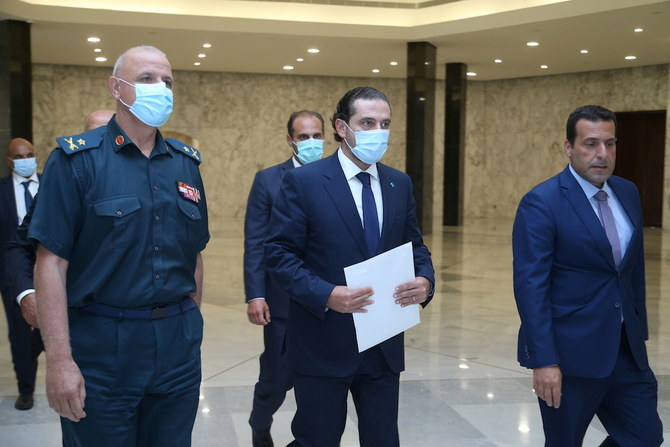
By NAJIA HOUSSARI MOHAMMED ABU ZAID -- arabnews.com -- BEIRUT, CAIRO: After he presented a 24-minister cabinet lineup to Lebanon President Michel Aoun on Wednesday, prime minister-designate Saad Al-Hariri is expected to either step down or go on with his mission. If the proposal is approved, it could end a political stalemate that has pushed the country toward social and economic collapse for the past nine months. If Aoun does not approve, Hariri has vowed to resign. “Now is the moment of truth,” Hariri told reporters after delivering the proposal to the presidential palace in Beirut. “This cabinet can help the country rise again and put an end to the collapse,” Hariri, who was designated in October, said he was expecting Aoun’s response on Thursday and he “will be making his decision accordingly.” The proposal does not give a blocking third to any political side and came after French Presidential Envoy Patrick Durel and Mahmoud Mohieldin, the executive director of the International Monetary Fund (IMF), renewed pressure on Lebanese officials to form a government.
Lebanon has been without a functioning government since the previous one resigned in the wake of the Aug. 4 Beirut port blast that claimed the lives of 215 people, injured 6,000 more, and destroyed Beirut’s waterfront along with large sections of neighboring residential areas. Hariri presented his cabinet proposal to Aoun during a 30-minute meeting at the presidential palace, and according to a source close to Hariri, “the proposal for a cabinet includes new names.” Hariri presented his proposal to Aoun after he made a brief visit to Cairo on Wednesday where he met with Egyptian President Abdel Fattah El-Sisi. Sources in Cairo said Egypt had promised economic and political support for a new government and that a delegation would travel to Beirut soon. El-Sisi stressed “Egypt’s support for Hariri’s path aimed at restoring stability in Lebanon, addressing current challenges, and for his attempts to form a government … Lebanon must put national interests above any other interests, thus preserving the capacities of the brotherly Lebanese people and its national unity.” Hariri also held talks with Egypt’s Foreign Minister Sameh Shoukry.
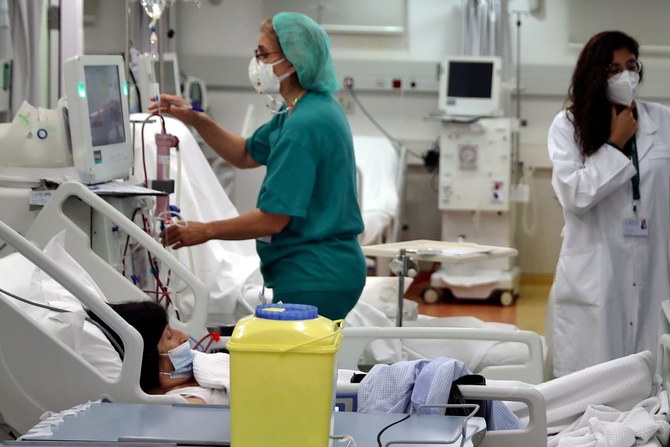
By GEORGI AZAR -- arabnews.com -- DUBAI: Two public hospitals in Lebanon have threatened to shut their doors from Thursday, July 15, if officials fail to disburse urgently needed supplies, funds and materials as the healthcare sector inches closer toward a collapse. Lebanon has been hit with an unprecedented financial, economic, and monetary crisis that has wiped out life savings coupled with a crippling liquidity crunch. Shahar Gharbi Governmental Hospital, located in the heart of Aley district, announced Tuesday that it would stop receiving patients as of Thursday. “We’re facing crisis after crisis. Fuel shortages, medicine shortages and unsustainable wages,” Nawal Al Hasaniya, a member of the hospital’s secretary administration, told Arab News.
The health sector, as with virtually all other sectors across the country, has been reeling under the burden of the country’s severe financial crisis, prompting medical practitioners to repeatedly sound the alarm. The national currency has lost more than 91 percent of its value since October 2019, causing the value of the minimum wage to plummet to around $35 per month. At Sibline Government Hospital on the southern outskirts of Beirut, managing doctor Ali Al Barraj echoed Hasaniya’s concerns. “It’s an extremely tough situation. Starting tomorrow we’re going to shut down,” he said. Just like Shahar Hospital, his facility will limit its activities to only treating life-threatening conditions such as dialysis and heart conditions. Employees, they explained, now earn as little as $40 per month, with Barraj calling on the Health Ministry to disperse LL3 billion while raising their wages. A similar plea was made by Sibline Hospital, yet both have fallen on deaf ears. “Until now, we haven’t heard anything, and we are headed toward an escalation,” Hasaniya said.

by bbc.com -- Dearbail Jordan & Simon Jack -- At 10.30pm on a cold December night in 2019, a former titan of the global car industry lay bundled inside a box on board a plane, waiting to flee Japan. "The plane was scheduled to take off at 11pm," recalls Carlos Ghosn. "The 30 minutes waiting in the box on the plane, waiting for it to take off, was probably the longest wait I've ever experienced in my life." Now, for the first time, the man who was once the boss of both Nissan and Renault has detailed his daring escape. In an exclusive interview with the BBC, Mr Ghosn tells how he disguised himself to slip unnoticed through the streets of Tokyo, why a large music equipment box was chosen to smuggle him out of Japan and the elation he felt when he finally landed in his native Lebanon. "The thrill was that finally, I'm going to be able to tell the story," he said.
Mr Ghosn was arrested in November 2018 over allegations by Nissan that he had understated his annual salary and misused company funds, which he denies. At the time, Mr Ghosn was the chairman of the Japanese carmaker. He was also chairman of France's Renault and the boss of a three-way alliance between both carmakers and Mitsubishi. His cost-cutting at Nissan - initially controversial - was ultimately seen to have saved the carmaker and he became a highly respected and recognisable figure. But he insists he was "collateral damage" in a fight back from Nissan against the increasing influence of Renault which still owns 43% of the Japanese company. Documentary series Storyville details his extraordinary rise and sudden fall in Carlos Ghosn: The Last Flight which will be shown on BBC 4 on Wednesday 14 July.
by middleeastmonitor.com — Lebanese President Michel Aoun confirmed Tuesday that the country’s parliamentary elections will be held as scheduled in 2022, Anadolu …




Population Movements to Keserwan - The Khazens and The Maans
ما جاء عن الثورة في المقاطعة الكسروانية
ثورة أهالي كسروان على المشايخ الخوازنة وأسبابها
Origins of the "Prince of Maronite" Title
Growing diversity: the Khazin sheiks and the clergy in the first decades of the 18th century
Historical Members:
Barbar Beik El Khazen [English]
Patriach Toubia Kaiss El Khazen(Biography & Life Part1 Part2) (Arabic)
Patriach Youssef Dargham El Khazen (Cont'd)
Cheikh Bishara Jafal El Khazen
Patriarch Youssef Raji El Khazen
The Martyrs Cheikh Philippe & Cheikh Farid El Khazen
Cheikh Nawfal El Khazen (Consul De France)
Cheikh Hossun El Khazen (Consul De France)
Cheikh Abou-Nawfal El Khazen (Consul De France)
Cheikh Francis Abee Nader & his son Yousef
Cheikh Abou-Kanso El Khazen (Consul De France)
Cheikh Abou Nader El Khazen
Cheikh Chafic El Khazen
Cheikh Keserwan El Khazen
Cheikh Serhal El Khazen [English]
Cheikh Rafiq El Khazen [English]
Cheikh Hanna El Khazen
Cheikha Arzi El Khazen
Marie El Khazen