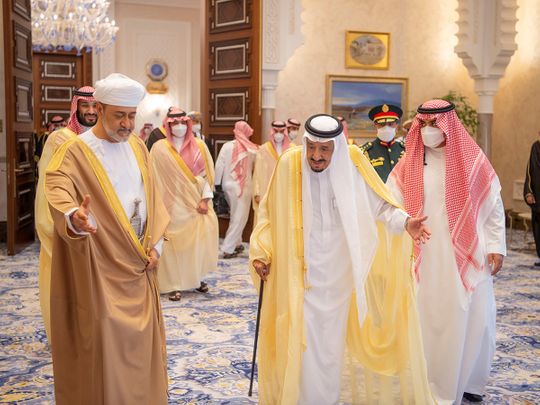
By Vivian Nereim and Donna Abu-Nasr -- bloomberg.com -- The sultan of Oman landed in Saudi Arabia on Sunday in the first visit by an Omani leader in over a decade, a sign of shifting alliances in the Persian Gulf as the kingdom reaches out to states with closer ties to regional rival Iran. Skyscrapers in the Saudi capital, Riyadh, were lit up in red and green, the colors of the Omani flag, to celebrate Sultan Haitham bin Tariq’s arrival. The visit to the city of Neom, where he was greeted by Saudi Arabia’s de facto ruler, Crown Prince Mohammed bin Salman, coincides with the opening of the first-ever land crossing connecting the countries as Oman tries to diversify trade routes. The Saudi cabinet also authorized officials to prepare and sign draft agreements with Oman in a slew of fields including commerce, culture, investment promotion and post and transport. “There’s been a lot of work behind the scenes to try to build the foundation of something much more significant between the Saudis and Omanis,” said Ayham Kamel, head of the Middle East and North Africa at the political risk consultancy Eurasia Group. “Sultan Haitham is viewed in Riyadh as leaning toward Saudi in terms of Gulf affairs.”
A closer relationship could be an economic boon for Oman, which is struggling to diversify its economy away from oil. It also comes as Prince Mohammed reaches out to states once held at a distance over differences in their approach to Iran. Saudi Arabia has forged closer ties with Iraq, hosting the prime minister in March, and reconciled this year with Qatar -- a Gulf neighbor it had a rancorous split from in 2017. Sponsored Content Resilience Through Digitalization and Sustainability Yokogawa At the same time, tensions have spiked between Saudi Arabia and another Gulf Cooperation Council neighbor, the United Arab Emirates, over differences on oil policy, geopolitical views and economic competition. “It’s almost a new crown prince who thinks about regional affairs differently,” Kamel said. “He’s much more interested in building a GCC-centric multifaceted relationship that does not rely only on one ally, which used to be the UAE, but builds on a much broader network of alliances.”

by ncregister.com -- On July 1, leaders of Christian Churches of Lebanon — including heads of the Maronite, Melkite, Greek Orthodox, Syrian Orthodox, Chaldean, Syrian Catholic and evangelical communities — were gathered in Rome for a day of prayer and reflection with Pope Francis, in response to the devastating economic and political crisis in Lebanon. These religious leaders made special appeals to Lebanon’s citizens not to become discouraged and lose heart; to the political leaders to find solutions to the current economic, social and political crisis; to the Lebanese of the diaspora to serve the homeland; and to the members of the international community to undertake a joint effort to save Lebanon. In the words of Pope Francis, the intention of the gathering was that Lebanon “must remain a project of peace. Its vocation is to be a land of tolerance and pluralism, an oasis of fraternity where different religions and confessions meet, where different communities live together, putting the common good before their individual interests.”
Why Lebanon Is a Message
Prince Klemens von Metternich (1773-1859) was Austria’s foreign minister and architect of the “Concert of Europe” — a viable diplomatic system between the European Powers which kept Europe at peace for almost a century following the Napoleonic wars. Before sending his ambassador to Constantinople, Metternich instructed him: “Tell the Sultan, if there is war in Lebanon there will be war in the Levant, if there is peace in Lebanon there will be peace in the Levant.” The Austrian statesman and diplomat knew how to keep the equilibrium and balance of powers to ensure peace and stability. He understood that a peaceful Lebanon contributed to a peaceful and stable region, but an explosive region would sooner or later come back to haunt the territorial integrity of Lebanon, the Christian presence in the region and the coexistence among its religious communities.
باريس ـ بشارة غانم البون
“حدث نادر شهدته عاصمة الكثلكة التي انشغلت دوائرها الفاتيكانية بيوم لبناني طويل قلّما عرفته في السابق”. هكذا يُعلّق ديبلوماسي عتيق، خبير بشؤون الكرسي الرسولي على مدى اكثر من ثلاثين عاماً، على الساعات العشر التي خصّصها البابا فرنسيس لـ”لبنان الحبيب الذي احمله في قلبي”، على حد قوله.
وقد سجلت الأوساط المتابعة لملف العلاقات الفاتيكانية – اللبنانية ملاحظات على هامش جلسات هذا اليوم الطويل، وأبرزها الآتي:
-اظهار مدى الاهتمام الشخصي للبابا فرنسيس ومدى التزام المؤسسات الفاتيكانية بلبنان “ليس فقط تعبيراً عن القلق الكبير على وجود شعب ومصيره بل أيضاً حرصاً على مستقبل
بلد صغير بحجمه وكبير برسالته”.

By Sunniva Rose -- thenationalnews.com -- US and French diplomats have attempted to pressure a reluctant Saudi Arabia to increase its involvement in Lebanon in what analysts described as an unprecedented effort to save the crisis-hit country from itself. But the outcome of their negotiations remains unclear apart from potentially delivering more in-kind humanitarian aid. Ambassadors Anne Grillo of France and Dorothy Shea of the US visited Saudi Arabia on Thursday to discuss Lebanon's economic crisis and political paralysis. They said in a joint statement afterwards that the country desperately needed a “fully empowered government”. The international community has refused to bail out the cash-strapped state after decades of mismanagement and corruption, arguing that politicians should first bring in laws to increase transparency and accountability.
The failure of Lebanese leaders to act has led to severe electricity, water and medical shortages amid rapidly increasing inflation and poverty. The local currency is trading at more than 19,000 Lebanese pounds to the dollar – less than a tenth of its official value. Lebanon is without a fully functioning government and political bickering over the formation of a new one persists. The previous Cabinet resigned following the deadly blast that rocked Beirut’s port on August 4 last year. “We are providing a lot of emergency and humanitarian aid to Lebanon but we could do much more if the Lebanese shouldered their responsibilities,” a French diplomatic source told The National. The US embassy in Beirut was not immediately available for comment. Saudi Arabia has traditionally been financially supportive of Lebanon and aligned with its Sunni Muslim and pro-Western leaders. But it has distanced itself in recent years owing to increasing concerns about the power wielded by Hezbollah. The Shiite Muslim group is backed by Saudi Arabia’s regional archenemy, Iran.




Population Movements to Keserwan - The Khazens and The Maans
ما جاء عن الثورة في المقاطعة الكسروانية
ثورة أهالي كسروان على المشايخ الخوازنة وأسبابها
Origins of the "Prince of Maronite" Title
Growing diversity: the Khazin sheiks and the clergy in the first decades of the 18th century
Historical Members:
Barbar Beik El Khazen [English]
Patriach Toubia Kaiss El Khazen(Biography & Life Part1 Part2) (Arabic)
Patriach Youssef Dargham El Khazen (Cont'd)
Cheikh Bishara Jafal El Khazen
Patriarch Youssef Raji El Khazen
The Martyrs Cheikh Philippe & Cheikh Farid El Khazen
Cheikh Nawfal El Khazen (Consul De France)
Cheikh Hossun El Khazen (Consul De France)
Cheikh Abou-Nawfal El Khazen (Consul De France)
Cheikh Francis Abee Nader & his son Yousef
Cheikh Abou-Kanso El Khazen (Consul De France)
Cheikh Abou Nader El Khazen
Cheikh Chafic El Khazen
Cheikh Keserwan El Khazen
Cheikh Serhal El Khazen [English]
Cheikh Rafiq El Khazen [English]
Cheikh Hanna El Khazen
Cheikha Arzi El Khazen
Marie El Khazen