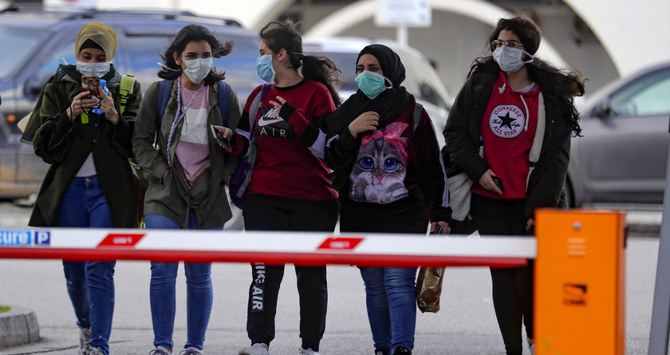
by arabnews.com -- NAJIA HOUSSARI -- BEIRUT: The future of thousands of Lebanese students is at stake as private educational institutions assess their ability to continue operations in the next academic year, due to the economic crunch facing Lebanon. “If the economic situation continues, private schools will be forced to close down for good, a move that will affect more than 700,000 students, 59,000 teachers and 15,000 school administrators,” said Father Boutros Azar, secretary-general of the General Secretariat of Catholic Schools in Lebanon, and coordinator of the Association of Private Educational Institutions in Lebanon.
Over 1,600 private schools are operating in Lebanon, including free schools and those affiliated to various religion societies, Azar said. The number of public schools in Lebanon, he added, is 1,256, serving 328,000 students from the underprivileged segment of society and 200,000 Syrian refugee students. “The number of teachers in the formal education sector is 43,500 professors and teachers — 20,000 of them are permanent staff and the rest work on a contract basis,” Azar said. This development will also have an impact on private universities, whose number has increased to 50 in the past 20 years. Ibrahim Khoury, a special adviser to the president of the American University of Beirut (AUB), told Arab News: “All universities in Lebanon are facing an unprecedented crisis, and the message of AUB President Dr. Fadlo R. Khuri, a few weeks ago, was a warning about the future of university education in light of the economic crisis that Lebanon is facing.”
Khoury said many universities would likely reduce scientific research and dispense with certain specializations. “Distance education is ongoing, but classes must be opened for students in the first semester of next year, but we do not yet know what these classes are.” Khoury added: “Universities are still following the official exchange rate of the dollar, which is 1,512 Lebanese pounds (LBP), but the matter is subject to future developments.” Lebanese parents are also worried about the future of their children, after the current school year ended unexpectedly due to the coronavirus disease (COVID-19) pandemic.
![Though illegal, black-market currency exchange transactions have become commonplace in economically ravaged Lebanon, and are arranged between people who meet through popular messaging apps like WhatsApp and Telegram [File: Mohamed Azakir/Reuters]](https://www.aljazeera.com/mritems/imagecache/mbdxxlarge/mritems/Images/2020/5/28/cb75a668edcd463f9a3880805a934809_18.jpg)
by aljazeera.com -- Timour Azhari -- Beirut, Lebanon - A four-wheel drive vehicle pulls up to the curb of a narrow side street in Beirut and collects a customer who climbs into the front passenger seat. "How's it going? Thanks for doing this on short notice," says the customer to the driver. Pleasantries exchanged, the two get down to business. The customer pulls out a small roll of United States $100 bills, counts them individually and hands them to the driver, who counts them again. The numbers confirmed, the driver reaches into a door compartment, pulls out a bulging envelope and hands it to the passenger, who opens it. Inside are dozens of crisp blue and green Lebanese pound notes, 50,000 and 100,000 denominations, each bearing the name of Lebanon's central bank. The passenger counts the notes. By the time he's finished, the driver has circled the block. He drops the passenger off where he was picked up. "Let me know when you have more," he says, and disappears up the street.
This transaction, which Al Jazeera observed recently, is a black-market currency exchange. Though illicit, such transactions have become commonplace in the crisis-torn nation, arranged between people who meet through popular messaging apps like WhatsApp and Telegram. Some of those groups have swelled since late April to boast hundreds of members. Due to a government crackdown on legal, parallel exchanges, the black market is the only way most people in the country can currently swap rapidly devaluing Lebanese pounds for increasingly scarce US dollars. Lebanon black market exchange Some messaging app groups connecting black market buyers and sellers of currencies in Lebanon have swelled since late April to boast hundreds of members, after a government crackdown on legal, parallel exchanges backfired and drove the trade deeper underground

by middleeasteye.net -- By Kareem Chehayeb -- Inside parliament and out, a controversial Lebanese amnesty bill has been stoking anger, drawing resentment and sparking quarrels and protests. Postponed once again on Thursday evening, it is a row that looks set to rumble on. Divisions between parties at the last minute hampered an agreement on the bill, which had removed a controversial provision that would allow ex-militants who collaborated with Israel during its occupation of southern Lebanon to return home. Parliament speaker Nabih Berri slammed his table angrily as MPs, including the Free Patriotic Movement leader Gebran Bassil, threatened to leave the session, which was then adjourned before the adaptation of the amnesty law.
Former Prime Minister Saad Hariri and other Future Movement MPs left the session telling the media that there was constant interference to prevent lawmakers from reaching a consensus. “I don’t know why they find a way to outsmart each other in this country so each one comes out looking like a hero,” an outraged Hariri told reporters. The amnesty bill was among 37 measures to be discussed on Thursday, the third time parliament had met for a legislative session since the coronavirus outbreak. The session was held at a makeshift conference hall at Beirut’s Unesco Palace in accordance with social distancing measures.
Amnesty for ‘Israeli agents’
Although discussion of the draft amnesty law didn’t take place until Thursday evening, in the morning demonstrators in surgical masks and wearing keffiyehs - traditional scarves associated with Palestinian resistance - had gathered outside the Unesco Palace. The demonstrators were voicing their opposition against the provision in the draft bill that would allow ex-militants who collaborated with Israel during its occupation of southern Lebanon to return as long as they relinquish their Israeli nationality. “Qana urges you to not let the [Israeli] agents return,” one sign read, referring to the southern town that Israel shelled twice; once at a United Nations compound in 1996 where civilians sought refuge, and another time in 2006 which killed 54 civilians, over half of which were children.
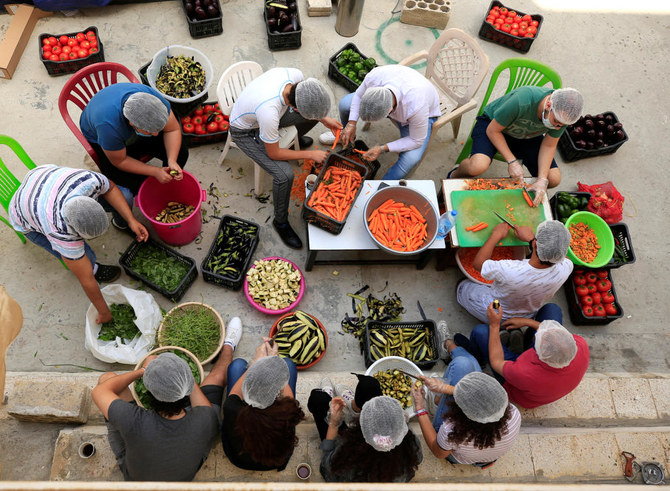
by reuters -- BEIRUT: At a street market in southern Beirut, Lebanese crowd around volunteers handing out free rations of bread and pasta, staples that have become a lifeline to families whose living standards have plunged during a financial crisis. “People can’t buy meat or fish anymore. Chicken is getting more expensive. They can only afford vegetables and bread,” said Salwa Hable, an organizer helping distribute the privately donated food. Lebanon’s economic crisis has brought mounting hardship for its roughly 6 million people. Prices have soared, the result of a dollar crunch that has sunk the local currency since October and eviscerated purchasing power. “It’s going to soon turn into hunger protests,” said Hable.
It was getting harder to solicit donations from better-off Lebanese, themselves feeling the pinch of the most destabilising crisis since the 1975-1990 civil war, she said. The worsening conditions have already threatened more serious unrest. Last month protesters defying a coronavirus curfew rioted, burning banks and leaving a demonstrator dead. Prime Minister Hassan Diab said last week the double-blow of the financial meltdown and coronavirus pandemic could tip Lebanon into a full-blown food crisis as basics like bread become unaffordable. People are eating less, with butchers complaining of shrinking sales, restaurants empty, and families making do with simple carbohydrates — even during the holy month of Ramadan, typically a time of nightly feasts. “We stopped buying fruits for ourselves. We get something small for my daughter, but that’s it,” said George Ortass, 46, a taxi driver.

Population Movements to Keserwan - The Khazens and The Maans
ما جاء عن الثورة في المقاطعة الكسروانية
ثورة أهالي كسروان على المشايخ الخوازنة وأسبابها
Origins of the "Prince of Maronite" Title
Growing diversity: the Khazin sheiks and the clergy in the first decades of the 18th century
Historical Members:
Barbar Beik El Khazen [English]
Patriach Toubia Kaiss El Khazen(Biography & Life Part1 Part2) (Arabic)
Patriach Youssef Dargham El Khazen (Cont'd)
Cheikh Bishara Jafal El Khazen
Patriarch Youssef Raji El Khazen
The Martyrs Cheikh Philippe & Cheikh Farid El Khazen
Cheikh Nawfal El Khazen (Consul De France)
Cheikh Hossun El Khazen (Consul De France)
Cheikh Abou-Nawfal El Khazen (Consul De France)
Cheikh Francis Abee Nader & his son Yousef
Cheikh Abou-Kanso El Khazen (Consul De France)
Cheikh Abou Nader El Khazen
Cheikh Chafic El Khazen
Cheikh Keserwan El Khazen
Cheikh Serhal El Khazen [English]
Cheikh Rafiq El Khazen [English]
Cheikh Hanna El Khazen
Cheikha Arzi El Khazen
Marie El Khazen