by Cindy Wooden - cruxnow.com -- ROME - Pope Francis “is a father who knows very well his daughters and sons,” including those who belong to the Eastern Catholic churches, said the Armenian Catholic bishop of the United States and Canada. Bishop Mikael A. Mouradian of the California-based Armenian Catholic Eparchy of Our Lady of Nareg was one of 15 bishops from eight Eastern Catholic churches who spent close to three hours conversing with Pope Francis Feb. 20. The meeting was part of the bishops’ “ad limina” visits to Rome to report on the status of their eparchies or dioceses. They were the last group of U.S. bishops to complete the visits, which are required regularly of every bishop in the world.
Mouradian had made an “ad limina” visit in 2012, meeting with Pope Benedict XVI. Both popes “were very fraternal” and very much teachers, but Pope Francis’s advice and counsel came from a place “much more near to the heart,” the bishop said. The Armenian bishop and others who spoke to Catholic News Service said they thanked Pope Francis for his decision in 2014 to lift an 85-year-old Vatican ban on ordaining married priests for the Eastern Catholic churches outside their traditional homelands where married priests are common. “I ordained my first married priest two years ago,” the bishop said. “He is our first American-born vocation to the priesthood, and he’s doing an amazing job.”
Mouradian said the pope’s decision to lift the ban did not open any floodgates because the bishop has conditions candidates must meet: “I always request that they have at least five years of experience in matrimony” and have children; and they must have at least a master’s of divinity degree. In addition, “the wife should agree that the husband will be a priest.” When he was named bishop in 2011, he said, all the priests of the eparchy were from the Middle East. He was told, “Don’t look for vocations in the States; you will not find them.” But, he said, the Gospel says to pray that God would send workers for the vineyard. “That’s what I did. I prayed. And worked a little bit for it.”

by asiatimes.com -- ALISON TAHMIZIAN MEUSE -- The World Bank this week warned that Lebanon, once dubbed the Switzerland of the Middle East for its unique status as both a snow-capped holiday destination and discreet banking hub for Gulf Arabs, is at risk of “implosion” should it fail to reform. A drive from Lebanon’s mountainous north to the capital Beirut will make an observer immediately feel the impact of capital controls and the economic downturn. Ski resorts, from the Cedars to Faraya overlooking the Mediterranean, are operating at partial capacity despite generous powder on the slopes; the oil needed to power electricity generators for the chairlifts is proving far too costly to run them through the season. The ubiquitous billboards and ads that populate every usable space the eye can see are either blank, advertising for New Year’s Eve concerts long-since passed, or screaming out jaw-dropping sales of 50% or more at sports stores and malls. Every fourth car dealership along the north-south highway, from Porsche to standalone lots, is empty or out of business. At rest stops, a pack of Cedars cigarettes, for years priced at 1,000 Lebanese pounds (then 70 cents), have now nearly doubled.
At night, the highway lights remain dark – though this has been the case for years, just one of the many symptoms of rampant mismanagement and corruption to which the population had been forced to acclimate, but which now may finally be hitting a breaking point. “Economic rationing is compulsory today,” Neemat Frem, a prominent industrialist, told one of the country’s most watched talk shows Thursday night. “We can no longer pay for our electricity debt!” Frem, a relative newcomer to politics now heading the parliamentary commission for economy and trade, raised alarm bells on the state of the country’s electricity sector, which loses $2 billion per year despite most households relying on their own generators for half the day’s power. While the party of Lebanese President Michel Aoun has been in charge of the energy portfolio for the better part of the last decade, entrenched corruption is blind to party affiliation. All of Lebanon’s state utilities, from telecom to waste management, have been hollowed out for decades to shore up sectarian patronage networks. For a population that has long prided itself on resilience in the face of crumbling infrastructure and incompetent and corrupt governance, the reality that this moment is different is setting in.
CAIRO ( Sputnik ) A 45-years old woman, who arrived from Iran, has been infected with the novel coronavirus, officially named COVID-19, …

The Observers -- Five years ago, Al Sayed left his hometown, Barja, which is located about 30 kilometres south of Beirut, Lebanon, to study at the Wuhan University of Science and Technology in Wuhan, China. He’s lived in the city ever since. The new virus known as Covid-19 was first identified in Wuhan in late December 2019. On January 23, 2020, Chinese officials placed the entire city under quarantine as Covid-19 continued to spread. The very next day, Al Sayed took to Facebook to share what life was like under quarantine and his posts immediately started circulating across the Arab world. At first, Al Sayed was angry that the Lebanese government hadn’t decided to repatriate its nationals who were trapped in Wuhan. However, on the fifth day of the quarantine, he posted a long statement explaining that he had decided to stay in Wuhan. "It’s like there is a war going on in Wuhan"
Population Movements to Keserwan - The Khazens and The Maans
ما جاء عن الثورة في المقاطعة الكسروانية
ثورة أهالي كسروان على المشايخ الخوازنة وأسبابها
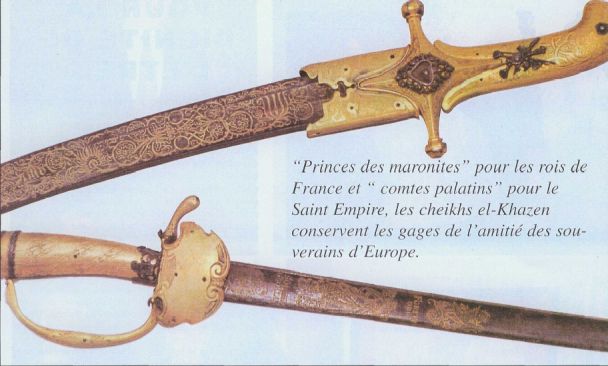
Origins of the "Prince of Maronite" Title
Growing diversity: the Khazin sheiks and the clergy in the first decades of the 18th century
Historical Members:
Barbar Beik El Khazen [English]
Patriach Toubia Kaiss El Khazen(Biography & Life Part1 Part2) (Arabic)
Patriach Youssef Dargham El Khazen (Cont'd)
Cheikh Bishara Jafal El Khazen
Patriarch Youssef Raji El Khazen
The Martyrs Cheikh Philippe & Cheikh Farid El Khazen
Cheikh Nawfal El Khazen (Consul De France)
Cheikh Hossun El Khazen (Consul De France)
Cheikh Abou-Nawfal El Khazen (Consul De France)
Cheikh Francis Abee Nader & his son Yousef
Cheikh Abou-Kanso El Khazen (Consul De France)
Cheikh Abou Nader El Khazen
Cheikh Chafic El Khazen
Cheikh Keserwan El Khazen
Cheikh Serhal El Khazen [English]
Cheikh Rafiq El Khazen [English]
Cheikh Hanna El Khazen
Cheikha Arzi El Khazen
Marie El Khazen