
By Andrew O'Reilly, John Roberts | Fox News -- President Trump on Tuesday called for a two-state solution to resolve the Israeli-Palestinian conflict, as he unveiled the details of his administration’s much-awaited Middle East peace plan. Trump announced the proposal alongside Israeli Prime Minister Benjamin Netanyahu during remarks in the East Room of the White House. "My vision presents a win-win situation for both sides," Trump said. "Today Israel has taken a giant step toward peace." He later tweeted a map of the proposed State of Palestine. While Trump and Netanyahu praised the plan as a way toward ending the decades-long conflict between the Israelis and Palestinians, odds of the peace plan taking shape are long given that the Palestinians have preemptively rejected the plan. "This is a great deal," Trump said. "And the Palestinians may not have this opportunity ever again."
Trump acknowledged he’s setting out toward a goal that has eluded every U.S. president in modern times but claimed those prior efforts were too vague and short on critical details. Trump declared his plan is “the most detailed proposal ever put forward." "All prior administrations from President Lyndon Johnson have tried and failed," Trump said. "In the past, even the most well-intentioned plans were light on details." Trump added: "There is nothing tougher than this one, we have an obligation to humanity to get it done." Netanyahu, who faces a tough re-election in March amid a corruption scandal, used his time on the dais to praise Trump's plan and how it benefited Israeli sovereignty and security. The Israeli leader added that past deals had not had the "right balance between Israeli security and Palestinians aspirations." "You have charted a brilliant future for Israelis and Palestinians toward a lasting peace," he said. "For decades that peace has proved elusive." He added: "It's a great plan for Israel, it's a great plan for peace."
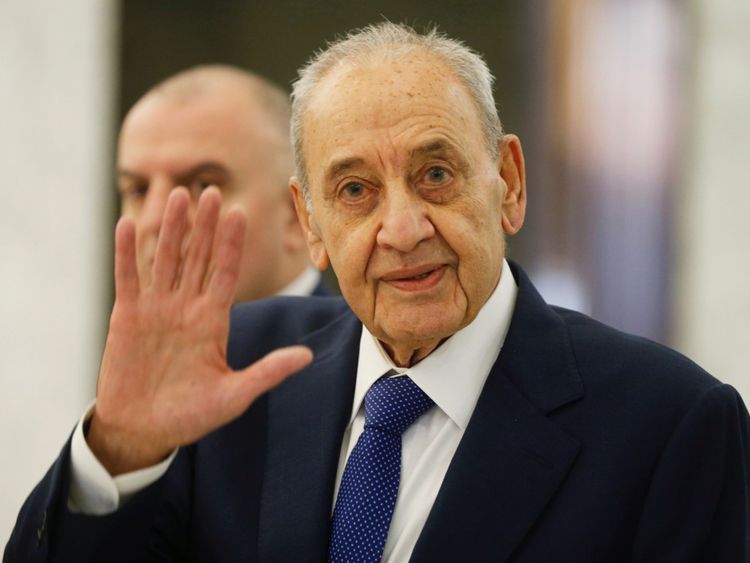
by gulfnews.com -- Damascus: Lebanese Parliament Speaker Nabih Berri and ex-director of general security Jamil Al Sayyed are technically part of the same team, both affiliated with the Hezbollah-led March 8 Coalition. In reality, however, the two Shiite politicians are miles apart, due to the simmering rivalries between them. Prime on the list is a firm belief among Berri’s supporters that Al Sayyed wants to succeed him as speaker of parliament — a post that Berri has held since 1992. “The battle for the post of speaker of parliament is already underway,” said political analyst Fadi Akoum, “although the new elections are not due before two years from now.”
The threat raised much anger in Berri circles, who accuse Al Sayyed of insulting their boss. Hezbollah, a firm ally of both Nabih Berri and Al Sayyed, has been surprisingly silent over the latest spat, standing at arms-length from both men. Berri and Al Sayyed first worked together in the 1980s, when the former held the ministry of justice and Al Sayyed was director of intelligence in South Lebanon. In 1998, Al Sayyed was promoted to the job of director of general security, during the era of Syria’s strongman in Lebanon, President Emille Lahhoud.
Al Sayyed became a powerbroker in Lebanese politics, challenging Berri’s long-established grip over the Shiite community. He was discharged and arrested in 2005, accused of the murder of former Prime Minister Rafik Hariri. Upon his release in 2009, he launched his political career within the Hezbollah-led March 8 Coalition, challenging Berri, who was supposed to be a tactical ally. “Politicians in Lebanon have traditionally named their successors, whether in their own political parties or government posts,” said Akoum. “Berri has not named a successor, which explains Sayyed’s ambition to succeed him as speaker. He has positioned himself within the Resistance Bloc, which means full support from Hezbollah. The problem is how he will deal with the Future Movement, where many still accuse him of either taking part in or knowing about the conspiracy to assassinate Hariri.”

BEIRUT (Reuters) - Lebanon’s Christian religious authorities on Tuesday urged anti-government protesters to give a new government breathing room to tackle a dire financial crisis, condemning what they described as mob assaults on security forces in recent marches. Many demonstrators have rejected the government formed last week by the Iran-backed Shi’ite group Hezbollah and its allies without participation of major political parties including the second-largest Christian party, Lebanese Forces (LF). Demonstrations that began last October against a political elite blamed for steering Lebanon into its worst crisis in decades have turned violent as some protesters clashed with security forces at barricades around parliament and government headquarters in central Beirut to demand an independent cabinet. “The Fathers stress the right for peaceful demonstrations to demand reform, but strongly reject the mobs on the streets and squares, especially in Beirut, lest the mobilization veers away from its noble goals,” the Christian religious leaders said in a statement after a summit.
![People will often buy assets like gold, art and gems to protect their savings against bank failures, currency devaluations and other uncertain outcomes that erode savings [File: Mohamed Azakir/Reuters]](https://www.aljazeera.com/mritems/imagecache/mbdxxlarge/mritems/Images/2020/1/26/98b887f3c43c49ee99484d498a055806_18.jpg)
by reuters -- When she heard Lebanese banks would limit cash withdrawals, Rita, a doctor, rushed out to buy a $10,000 Rolex watch on her credit card, anxious to protect some of her savings. "It's better than keeping my money in the bank," she said. Every week, account holders line up for their quota of cash - for some less than $200 - from their banks, which have also blocked foreign money transfers as Lebanon sinks deep into economic crisis. Dollar shortages have pushed up prices, the Lebanese pound has slumped on the parallel market and confidence in the banking system has all but collapsed. People with savings in the bank are scrambling to get their money out, buying jewellery, cars and land with credit cards or cashier's checks.
Several people told Reuters news agency they feared even tighter controls, a haircut on their deposits, bank failure or a devaluation of the Lebanese pound, which has been pegged to the United States dollar for 22 years. They asked not to be fully identified due to safety concerns. Lebanon's central bank insists deposits are safe and has pledged to maintain the dollar peg, while the head of the country's banking association said the limits on withdrawals and other measures aimed "to keep the wealth of Lebanon" in the country. As remittances from abroad started to dry up last summer, many ordinary Lebanese started stashing cash at home, fearing a clampdown on bank withdrawals to keep foreign exchange from fleeing the country. That was months before protests erupted in October against the ruling elite that plunged Lebanon into its worst crisis in decades. In the capital, Beirut, staff at several jewellery stores said customers had come in recently looking to buy gold and diamonds, sometimes to sell them abroad, though most jewellers are now only accepting cash.




Population Movements to Keserwan - The Khazens and The Maans
ما جاء عن الثورة في المقاطعة الكسروانية
ثورة أهالي كسروان على المشايخ الخوازنة وأسبابها
Origins of the "Prince of Maronite" Title
Growing diversity: the Khazin sheiks and the clergy in the first decades of the 18th century
Historical Members:
Barbar Beik El Khazen [English]
Patriach Toubia Kaiss El Khazen(Biography & Life Part1 Part2) (Arabic)
Patriach Youssef Dargham El Khazen (Cont'd)
Cheikh Bishara Jafal El Khazen
Patriarch Youssef Raji El Khazen
The Martyrs Cheikh Philippe & Cheikh Farid El Khazen
Cheikh Nawfal El Khazen (Consul De France)
Cheikh Hossun El Khazen (Consul De France)
Cheikh Abou-Nawfal El Khazen (Consul De France)
Cheikh Francis Abee Nader & his son Yousef
Cheikh Abou-Kanso El Khazen (Consul De France)
Cheikh Abou Nader El Khazen
Cheikh Chafic El Khazen
Cheikh Keserwan El Khazen
Cheikh Serhal El Khazen [English]
Cheikh Rafiq El Khazen [English]
Cheikh Hanna El Khazen
Cheikha Arzi El Khazen
Marie El Khazen