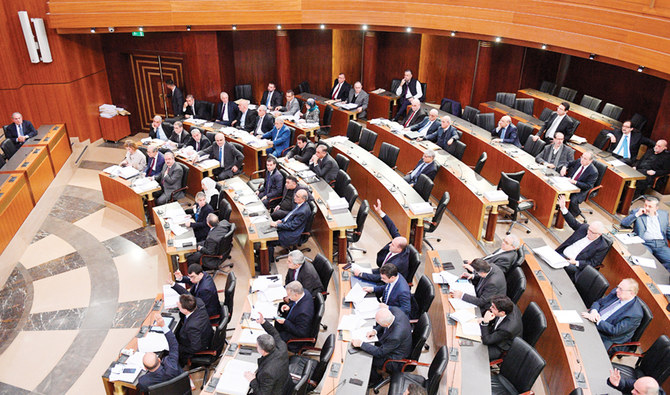
by AFP -- BEIRUT: The Lebanese parliament approved the country’s 2020 budget on Monday, in an unprecedented session that revealed the true extent of the state of confusion in Beirut. The governments of former Prime Minister Saad Hariri, which drafted the budget, and current Prime Minister Hassan Diab, did not attend the budget debate, with Diab stating his government had “not yet won the confidence of Parliament, and has no right to retrieve the draft budget to study and modify it.” The session was attended by just 70 deputies out of its 128, and was boycotted by the deputies of the Lebanese Forces and the Phalange parties, and a number of independent members of Parliament (MPs).
Forty-nine MPs approved the budget, from the Hezbollah, Amal, and Free Patriotic Movement blocs and their allies. Thirteen MPs voted against it, including the Future Movement bloc, and eight abstained, including the Democratic Gathering bloc, which is loyal to Walid Jumblatt, leader of the Progressive Socialist Party. The budget did not include any economic vision, but was limited to numbers. The head of the Parliamentary Finance and Budget Committee, Ibrahim Kanaan, said that it included “an estimate of resources and allocations of funds.” The budget deficit reached $7.5 billion.

by the thehill.com -- Hanin Ghaddar -- Against the backdrop of three months of political and economic protests, Lebanese politicians appear to have reached a deal establishing a nominally technocratic government in Beirut. Still beholden to Hezbollah, the government has little Sunni or Druze support. Some protesters already call this a “Halloween government” since it gives thinly disguised cover to longtime establishment politicians. But the new government is unlikely to be able on its own to tackle the single biggest challenge it faces: the rampant corruption responsible for the country’s acute financial crisis. The formation of a new Lebanese government has been a central demand of the international community and a necessary precondition for any international aid. But that is not enough. The government must quickly take action to fight corruption and enhance transparency. For a country that has run on corruption and political patronage, this will be a very heavy lift.
Nearly all of Lebanon’s political establishment is entangled in Beirut’s deep-rooted corruption crisis, which cuts across the sectarian divide. Lebanon ranks 138th out of 180 nations in the Corruption Perceptions Index released by the anti-corruption watchdog Transparency International. Meeting in December, the International Support Group for Lebanon issued a final statement in Paris urging Lebanese authorities to “take decisive action” to tackle corruption and tax evasion while improving economic governance and the country’s business environment. At the time, U.S. Secretary of State Mike Pompeo said that while Lebanon must take these steps, the U.S. is ready to “do the things that the world can do to assist the Lebanese people getting their economy right and getting their government right.”
Today, the U.S. should take action that would force the new government’s hand and empower it to take on the corrupt political establishment — something no Lebanese government could otherwise do on its own: Washington should issue sanctions targeting some of the most egregious corrupt actors across the Lebanese political and sectarian spectrum under the Global Magnitsky Act. Corrupt leaders seek profit and the political power that comes with funding patronage projects. Global Magnitsky sanctions would not only name and shame Lebanon’s most corrupt actors, it would block all property and interests they hold in the United States, which are likely to be substantial. There are other tools available to designated political corruption — such as Section 7031(c) of the Department of State, Foreign Operations, and Related Programs Appropriations Act, 2020. The State Department employed this tool earlier this month targeting Moldovan corruption, but it includes only a ban on visa to enter the United States for the designee and their family members, and it lacks the authority to block funds held in the United States. Global Magnitsky would be a better fit in the case of Lebanon.

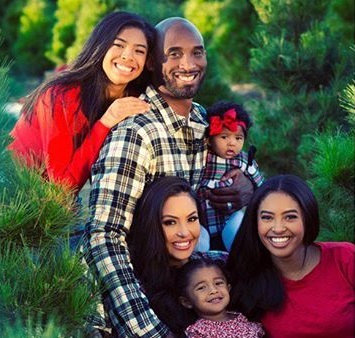

by Rebecca Mansour -- breitbart.com -- As tributes pour in for basketball legend Kobe Bryant after his tragic death in a helicopter crash in Calabasas, California, on Sunday at the age of 41, some fans are remembering how Bryant’s Catholic faith sustained him during a difficult period of his life and inspired his philanthropy. The former Laker and father of four was raised Catholic and spent his childhood in Italy, where his father, Joe Bryant, played professional basketball in Italian leagues. Bryant and his wife were married at a Catholic parish in Southern California in 2001 and are regular parishioners in Orange County, California, according to Catholic News Agency.
Los Angeles Archbishop José H. Gomez issued condolences on Sunday. “I am praying for him and his family. May he rest in peace and may our Blessed Mother Mary bring comfort to his loved ones,” the archbishop tweeted. Singer Cristina Ballestero shared on Instagram a story about encountering Kobe at a weekday mass at Holy Family Cathedral in Orange, California. “Right as mass begins I see a huge shadow in my right peripheral vision and hear a decently loud creak from probably a big man. I double took to see… it was KOBE BRYANT IN THE SAME PEW AS ME ON THE OTHER END!” Ballestro wrote. “As we went up to communion, he waited for me to go. If you grew up in the Catholic Church, you understand this is a respectful thing men do in church as a sign of respect to women. He said I have a beautiful voice. I said thank you and went up to communion.”
![Bassil enjoys unwavering support from his Christian base, who see him as a shrewd hard worker and a protector of their rights [Tamas Kovacs/MTI via AP]](https://www.aljazeera.com/mritems/imagecache/mbdxxlarge/mritems/Images/2020/1/25/f71f2eec8e334f17ab09fab163794705_18.jpg)
This is an opinion article and does not necessarily represent khazen.org opinion
by Al -Jazeera -- Timour Azhari -- Beirut, Lebanon - A colorful mix of insults and allegations of nepotism, racism and corruption is how an average Lebanese protester would describe the country's former Minister of Foreign Affairs Gebran Bassil. He is not alone. Lebanon's entire ruling class has been targeted by protesters who took to the streets more than 100 days ago to demand an end to corruption and sectarian politics. He is one of the newer politicians on the bloc, having come to power after the country's 15-year civil war. But Bassil quickly rose to be a symbol the cynical sectarian politics and mismanagement that have dominated the post-war era.
Protesters point to his last 10 years in the government where he moved through the telecommunication, energy and foreign ministries and assumed leadership of one of the country's biggest parties, the Free Patriotic Movement (FPM). Lebanon has some of the highest telecommunications costs in the world, and the FPM has held the energy portfolio for a decade while the country remains without uninterrupted electricity supply. Bassil enjoys unwavering support from his Christian base, who see him as a shrewd hard worker and a protector of their rights in Lebanon. Member of Parliament Mario Aoun, a member of Bassil's FPM parliamentary bloc, told Al Jazeera that Bassil was being "targeted because of his successes".
Insults from the crowd
When the protests against Lebanon's corrupt ruling elite broke out 100 days ago, crude chants were aimed at Bassil's mother. So severe were the insults that Bassil, in his first address after more than two weeks of uncharacteristic silence, apologized to his mother. "I'm so sorry that you were attacked because of me and it wasn't your fault. You taught me to love Lebanon," he said, addressing her in front of crowds of supporters at an organised rally on the outskirts of the capital Beirut. Before the protests, Bassil was widely expected to remain a top minister in government for a long time and was thought to be a serious contender for the presidency, a post currently held by his 84-year-old father-in-law, Michel Aoun.

Population Movements to Keserwan - The Khazens and The Maans
ما جاء عن الثورة في المقاطعة الكسروانية
ثورة أهالي كسروان على المشايخ الخوازنة وأسبابها
Origins of the "Prince of Maronite" Title
Growing diversity: the Khazin sheiks and the clergy in the first decades of the 18th century
Historical Members:
Barbar Beik El Khazen [English]
Patriach Toubia Kaiss El Khazen(Biography & Life Part1 Part2) (Arabic)
Patriach Youssef Dargham El Khazen (Cont'd)
Cheikh Bishara Jafal El Khazen
Patriarch Youssef Raji El Khazen
The Martyrs Cheikh Philippe & Cheikh Farid El Khazen
Cheikh Nawfal El Khazen (Consul De France)
Cheikh Hossun El Khazen (Consul De France)
Cheikh Abou-Nawfal El Khazen (Consul De France)
Cheikh Francis Abee Nader & his son Yousef
Cheikh Abou-Kanso El Khazen (Consul De France)
Cheikh Abou Nader El Khazen
Cheikh Chafic El Khazen
Cheikh Keserwan El Khazen
Cheikh Serhal El Khazen [English]
Cheikh Rafiq El Khazen [English]
Cheikh Hanna El Khazen
Cheikha Arzi El Khazen
Marie El Khazen