By Reuters — BEIRUT: Lebanese army troops on Tuesday (Dec 17) lobbed tear gas to disperse hundreds of supporters of the Shi’ite …
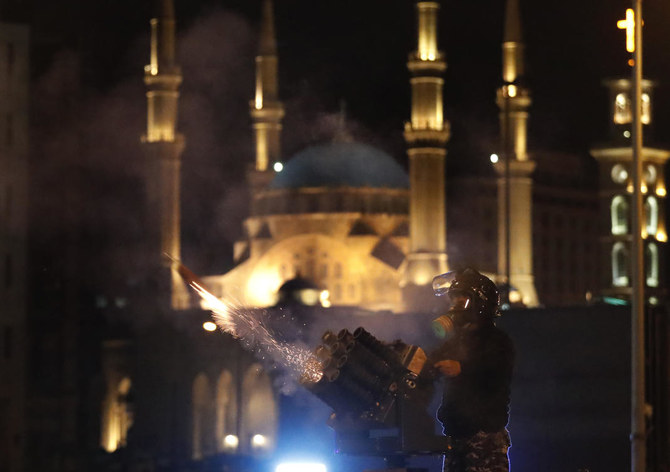
by AP theguardian.com --- Thousands of Lebanese protesters defiantly returned on Sunday to rally outside parliament in the capital, Beirut, hours after security forces chased them out, using teargas and rubber bullets and injuring dozens. On Saturday night into Sunday there was one of the most violent crackdowns on protesters since nationwide anti-government demonstrations began two months ago, leading to the resignation of prime minister Saad Hariri on 29 October. Attackers in northern Lebanon also set fire to the offices of two major political parties, the state-run National News Agency said. The protesters who showed up in Beirut on Sunday chanted against the security crackdown and called for an independent new head of government unaffiliated with established political parties. The crowd, many raising Lebanese flags, chanted: “We won’t leave. We won’t leave. Just arrest all the protesters!”
Others raised posters saying the teargas won’t keep them away. “We are crying already,” said one, in a jab at the deep economic crisis the Lebanese people are facing. The streets leading to parliament were filled with men, women and even children. Some huddled in smaller groups while others were lifted on to people’s shoulders as they chanted into megaphones. In the town of Kharibet al-Jindi, an office of the party of the former prime minister Saad Hariri was torched and its windows were broken. In a separate attack in the town of Jedidat al-Juma, assailants stormed an office of the largest party in parliament, affiliated with President Michel Aoun and headed by the foreign minister, Gebran Bassil. The party said the contents of the office had been smashed and burned. Hours earlier in Beirut, security forces had carried out the most violent crackdown on protesters since nationwide demonstrations began two months ago. The security forces fired rubber bullets and teargas and used water cannon throughout the night to disperse protesters in the city centre and around parliament. The overnight confrontations left more than 130 people injured, according to the Red Cross and the Lebanese civil defense.


by thenational.ae -- Security forces on Saturday fired tear gas and rubber bullets at protesters in Beirut, some of whom tried to break into a barricaded central district of Lebanon's capital. The clashes continued into the early morning on Sunday as riot police used water cannon and more tear gas to disperse protesters who pelted them with stones. Riot police and security forces deployed en masse, chasing demonstrators in the street, beating and detaining some of them, a Reuters witness and a protester said. State news agency NNA said the tear gas had made several people faint, while the Lebanese Civil Defence said it treated 54 people who were wounded, taking more than half to hospital.
The Lebanese Red Cross told AFP people had been treated for breathing difficulties and fainting, along with injuries caused by stones, noting that both security personnel and civilians were among those treated. The Internal Security Forces said at least 20 police were wounded. Hundreds of people were gathered as part of a wave of protests that have swept Lebanon since October 17, furious at a ruling elite that steered the country towards its worst economic crisis in decades. Protesters accuse the political class of milking the state for their own benefit through networks of patronage.
Earlier on Saturday dozens of young people opposed to the anti-government protest movement clashed with riot police in the capital, throwing rocks and firecrackers against volleys of teargas. Young counter-protesters from an area of Beirut dominated by the powerful Shiite movement Hezbollah and fellow Shiite movement Amal tried to raid a key anti-government protest camp in Martyrs' Square on Saturday afternoon. Anti-riot police intervened, firing tear gas to disperse them. The square, in central Beirut, has been at the epicentre of the protests over perceived official corruption, poor services and economic woes. These large anti-government rallies, which grew into calls for a root-and-branch overhaul of the state, have mostly passed off peacefully. However, clashes have become more frequent in recent weeks, with supporters of Hezbollah and Amal attacking protest camps in several cities amid counter-demonstrations. Both Amal and Hezbollah are partners in Lebanon's cross-sectarian government.

by thearabweekly.com -- Makram Rabah -- When the French Mandate founded “Grand Liban” — the State of Greater Lebanon — almost a century ago, it was never assumed that the small merchant republic would someday reach rock bottom. Decades of unheeded political corruption, coupled with Beirut’s inability to maintain solid connections with its regional Arab allies, left Lebanon desperate for a lifeline from the international community, primarily France. The International Support Group for Lebanon (ISG), led by France and the United Nations, met December 11 in Paris to discuss options to help Lebanon in its predicament. Observers said the ISG was a first step towards Lebanon’s economic salvation because France would lead an international effort to inject much-needed funds into the Lebanese economy, which collapsing towards a total meltdown.
Time and again, French President Emmanuel Macron has shown remarkable resolve in supporting the government of Lebanese Prime Minister Saad Hariri, including sponsoring the CEDRE donor conference in April 2018, which earmarked $11 billion to overhaul Lebanon’s decaying infrastructure and jump-start its ailing economy. However, the CEDRE funds were part of a wide reform package that the Lebanese state had publicly subscribed to, which included administrative, fiscal and budgetary reform, none of which were implemented by Hariri’s cabinet, leaving the $11 billion in limbo. Despite visits by French envoy Pierre Duquesne and his repeated urging to Lebanese officials of the importance of the reforms, the recommendations were ignored and the Hariri government failed to address key challenges, primarily reform of the electricity sector and the proper passing of the annual budget. Lebanon’s lack of seriousness, its irresponsible attitude and its refusal to heed the warnings of the international community were penalised in Paris when the ISG convened without any serious Lebanese presence. Beirut was represented by token senior diplomats and a few Hariri advisers.
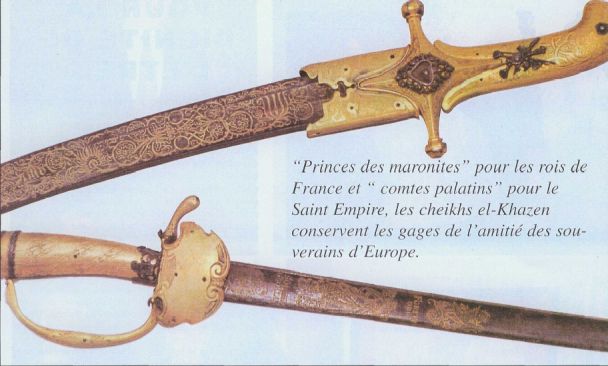
Population Movements to Keserwan - The Khazens and The Maans
ما جاء عن الثورة في المقاطعة الكسروانية
ثورة أهالي كسروان على المشايخ الخوازنة وأسبابها
Origins of the "Prince of Maronite" Title
Growing diversity: the Khazin sheiks and the clergy in the first decades of the 18th century
Historical Members:
Barbar Beik El Khazen [English]
Patriach Toubia Kaiss El Khazen(Biography & Life Part1 Part2) (Arabic)
Patriach Youssef Dargham El Khazen (Cont'd)
Cheikh Bishara Jafal El Khazen
Patriarch Youssef Raji El Khazen
The Martyrs Cheikh Philippe & Cheikh Farid El Khazen
Cheikh Nawfal El Khazen (Consul De France)
Cheikh Hossun El Khazen (Consul De France)
Cheikh Abou-Nawfal El Khazen (Consul De France)
Cheikh Francis Abee Nader & his son Yousef
Cheikh Abou-Kanso El Khazen (Consul De France)
Cheikh Abou Nader El Khazen
Cheikh Chafic El Khazen
Cheikh Keserwan El Khazen
Cheikh Serhal El Khazen [English]
Cheikh Rafiq El Khazen [English]
Cheikh Hanna El Khazen
Cheikha Arzi El Khazen
Marie El Khazen