
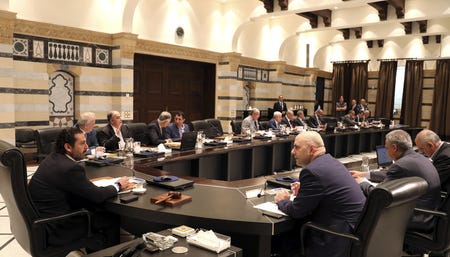
In January, Kuwait’s highest court overturned the death sentence imposed by a lower tribunal against one of the men, reducing it to life, it also reduced the life sentence for another man to 15 years in prison and sentenced several others previously judged “not guilty” to 10 years. Twelve of the Kuwaiti nationals convicted in absentia were arrested Saturday on charges of spying for Iran and Hezbollah. Two other Kuwaitis and one Iranian national remain at large. In July, Kuwait expelled 15 diplomats for alleged links to the cell. “There is a great Kuwaiti resentment toward [this matter] and they are right about it, and we in Lebanon will cooperate on the issue,” Hariri said.
Following a meeting with his Kuwaiti counterpart, Sheikh Jaber al-Mubarak al-Sabagh, Hariri said he was hopeful this resentment would not translate into measures against Lebanon, but said the issue had to be addressed “clearly and boldly” in order to prevent further strains between the two countries. President Michel Aoun also pledged to follow up on the issue. “The Kuwaiti people, state and emir always treated Lebanon and the Lebanese as they treat the Kuwaitis. I hope that the relations will improve,” Hariri said. The diplomatic strain recently led to speculation that Gulf Cooperation Council countries could implement a blockade against Lebanon, similar to that against Qatar, with dire repercussions for economic stability.
BEIRUT (Reuters) – The leader of Lebanon’s Hezbollah on Sunday dismissed the prospect of tougher U.S. sanctions against his group, which is …
Saudi Gazette – KUWAIT CITY — Authorities on Saturday arrested 12 convicted members of a “terrorist cell” with ties to Iran and …
By Lisa Barrington BEIRUT (Reuters) - Hezbollah and its allies are pressing the Lebanese state to normalize relations with President Bashar al-Assad's government in Syria, testing Lebanon's policy of "dissociation" from the Syrian conflict and igniting a political row. Calls for closer ties with the Syrian government, including on refugee returns and military operations on the Lebanon-Syria border, come as Assad regains control of more territory from insurgents and seeks to recover his international standing. The Lebanese policy of "dissociation", agreed in 2012, has aimed to keep the deeply divided state out of regional conflicts such as Syria even as Iran-backed Hezbollah became heavily involved there, sending fighters to help Assad, who is also allied to Iran. The policy has helped rival groups to coexist in governments bringing together Hezbollah, classified as a terrorist group by the United States, with politicians allied to Iran's foe Saudi Arabia, underpinning a degree of political entente amid the regional turmoil.
While Lebanon never severed diplomatic or trade ties with Syria, the government has avoided dealing with the Syrian government in an official capacity and the collapse of the policy would be a boost a political boost to Assad. It would also underline Iran's ascendancy in Lebanon, where the role of Saudi Arabia has diminished in recent years when it has focused on confronting Tehran in the Gulf instead. Assad's powerful Lebanese Shi'ite allies want the government to cooperate with Syria on issues such as the fight against jihadists at their shared border and securing the return of the 1.5 million Syrians currently taking refuge in Lebanon. "Everybody recognizes (the dissociation policy) as a farce to some extent, but at least it contained the conflict and prevented Lebanon from being dragged even further into what is going on in Syria," said Maha Yahya, director of the Carnegie Middle East Centre in Beirut. "(A normalization of relations) would be viewed as a victory, if using sectarian terms, of Shi'ites versus the Sunnis and will just inflame tensions even more."




Population Movements to Keserwan - The Khazens and The Maans
ما جاء عن الثورة في المقاطعة الكسروانية
ثورة أهالي كسروان على المشايخ الخوازنة وأسبابها
Origins of the "Prince of Maronite" Title
Growing diversity: the Khazin sheiks and the clergy in the first decades of the 18th century
Historical Members:
Barbar Beik El Khazen [English]
Patriach Toubia Kaiss El Khazen(Biography & Life Part1 Part2) (Arabic)
Patriach Youssef Dargham El Khazen (Cont'd)
Cheikh Bishara Jafal El Khazen
Patriarch Youssef Raji El Khazen
The Martyrs Cheikh Philippe & Cheikh Farid El Khazen
Cheikh Nawfal El Khazen (Consul De France)
Cheikh Hossun El Khazen (Consul De France)
Cheikh Abou-Nawfal El Khazen (Consul De France)
Cheikh Francis Abee Nader & his son Yousef
Cheikh Abou-Kanso El Khazen (Consul De France)
Cheikh Abou Nader El Khazen
Cheikh Chafic El Khazen
Cheikh Keserwan El Khazen
Cheikh Serhal El Khazen [English]
Cheikh Rafiq El Khazen [English]
Cheikh Hanna El Khazen
Cheikha Arzi El Khazen
Marie El Khazen