
Daily Star.com.lb - Federica Marsi - BEIRUT: Prime Minister Saad Hariri raised the importance of renewing ties between the country and the Lebanese diaspora, at the launch of a new virtual network of entrepreneurs, businesspeople and creative minds Thursday. Diaspora ID – designed by the private company Netways and financed by a $1 million grant from USAID – seeks to virtually connect Lebanese entrepreneurs outside and inside the country, thus spawning mutually beneficial business relationships. “Diaspora ID has created an unimaginable opportunity for Lebanese at home and abroad. Its possibilities are endless,” Prime Minister Hariri said at the launch event held Thursday at the Grand Serail. “It has created a new IT solution and used cutting-edge artificial intelligence to capitalize on the enormous potential of the Lebanese diaspora to contribute to employment and economic growth in Lebanon,” Hariri added.
A video presentation of the project showed a world map of connected dots, representing Lebanese expats, located geographically with a pin containing the platform’s symbol – a bird with spread wings. No part of the world lacked its fair share of pins, each labeled with a Lebanese name. The Lebanese diaspora is estimated to be in the range of 14 million people – several times larger than the Lebanese population of the country. According to Hariri, many expats maintain an emotional bond with their native country and would be eager to give back to it and contribute to its development. “I am here today because I believe in your power, the power of today’s innovators and the power of Lebanon’s diaspora,” he said.
Engineer and Netways Managing Partner Rola Mousa conceived of the platform as a way to give back after having lived for a long time outside of the country. “I had a dream to provide the Lebanese with a similar opportunity,” she said at the launch event Thursday. As Mousa explained, the platform will serve several functions. By listing their companies on the platform, users inside and outside Lebanon can describe their services and their needs and be matched to users with a complementary profile. The platform will also provide users abroad with information on the history of their ancestral villages in Lebanon. “This will serve particularly medium and small companies, which represent 93 percent of businesses in Lebanon,” Mousa said.
She echoed Hariri, saying that many Lebanese nationals living outside the country share her eagerness to contribute to their homeland. Consequently, Diaspora ID also provides the opportunity for skilled individuals in a variety of sectors to offer virtual training to similar businesses in Lebanon that might be in need guidance and expert advice. “This is what I call ‘brain circulation,’” Mousa said, adding that the transfer of knowledge facilitated by the platform will give the Lebanese diaspora an easy and quick way to contribute to Lebanon’s development.
BEIRUT, Aug. 10 (Xinhua) — The Lebanese army has shelled the posts of the Islamic State group (IS) on the outskirts of …
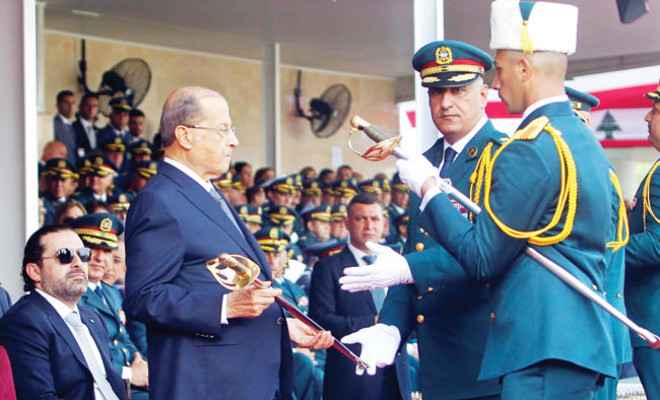
Arab news - BEIRUT: Lebanese Prime Minister Saad Hariri on Wednesday banned official visits to Syria by ministers — and was immediately defied by a Hezbollah member of his Cabinet. Industry Minister Hussein Hajj Hassan said he would accept an invitation to attend the Damascus International Fair this month in an official capacity. “I will attend the opening of the Damascus exhibition and I will meet with our fellow ministers there,” he said. Earlier, Hariri had reminded a Cabinet meeting that they were “a national unity government” and should distance themselves from regional conflicts. For that reason, he said, any “Lebanese ministerial visit to Syria in the name of the government” would be refused. The Syrian regime has invited several Lebanese ministers to the Damascus event, which begins on Aug. 17 and is aimed at “rebuilding Syria.” They include Education Minister Marwan Hamadeh, a known opponent of the Assad regime.
Information Minister Melhem Riachy said after the Cabinet meeting: “Prime Minister Hariri was clear about the disassociation policy and distancing ourselves from regional conflicts and axes. The visit of any minister to Syria will be on a personal level and not in the name of the government.”

by sputniknews.com/ Many beaches and swimming pools in Lebanon have reacted to increasing numbers of women arriving in "burkinis," by banning the swimming suit. More and more beach-goers in Lebanon have become subject to a restriction on wearing the "burkini," a swimming costume for conservative Muslims that covers a women's body from top to toe. Burkini sales have soared in recent years as the garment has received attention from the media and the authorities in Europe and elsewhere. After the burkini was banned from beaches in several regions of southern France in August 2016, sales of the garment increased several times over, suppliers reported Australian designer Aheda Zanetti, who claims the trademark on the name burkini and burqini, told the BBC that online sales were up 200 percent as a result of the furor.
Recently, the owners of private beaches and swimming pools in Lebanon have ordered swimmers not to wear burkinis. One swimming pool owner told Sputnik Arabic that he banned the costume, explaining that the socially accepted clothing for females to swim in public places is a bikini. Lebanese sociologist Talal Atrisi told Sputnik that the country is home to diverse cultures which have peacefully co-existed for a long time. A burkini ban on certain beaches doesn't mean that these women are completely prevented from swimming, but rather that they are supposed to visit special women-only beaches or pools. Some owners of public pools and beaches are trying to attract a certain clientele, who might not want to see women in burkinis, the expert explained. "There is a culture with a conservative Islamic dimension which is manifested in terms of dress and tradition. In contrast, there is another culture that is also relatively conservative but influenced by the western atmosphere," Atrisi said.




Population Movements to Keserwan - The Khazens and The Maans
ما جاء عن الثورة في المقاطعة الكسروانية
ثورة أهالي كسروان على المشايخ الخوازنة وأسبابها
Origins of the "Prince of Maronite" Title
Growing diversity: the Khazin sheiks and the clergy in the first decades of the 18th century
Historical Members:
Barbar Beik El Khazen [English]
Patriach Toubia Kaiss El Khazen(Biography & Life Part1 Part2) (Arabic)
Patriach Youssef Dargham El Khazen (Cont'd)
Cheikh Bishara Jafal El Khazen
Patriarch Youssef Raji El Khazen
The Martyrs Cheikh Philippe & Cheikh Farid El Khazen
Cheikh Nawfal El Khazen (Consul De France)
Cheikh Hossun El Khazen (Consul De France)
Cheikh Abou-Nawfal El Khazen (Consul De France)
Cheikh Francis Abee Nader & his son Yousef
Cheikh Abou-Kanso El Khazen (Consul De France)
Cheikh Abou Nader El Khazen
Cheikh Chafic El Khazen
Cheikh Keserwan El Khazen
Cheikh Serhal El Khazen [English]
Cheikh Rafiq El Khazen [English]
Cheikh Hanna El Khazen
Cheikha Arzi El Khazen
Marie El Khazen