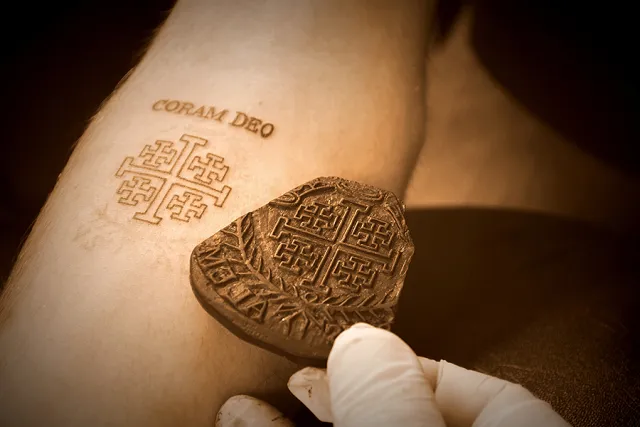
By Adelaide Mena - .- In the Old City of Jerusalem it's hard to escape the ancient history that's still alive within its walls. A simple smartphone search can send you on a walk to a centuries-old shop, bring you to the steps of a millennium-old Church, or lead you past the 3,000 year-old Temple Mount – all bursting with people and energy. But it's only within the stone walls of Razzouk Ink that the modern pilgrim can have that history etched onto his or her body for the rest of their lives. And Christian pilgrims have come to the tattoo artists of the Razzouk family since the Crusades to receive ancient signs of Christian identity and pilgrimage. Even today, as the family uses up-to-date procedures and incorporates contemporary trends into some of their artwork, the Razzouk family still draws upon the history and skills passed down through the generations for nearly three-quarters of a millennium. They also incorporate instruments and designs dating back several hundred years, carrying on one of the world's oldest tattoo traditions.
A family legacy, written in ink
Wassim Razzouk, 43, is a tattoo artist descending from a centuries-long line in the trade: 700 years to be exact. “We are Copts, we come from Egypt, and in Egypt there is a tradition of tattooing Christians, and my great, great ancestors were some of those tattooing the Christian Copts,” he told me. The first evidence of a Christian tattoo tradition traces back to the Holy Land and Egypt as early as the 6th or 7th Century. From there, the tradition spread throughout Eastern Christian communities such as the Ethiopian, Armenian, Syriac and Maronite Churches. To this day, many Coptic Churches require a tattoo of a cross or other proof of Christian faith to enter a church. (Tattoo traditions among groups such as Celtic and Croatian Catholics emerged separately and at a later date.) With the advent of the Crusades beginning in 1095, the existing practice of tattooing pilgrims to the Holy Land expanded to the European visitors. Numerous accounts dating back to the 1600s describe Christian pilgrims taking part in already long-existing customs of receiving a tattoo upon completing a visit to the Holy City – a custom that survives to this day.
While in the tattoo parlor, I witnessed the Razzouk family help a Roman Catholic bishop from Europe plan a tattoo he hopes to receive once he completes a personal pilgrimage later this year. Only weeks prior, Theophilos, the Coptic Bishop of the Red Sea, came to the Razzouk Family receive a pilgrimage tattoo. Other patrons of the Razzouk family have included Christian leaders of Ethiopia, persecuted Christians, and Christian pilgrims of all denominations from around the globe. The Razzouk family themselves placed their roots in Jerusalem as pilgrims. After many pilgrimages and several generations of tattooing pilgrims and Christians of Jerusalem and the Holy Land, the Razzouk family relocated permanently to the Holy City around 1750. “A lot of them decided to come to the Holy Land as pilgrims themselves and decided to stay,” Wassim said. “For the past 500 years, we’ve been tattooing pilgrims in the Holy Land, and it’s been passed down from father to son.”
BY: Natalie Johnson – As Iraqi troops closed in on Mosul over the past few months, the Islamic State seized civilian homes …
by Reuters, BEIRUT: Thousands of music fans poured into a stadium in Lebanon’s Baalbek on Friday night for the opening performance of …

BEIRUT: After years of wrangling, Lebanese lawmakers passed a new vote law in June that will govern the parliamentary elections slated for Spring 2018. The move marks a major step forward for the country, as political work had ground to a halt while lawmakers focused solely on agreeing the final text. Unlike the former winner takes all system, the new law will see proportional representation implemented for the first time in Lebanon. Candidates will be able to vote from anywhere in the country – through so-called magnetic voting cards – rather than having to travel to their district.
While no single bloc claimed dominance and the final agreement left out several major points called for by certain parties, it was praised as the first fully home-grown electoral law. It remains hard to predict how the new system of voting - with its new proportional representation, redrawn districts and preferential votes - will affect the outcome. However, analysts and experts who looked at the text soon after it was published said they expect to see the share of seats decrease somewhat for many of the major parties. With the reduction expected to be largely uniform across the spectrum, it hasn’t been treated as a significant loss by the major blocs. That said, several experts believe Hezbollah, through affiliated parties and candidates, could significantly increase their share of seats in parliament.
While it won’t be included in the next elections, Foreign Minister and head of the Free Patriotic Movement Gebran Bassil’s call for six MPs to be assigned for the diaspora has been heeded and the framework has been written into the new vote law. However, it will require a further Cabinet decree at some point after the next election to see it activated in future cycles, which could also come with significant wrangling and opposition. The 11-month so-called “technical extension” of Parliament’s term is to educate voters and overseers on the new law to facilitate a smooth process. In an effort to assist in this endeavor, The Daily Star has translated the full text of the new vote as closely to the original Arabic wording as possible. - The Daily Star
Lebanese electoral law 2017:
Population Movements to Keserwan - The Khazens and The Maans
ما جاء عن الثورة في المقاطعة الكسروانية
ثورة أهالي كسروان على المشايخ الخوازنة وأسبابها
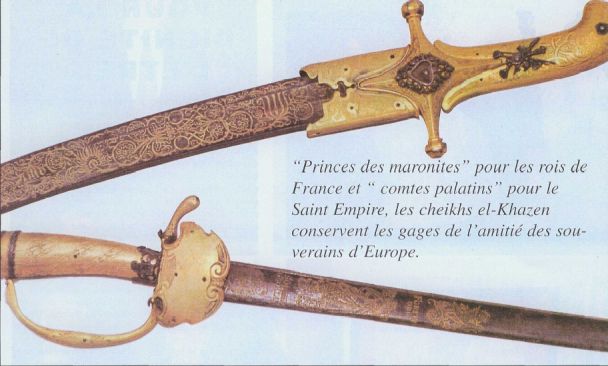
Origins of the "Prince of Maronite" Title
Growing diversity: the Khazin sheiks and the clergy in the first decades of the 18th century
Historical Members:
Barbar Beik El Khazen [English]
Patriach Toubia Kaiss El Khazen(Biography & Life Part1 Part2) (Arabic)
Patriach Youssef Dargham El Khazen (Cont'd)
Cheikh Bishara Jafal El Khazen
Patriarch Youssef Raji El Khazen
The Martyrs Cheikh Philippe & Cheikh Farid El Khazen
Cheikh Nawfal El Khazen (Consul De France)
Cheikh Hossun El Khazen (Consul De France)
Cheikh Abou-Nawfal El Khazen (Consul De France)
Cheikh Francis Abee Nader & his son Yousef
Cheikh Abou-Kanso El Khazen (Consul De France)
Cheikh Abou Nader El Khazen
Cheikh Chafic El Khazen
Cheikh Keserwan El Khazen
Cheikh Serhal El Khazen [English]
Cheikh Rafiq El Khazen [English]
Cheikh Hanna El Khazen
Cheikha Arzi El Khazen
Marie El Khazen