Former war photographer and airline chief executive isn't the usual career trajectory for an emerging craft beer brewer. But that's the path Beirut-born Mazen Hajjar trod before building his company, Hawkers Beer. Although the Reservoir brewery was founded just 2½ years ago, it put down roots much earlier. According to Hajjar, he started the Middle East's first craft brewery, 961 (the country code for Lebanon), during the July 2006 war between Israel and Hezbollah. After a trip to Australia to sell his beer, he decided to start a brewery here.

Chef Joseph Abboud (right) has collaborated with Lebanese craft brewer Mazen Hajjar for Hawkers Beer in Reservoir. When the business opened, initially in partnership with Joseph Abboud (owner of Melbourne restaurants Rumi and the Moor's Head), it was able to produce 600,000 litres of beer a year. Six upgrades later it has capacity for 6.5 million litres a year. Hajjar and his team are committed to sustainable brewing practices. The beer's ingredients don't include chemicals, with brewing techniques inspired by tradition as well as experimentation. The brewery is home to one of Australia's most high-tech brewing systems and can package 6000 bottles an hour. It also has the largest solar rooftop energy system on a brewery in metropolitan Melbourne. It is a nose bleed to manage such growth.

The Canadian gold coin is now thought to be in tiny pieces
How Berlin's Lebanese mafia clans work - by dw.com
A Lebanese organized crime family is said to be behind the spectacular theft of a giant Canadian gold coin - "the Big Maple Leaf" - from a museum in Berlin. But who are the "family R?" German police arrest criminals in Berlin (picture-alliance/dpa/P. Zinken) Berlin police arrested only three men, aged 18, 19, and 20, in connection with the theft in March of the "Big Maple Leaf" from Berlin's Bode Museum, but the police operation that went with it was far wider. Some 300 officers were out at 6 a.m. on Wednesday morning, searching 14 different properties in Berlin for clues to the theft of the 100-kilogram (221 pound) solid gold coin, whose material value is estimated at 3.75 million euros ($4.3 million). There is no trace of the coin itself, and police believe it has long since been cut to pieces and sold on. The brief police statement on the three arrests (a fourth man was arrested later) added that the ongoing searches had confiscated four firearms, "a low six-figure sum" in cash, clothing, shoes and five vehicles - all of which are now being examined for traces of gold. But while the theft itself was fairly lo-fi - the tools the police presented included an aluminum ladder, an axe handle, a wheel-barrow and a green rope with spring hooks - state prosecutor Martina Lamb told reporters that the conspiracy was sophisticated and far-reaching, and that the 13 suspects in total were "out of the circle of Arab clans." They were all "brothers, cousins and sons" of the "R." family (German law stipulates that the surnames of suspects aren't made public).
The Lebanese mafia The German media often revels in speculation about the organized crime networks of what are often called the "Arab clans" in Berlin. There is even a new TV drama "4 Blocks," about the scene. It is unclear exactly how many people belong to the 10 families thought to "run" various areas of the Neukölln district of Berlin (the arrests made this week also happened in this area), with estimates ranging from a few hundred to 8,000 or even 10,000 relatives spread across Germany. Nevertheless, Tom Schreiber, a Social Democrat representative in the Berlin state parliament, who published a 40-point plan to combat organized crime in the city last year, was keen to underline that only a small handful of the members of these families are actually criminals - "2 or 3 percent," he said. While the networks specialize in drug dealing and prostitution, they are not above the occasional spectacular robbery. In 2009, for instance, thieves broke into Germany's most famous department store - the KaDeWe in western Berlin - and got away with some 7 million euros worth of jewelry, which has never been recovered. "Up until now, they almost never found the loot, and they won't find the gold this time," said Ralph Ghadban, a Lebanese social worker turned author who has researched Berlin's organized crime networks. "And if the people end up in prison for a few years - if they get 3.7 million euros - it'll have been worth it."
by daily star.com.lb BEIRUT: Progressive Socialist Party chief MP Walid Jumblatt contacted Prime Minister Saad Hariri to voice his objection to Foreign …
by Thomas Woodley President of Canadians for Justice and Peace in the Middle East (CJPME) For years, Lebanese Canadians flying to Beirut …
Population Movements to Keserwan - The Khazens and The Maans
ما جاء عن الثورة في المقاطعة الكسروانية
ثورة أهالي كسروان على المشايخ الخوازنة وأسبابها
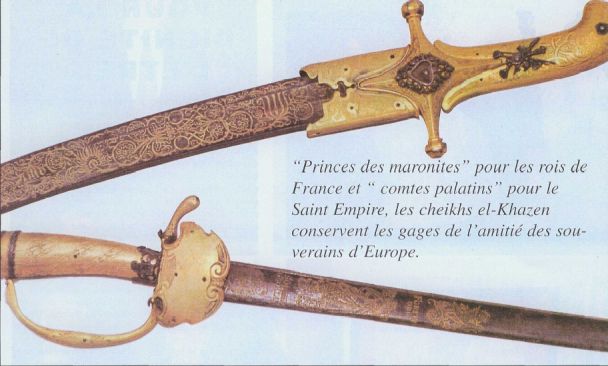
Origins of the "Prince of Maronite" Title
Growing diversity: the Khazin sheiks and the clergy in the first decades of the 18th century
Historical Members:
Barbar Beik El Khazen [English]
Patriach Toubia Kaiss El Khazen(Biography & Life Part1 Part2) (Arabic)
Patriach Youssef Dargham El Khazen (Cont'd)
Cheikh Bishara Jafal El Khazen
Patriarch Youssef Raji El Khazen
The Martyrs Cheikh Philippe & Cheikh Farid El Khazen
Cheikh Nawfal El Khazen (Consul De France)
Cheikh Hossun El Khazen (Consul De France)
Cheikh Abou-Nawfal El Khazen (Consul De France)
Cheikh Francis Abee Nader & his son Yousef
Cheikh Abou-Kanso El Khazen (Consul De France)
Cheikh Abou Nader El Khazen
Cheikh Chafic El Khazen
Cheikh Keserwan El Khazen
Cheikh Serhal El Khazen [English]
Cheikh Rafiq El Khazen [English]
Cheikh Hanna El Khazen
Cheikha Arzi El Khazen
Marie El Khazen