Asia Joumaa is a Lebanese web developer at the Beirut-based internet company Pixel38 and the top student to graduate from the second training cycle of SE Factory, an intensive coding bootcamp that provides young people with the technical skills they need to land jobs in the Lebanese digital sector — a space dominated by men from the top down of the glassy ceiling, like every tech ecosystem across the globe. “I’ve always wanted to work as a web developer, and then I got into SE Factory, which helped me get there,” shares Joumaa. “There’s a lot of young women who want to get into tech here in Lebanon.” Indeed there are.
At Beirut Digital District (BDD), a bustling tech hub in Lebanon’s capital that provides space and support services to 70 other companies (including SE Factory), the gender ratio is 55 percent women to 45 percent male. At the executive level, the ratio is 80 percent men to 20 percent women. But let’s back up for a second. The fact that more women are holding positions within BDD’s creative tech cluster, which is home to approximately 1,300 employees overall, is a bright anomaly, as there aren’t known tech scenes in the Western world where women outnumber men. In the U.S., the average percentage of women working in the tech industry is 30 percent, while women make up 59 percent of the country’s workforce. Meanwhile in the U.K., the percentage of women working in tech registers at 17 percent — lower than the number of women working in Parliament.
At this moment in time, embracing women in tech at any level should be non-negotiable for any business and government that intends to thrive. This isn’t simply because there is a growing, global crusade of groups championing female entrepreneurs. And it’s not because we’re not waiting 118 years for gender equality to finally transpire — because we’re not, by the way. It’s because women represent the largest market opportunity in the world, as they control $20 trillion in consumer spending a year. According to the 2016 World Economic Forum Global Gender Gap Report, Lebanon’s ranking for women’s rights is 135 out of 144. With more players in Lebanon’s digital network contributing to the employment and success of women, that position could and will hopefully change for the better. If the gender trend at BDD continues to expand beyond that community, and if more women in the country begin to pursue founder and executive roles, there’s hope for women to become a larger part of Lebanon’s economy.
By Elisabeth Sherman One of the world’s rarest, and oldest, cheeses in the world is made in Lebanon through a traditional, …

by Florence Massena, Contributor, Lebanon Pulse - Having become familiar with some of the material, Gino Raidy, the vice president of MARCH, the nongovernmental organization (NGO) behind the museum, told Al-Monitor, “Different trends could be observed according to the decades. In the 1940s, it mostly involved mentioning Israel.” Raidy further asserted, “In the 1950s-1960s, sexual explicitness was tolerated, but not political discussions. In the early 2000s, there was strong opposition to heavy metal. People would be arrested in the streets for wearing a heavy metal band T-shirt as many thought it was satanic. What stood to be censored became clearer after the Syrian army left in 2005, mostly focusing on sectarian and politics-related material. Nowadays, we note that LGBT art and events are getting targeted more and more.” The virtual museum aims to identify not only what has been banned and censored, but also the reasons behind it, in an effort to present the big picture when it comes to limits on freedom of expression in Lebanon.
The database launched on May 24, with an event at Phoenicia University, in Mazraat al-Daoudiyeh, in the south. An exhibition of panels and blackboards with words and names of individuals redacted to symbolize information omitted through censorship was followed by a discussion among free speech experts and activists. Participants included lawyer Hussein el-Achi, photojournalist Hussein Baydoun, author and activist Joumana Haddad, journalist and activist Luna Safwan and graffiti artist Omar Kabbani. In 2013 in Beirut, MARCH had organized “Censorship in Lebanon, An Uncensored Look,” a panel discussion on freedom of expression. Looking ahead, the team hopes to organize others in Tripoli after the end of Ramadan and maybe in the Bekaa Valley. “We believe that getting out of Beirut is important not only to inform people about censorship but also to have more discussions, address a different crowd living in rural areas and see what they think about the issue,” said Raidy, who is also a blogger. “Virtually, anyone can see what cultural material has been banned and censored, as well as what journalists and activists have been through when it comes to the expression of certain issues. We also invite people to submit entries if they hear about something new. Control over every cultural product in Lebanon is based on a law or decree, as detailed in “Censorship in Lebanon: Law and Practice,” a 2010 study by Nizar Saghieh, Rana Saghieh and Nayla Geagea, who are lawyers and members of The Legal Agenda, an NGO that follows socio-legal developments in Lebanon and the broader Middle East.
“Censorship of films in Lebanon is based on four very vague principles: respect for public morals, respect for the reputation or status of state authorities, respect for the sensitivities of the public and avoiding sectarian or religious incitement, and resisting calls that are unfavorable to the interests of Lebanon,” Ghida Frangieh, a lawyer with The Legal Agenda, told Al-Monitor. “If the General Security, which is a security agency, wants to ban a movie, it must refer it to an administrative committee, which reviews the film and gives its recommendation to the Ministry of Interior, which will make the final decision. The procedure is not transparent, and most of the time, the reason why a film is censored or banned is not given.” To this, Raidy added, “From the data we collected, the two main organizations asking General Security for censorship are first the Catholic Information Center and then Dar al-Fatwa,” the leading Sunni religious institution in the country. For example, in Nadine Labaki’s movie “Where Do We Go Now” (2012), a scene with a priest and a sheikh speaking to the public through the local mosque’s loudspeaker was cut. More recently, a Druze cleric's apparition was masked by a black dot in Philippe Aractingi’s 2017 movie “Listen /Ismaii.” Both decisions were supposedly based on concerns of sectarian incitement.

BEIRUT, Lebanon — Egypt, Saudi Arabia and three other Arab countries severed all ties with Qatar early Monday, in a renewal of a four-year effort to isolate it and in a sign of a new boldness after a visit to the region by President Trump. In an abrupt and surprising move, the five Arab states not only suspended diplomatic relations, as they have in the past, but also cut off land, air and sea travel to and from Qatar. All but Egypt, which has hundreds of thousands of people working there, ordered their citizens to leave the country. Qatar, like other monarchies in the Persian Gulf, is a close ally of Washington, and it hosts a major American military base that commands the United States-led air campaign against the Islamic State.
As such, the feud among regional allies threatens to stress the operations of the American-led coalition and complicate efforts in the region to confront Iran — but could also be a heavy blow to Tehran’s regional ambitions, if Qatar is forced to sever ties. Continue reading the main story Related Coverage Secretary of State Rex W. Tillerson offered to broker the impasse on Monday in the hope of preserving the Trump administration’s efforts to create broad coalitions against Iran and terrorist groups in the Middle East. “We certainly would encourage the parties to sit down together and address these differences,” Mr. Tillerson said. The severing of all connections by Bahrain, Egypt, Saudi Arabia, the United Arab Emirates and Yemen created an immediate crisis for Qatar. Qatari diplomats were given 48 hours to leave their posts in Bahrain, while Qatari citizens were allotted two weeks to depart Bahrain, Saudi Arabia and the United Arab Emirates. Photo President Trump in Riyadh, Saudi Arabia, in May.
Mr. Trump’s strong support for the Saudis may have helped encourage other Sunni states to renew their campaign against Qatar. Credit Stephen Crowley/The New York Times Qatar, a relatively small country jutting into the Persian Gulf, has a border with Saudi Arabia and is vulnerable to its larger neighbor. It imports almost all of its food, about 40 percent of it directly from Saudi Arabia. Several residents, reached on the internet chat, said that people were stocking up on food and cash. . Air traffic was disrupted, with the United Arab Emirates suspending service to Qatar by its three carriers, Etihad Airways, Emirates and FlyDubai, beginning Tuesday morning. Qatar Airways was banned from Saudi airspace. Saudi Arabia said it was taking the action to “protect its national security from the dangers of terrorism and extremism.” The Foreign Ministry of Qatar released a statement saying the action had “no basis in fact” and was “unjustified.” The Iranian government criticized the Saudi-led action against Qatar in a diplomatically worded rebuke. “Neighbors are permanent; geography can’t be changed,” Foreign Minister Mohammad Javad Zarif said on his Twitter account. “Coercion is never the solution,” Mr. Zarif said. “Dialogue is imperative, especially during blessed Ramadan.” It was not immediately clear why the five countries decided to take this action now.
Population Movements to Keserwan - The Khazens and The Maans
ما جاء عن الثورة في المقاطعة الكسروانية
ثورة أهالي كسروان على المشايخ الخوازنة وأسبابها
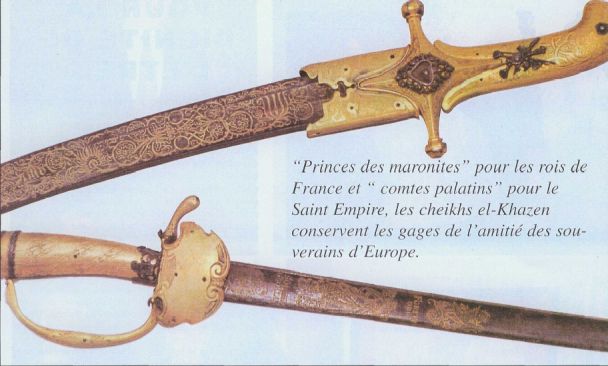
Origins of the "Prince of Maronite" Title
Growing diversity: the Khazin sheiks and the clergy in the first decades of the 18th century
Historical Members:
Barbar Beik El Khazen [English]
Patriach Toubia Kaiss El Khazen(Biography & Life Part1 Part2) (Arabic)
Patriach Youssef Dargham El Khazen (Cont'd)
Cheikh Bishara Jafal El Khazen
Patriarch Youssef Raji El Khazen
The Martyrs Cheikh Philippe & Cheikh Farid El Khazen
Cheikh Nawfal El Khazen (Consul De France)
Cheikh Hossun El Khazen (Consul De France)
Cheikh Abou-Nawfal El Khazen (Consul De France)
Cheikh Francis Abee Nader & his son Yousef
Cheikh Abou-Kanso El Khazen (Consul De France)
Cheikh Abou Nader El Khazen
Cheikh Chafic El Khazen
Cheikh Keserwan El Khazen
Cheikh Serhal El Khazen [English]
Cheikh Rafiq El Khazen [English]
Cheikh Hanna El Khazen
Cheikha Arzi El Khazen
Marie El Khazen