by Benjamin Sutton – hyperallergic.com Strollers along Beirut’s waterfront in the rapidly developing Biel area have been noticing an odd feature of the local …

by Josephine Deeb - Al Monitor
To some legislators' consternation but to no one's real surprise, Lebanon's parliamentary elections have been delayed yet again for at least three months. On April 12, the day before parliament was scheduled to meet, President Michel Aoun invoked Article 59 of the Lebanese Constitution, which allows him to postpone a parliamentary session for one month. He may do so once during the legislative term. Speaker Nabih Berri had called for the session to discuss extending parliament’s term, as members failed to agree on a new electoral law before a constitutional deadline expired. Aoun wants a new law implemented before elections are held for parliament, whose term ends June 21. He doesn't want the legislature to extend its own term without elections, which he considers illegal, but he also doesn't want a legislative vacuum. However, the constitution requires that voters be given 90 days to prepare for an election, so — because of repeated delays — one now can't be scheduled before August at the earliest. In a televised speech, Aoun addressed the Lebanese people, saying, “I have warned repeatedly against the extension since it is unconstitutional and will definitely not be the path toward the recovery of the government and its authorities and institutions on a sound constitutional basis.”
Minutes after Aoun announced his decision, Berri set another session for May 15. In the meantime, Lebanese political forces continue their quest to agree on an electoral law by then. Simon Abi Ramia, a member of parliament's Change and Reform bloc, told Al-Monitor that despite differences between the parties, political forces seek to agree on a new electoral law and his political bloc will strive to prevent a parliamentary extension by all means. Aoun wants to replace the contested 1960 Electoral Law, which is based on a majoritarian (winner-take-all) district electoral system with limited exceptions. That law allows Muslim leaders to select Christian parliament members in some constituencies. Aoun, a Maronite Christian, along with Hezbollah and the Amal Movement, are insisting on a "total proportionality" system, while others want either a hybrid law or the majoritarian system.
On the eve of April 13, the date set for the session to discuss the extension, the specter of civil war came back to haunt the Lebanese amid a sharp division of political forces and a serious threat by Christian political forces to take to the streets to prevent the session. They threatened to block the roads to prevent legislators from even reaching parliament.

by Rubina Abu Zeinab-Chahine| The Daily Star
Many years ago Lebanese journalism had always maintained a “reputation for excellence” and accordingly had a luster as a center of journalism. Historically, Lebanon was the first country in the region to have newspaper publishing, where the first was published in 1858. In the first half of the 20th century, hundreds of newspapers were published across the country, giving Lebanon its unique role in bridging East and West and making the history of the Lebanese press surrounded by analysts all over the Middle East. Press Martyrs’ Day is an occasion that has been commemorated on May 6 in public and private spheres throughout the country for many decades to honor journalists and activists killed in the name of free speech.
This occasion has always been a great opportunity to salute the Lebanese press and to praise the country’s media. It is a catalyst of hope to foster freedom and democracy and an eternal remembrance of journalists who sacrificed their lives for the country to survive and for the Lebanese people to live in peace. How did the Lebanese press assist the state in highlighting challenges and opportunities? Journalism in Lebanon has always been at the forefront of promoting social and political change. Twenty years ago Lebanon Opportunities, a leading business magazine, had “dreams abound of a modern country, fair to its citizens, hospitable to its returning or visiting expatriates and to tourists, enabling business to thrive and protecting the weak strata of its people” and committed itself to the “side of doers” as stated in the special anniversary issue of Lebanon Opportunities.
For 20 years, Lebanon Opportunities published every month, a magazine about “what is working, how it is done, where the opportunities are and how to face obstacles,” as presented by its publisher and editor-in-chief, Ramzi el-Hafez. Few words say everything about the hard work that has been delivering optimism and investing in hope throughout the last two decades. The 20th anniversary issue takes us in a “journey” of fulfilling a national promise of progress and development, backed up by statistics, analyzed and visualized data, generating a story of social change with strong impact on engaging audiences and promoting civic activism. It compares in a real and figurative sense the situation at the time the magazine started in 1997 with today’s situation, highlighting major national achievements in addition to emphasizing measures of success and failure.
BEIRUT, May 2 (Xinhua) Editor: Mu Xuequan — Hezbollah chief Sayyed Hassan Nasrallah called Tuesday the political parties in Lebanon to agree …
Population Movements to Keserwan - The Khazens and The Maans
ما جاء عن الثورة في المقاطعة الكسروانية
ثورة أهالي كسروان على المشايخ الخوازنة وأسبابها
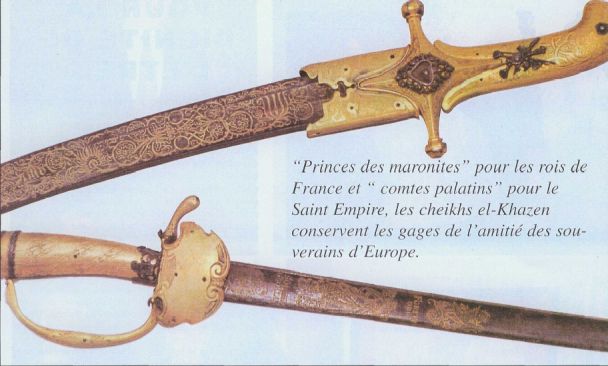
Origins of the "Prince of Maronite" Title
Growing diversity: the Khazin sheiks and the clergy in the first decades of the 18th century
Historical Members:
Barbar Beik El Khazen [English]
Patriach Toubia Kaiss El Khazen(Biography & Life Part1 Part2) (Arabic)
Patriach Youssef Dargham El Khazen (Cont'd)
Cheikh Bishara Jafal El Khazen
Patriarch Youssef Raji El Khazen
The Martyrs Cheikh Philippe & Cheikh Farid El Khazen
Cheikh Nawfal El Khazen (Consul De France)
Cheikh Hossun El Khazen (Consul De France)
Cheikh Abou-Nawfal El Khazen (Consul De France)
Cheikh Francis Abee Nader & his son Yousef
Cheikh Abou-Kanso El Khazen (Consul De France)
Cheikh Abou Nader El Khazen
Cheikh Chafic El Khazen
Cheikh Keserwan El Khazen
Cheikh Serhal El Khazen [English]
Cheikh Rafiq El Khazen [English]
Cheikh Hanna El Khazen
Cheikha Arzi El Khazen
Marie El Khazen