by The New Arab -- A new plan to make Beirut go cycle-friendly has gotten off to a rocky start, after pictures have emerged of drivers traversing into a new car-free cycle lane. The
new bike lane in the Downtown area was only laid less than a week ago,
but some cars have been photographed driving over the line - or even
parking in the bike lane. Supporters of the bike scheme have been quick to point out that the 20 metre-long bike lane
was empty at the time. Others on social media also said that more needs
to be done to raise awareness of bicycles in a city where bike riders
are few and far between. Lebanon launched its first
bike sharing scheme in the town of Byblos project in January, supported
and financed by private entities Bike 4 All and The IBL Bank. In
Beirut, the municipality will reportedly provide the space for 25
similar bike hiring stations, but will not be making any financial
contribution. If successful, the project could be
expanded to cover other major cities, such as Tripoli in the north,
where a limited cycling lane was launched recently but was unsucessful,
and Sidon and Byblos. One of the organisers behind the project, Jawad Sbeity, posted on social media that he wanted Beirut to be a bike friendly city by 2030.
The
bike scheme has received broad support from the government, but not
much is known on the Prime Minister's personal opinion of the scheme.
Vietnamese Ambassador to Egypt and Lebanon Do Hoang Long (right) presented his letter of credential to Lebanese President Michel Aoun at a …
by AFP: Lebanon launched a bike-sharing programme in its capital Beirut on Sunday, hoping to cut down on the congested city’s notorious …

Military helicopters flew overhead and police fanned out in force today as Pope Francis celebrated an open-air Mass for Egypt’s tiny Catholic community, on the final day of a visit aimed at comforting Christians following a series of attacks by Islamic militants. Despite the security concerns, Francis zoomed around the Cairo sports stadium in an open-topped golf cart before the start of Mass. The crowd cheered him wildly, waving Egyptian and Holy See flags and swaying to hymns sung by church choirs. The defence ministry’s stadium has a capacity of 25,000, but only about 15,000 people attended — a reflection that Catholics represent less than 1 percent of Egypt’s 92 million people. In his homily, Francis urged them to be good and merciful to their fellow Egyptians, saying “the only fanaticism believers can have is that of charity!” “Any other fanaticism does not come from God and is not pleasing to him!” he said.
Yesterday, Francis demanded that Muslim leaders renounce religious fanaticism that leads to violence. Francis made the appeal during a landmark visit to Cairo’s Al-Azhar, the revered, 1,000-year-old seat of Sunni Islam learning that trains clerics and scholars from around the world. Security was exceptionally tight around the stadium and in the upscale neighborhood where Francis spent the night, with uniformed and plain-clothed police stationed every meter (yard) or so along his motorcade route. Police used metal detectors to check vehicles for explosives and armed guards stood watch, some on rooftops, their faces covered. But Francis decided to forego the bullet-proof “popemobile” that his predecessors used on foreign trips and drove through Cairo in a simple Fiat, his window rolled down.
“He is a messenger of peace, he is really a messenger of peace,” said Amgad Eskandr before the Mass got under way at the stadium. “All his words talk about peace, call for peace, push for peace which is great.” His gestures sent a defiant message to the extremist Islamic State group, whose local affiliate in Egypt has vowed to target Egypt’s Christians to punish them for their support of President Abdel-Fattah el-Sissi. As defense minister, El-Sissi had led the military ouster of the Islamist Mohammed Morsi, Egypt’s first freely elected president whose one-year rule proved divisive.
Already, attacks against Christians in northern Sinai, the epicenter of the insurgency, have forced hundreds of families to flee the region, seeking refuge elsewhere in Egypt. Recent attacks on churches — one in Cairo in December and twin Palm Sunday attacks in cities north of the Egyptian capital — have claimed at least 75 lives and injured scores.
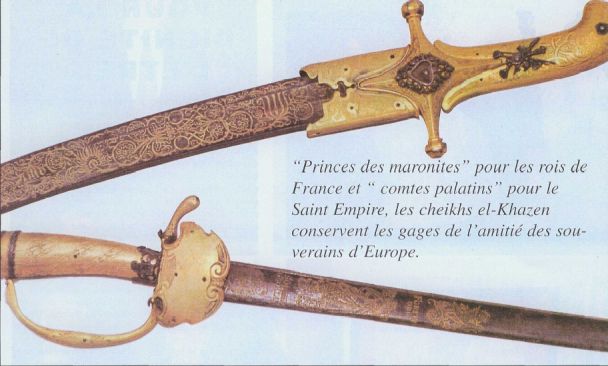
Population Movements to Keserwan - The Khazens and The Maans
ما جاء عن الثورة في المقاطعة الكسروانية
ثورة أهالي كسروان على المشايخ الخوازنة وأسبابها
Origins of the "Prince of Maronite" Title
Growing diversity: the Khazin sheiks and the clergy in the first decades of the 18th century
Historical Members:
Barbar Beik El Khazen [English]
Patriach Toubia Kaiss El Khazen(Biography & Life Part1 Part2) (Arabic)
Patriach Youssef Dargham El Khazen (Cont'd)
Cheikh Bishara Jafal El Khazen
Patriarch Youssef Raji El Khazen
The Martyrs Cheikh Philippe & Cheikh Farid El Khazen
Cheikh Nawfal El Khazen (Consul De France)
Cheikh Hossun El Khazen (Consul De France)
Cheikh Abou-Nawfal El Khazen (Consul De France)
Cheikh Francis Abee Nader & his son Yousef
Cheikh Abou-Kanso El Khazen (Consul De France)
Cheikh Abou Nader El Khazen
Cheikh Chafic El Khazen
Cheikh Keserwan El Khazen
Cheikh Serhal El Khazen [English]
Cheikh Rafiq El Khazen [English]
Cheikh Hanna El Khazen
Cheikha Arzi El Khazen
Marie El Khazen