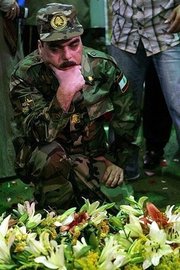
 (AFP) – Israeli security officials warned on Thursday that Lebanese murderer Samir Kantar, who was freed in a prisoner swap after nearly three decades behind bars, should now fear for his own life. "Every terrorist who committed an act of terror against Israel, especially someone like Kantar, who killed a little child and two other people, is a target," one of the officials told AFP. "If there is a chance for Israel to close the file on Kantar, Israel won’t hesitate," he added, speaking on condition of anonymity. Kantar, who turns 46 next week, was just 17 when he was sentenced to five life terms for a 1979 triple murder in one of the most notorious attacks in Israeli history. He was convicted of killing a police officer, a civilian and a four-year-old girl, whose skull he was accused of crushing with his rifle butt, in a raid in the northern Israeli town of Nahariya. Kantar, the longest-serving Arab prisoner in Israel, was freed on Wednesday along with four Hezbollah fighters captured in the 2006 war between Israel and the Lebanese Shiite guerrilla group. Another security official said Kantar "has become a target for killing." "Now that he is out of jail, we have no obligation towards Kantar, a loathsome murderer whose accounts will be settled in the end," the unnamed official told the top-selling Yediot Aharonot newspaper.
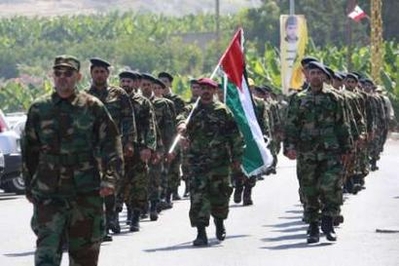
 AABEY, Lebanon (AFP) – Samir Kantar said on Thursday he had no regrets over the triple murder three decades ago that put him behind bars. I haven’t for even one day regretted what I did," he told AFP as he arrived at his family home in the Druze village of Aabey, southeast of Beirut, where he was given a hero’s welcome. "On the contrary I remain committed to my political convictions." Kantar, who turns 46 on July 22, was just 17 when he was sentenced to five life terms for a 1979 triple murder in one of the most notorious attacks in Israeli history. I feel enormous joy because I have returned to the ranks of the resistance and to my family," he said with defiance, dressed in a Hezbollah military uniform. People showered Kantar with rice and flower petals as he neared his humble home, where two men sacrificed a lamb in his honour. "A 16-year-old is different to a 46-year-old but his facial expressions and his smile are the same," his step-mother Siham Kantar, 71, told
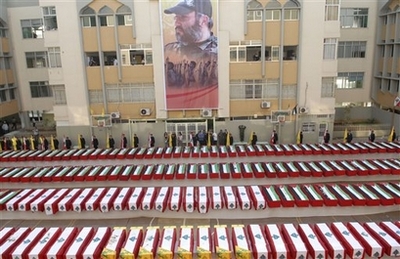
 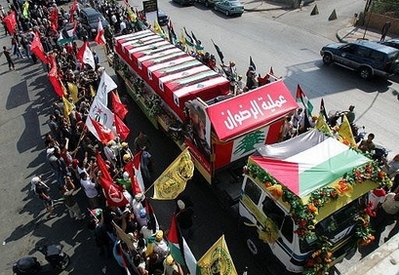 AFP. Druze leaders Walid Jumblatt and Talal Arslan as well as Labour Minister Mohamed Fneish, a member of Hezbollah, took part in the ceremonies in Aabey, lauding Kantar as a hero of the resistance. He was released by Israel along with four Hezbollah fighters on Wednesday in exchange for the bodies of two Israeli soldiers captured in a deadly cross-border raid by the Shiite guerrilla group two years ago. Funerals were held for the two soldiers on Thursday. Their capture sparked a 34-day war between Hezbollah and Israel in which more than 1,200 Lebanese, mostly civilians, and over 160 Israelis, mostly soldiers, were killed. "We are very happy on this beautiful day, this is a victory for Lebanon and the national resistance," said Yusra Khaddaj, 39, as she stood with her three young daughters on the road leading to Aabey. "Samir Kantar is the son of all the Lebanese," she added. One banner along the road leading to Aabey read: "From Palestine, to Iraq to Lebanon, the resistance is victorious." Israel on Wednesday also handed over the remains of 199 Lebanese and Palestinian fighters killed in recent years. Hundred of supporters threw rose petals and rice and some cheered as four tractor-trailers carrying the bodies arrived in Beirut from the border town of Naqura where Wednesday’s swap took place. The mothers of some of the Palestinian fighters killed in battles with Israeli troops during Lebanon’s 1975-1990 civil war wept and tried to touch the coffins draped in Lebanese or Palestinian flags. Other family members carried pictures of their missing sons, as the bodies of the fallen fighters were unloaded from the vehicles into a schoolyard where a communal prayer was to be held for them. Hezbollah has dubbed the swap "the Radwan operation" after the alias used by notorious Hezbollah military commander Imad Mughnieh, who was killed in a bombing in Syria in February blamed on Israel. Kantar visited Mughnieh’s tomb in Hezbollah’s stronghold in the southern suburbs of Beirut before heading to his village. His release and return to a jubilant hero’s welcome in Lebanon drew condemnation in Israel, where security officials warned he was now a target for killing. "Every terrorist who committed an act of terror against Israel, especially someone like Kantar, who killed a little child and two other people, is a target," one official told AFP.
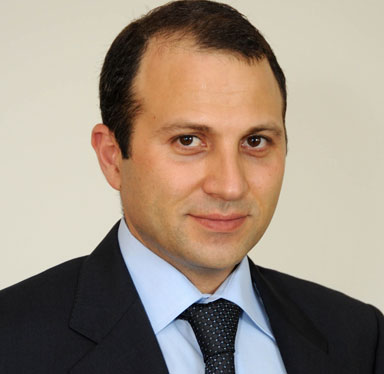 BEIRUT Middle east online – Lebanon’s new telecommunications minister on Thursday accused Israel of bombarding Lebanese people with threatening phone calls, a day after a prisoner swap between Israel and Hezbollah. "Hundreds of people throughout Lebanon received threatening phone calls on their landlines from Israel," Gibran Bassil said. "The phone would ring, the person would answer and they would hear a message saying, ‘This is from the state of Israel. Abandon Hezbollah or there will be another war, like there was in 2006,’" he said. Bassil, a member of the Free Patriotic Movement, the main Christian party in the opposition, said he has written a letter of protest to UN Secretary General Ban Ki-moon. "We consider this to be a clear violation of UN Security Council resolution 1701," Bassil said, referring to the resolution which ended the devastating 34-day war in 2006 between Israel and Hezbollah. No comment was immediately available from Israel. Many Lebanese had received similar phone messages urging them not to support Hezbollah during the course of the war which killed more than 1,200 Lebanese, mostly civilians and more than 160 Israelis, mostly soldiers. The news comes a day after the bodies of two Israeli soldiers were exchanged for five Lebanese prisoners and the remains of almost 200 Lebanese and Palestinian fighters.
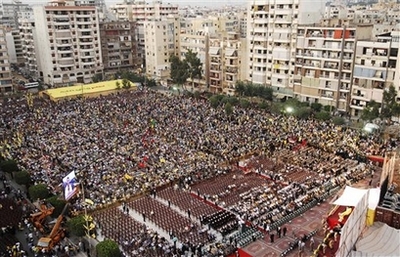 Five Lebanese prisoners freed by Israel arrived to a hero’s welcome in Lebanon Wednesday, hours after Hizbullah handed over the bodies of two Israeli soldiers seized two years ago. They were then flown by helicopters to Beirut, where they were accorded a red-carpet welcome by Lebanese President Michel Sleiman, Prime Minister Fouad Siniora, Parliament Speaker Nabih Berri, the entire Cabinet and a host of lawmakers and religious leaders. The five – Kontar and Hizbullah fighters Khaled Zidan, Maher Kourani, Mohammad Srour and Hussein Suleiman – stood on a platform as Sleiman spoke before shaking hands with politicians lined up to greet them. "Your return is a new victory and the future in your presence will be a path in which we will realize the sovereignty of our territory and the liberty of our people," Sleiman said. "I tell Samir and his companions that they have a right to be proud of their country, their army and their resistance." Kontar kissed his mother, Siham, 71, after the meet and greet with the politicians as crowds and the media swarmed around him. His mother had burst into tears earlier while waiting at the airport when she was told her son had arrived in Naqoura and was indeed free after more than 28 years in jail. "I never gave up hope for a day," she said, choked by emotion. "This moment makes up for 30 years of waiting. I want to hug and kiss him. My only wish is to see him." The four freed Hizbullah fighters were captured in the July-August 2006 war. They and Kontar were the last remaining Lebanese prisoners in Israel. "This new victory completes the victory of the July war," Kontar told Hizbullah television Al-Manar. Hizbullah chief Sayyed Hassan Nasrallah gave a speech in Beirut’s southern suburbs, where tens of thousands of people gathered Wednesday evening to hail his success in emptying Israeli jails of Lebanese prisoners. The five prisoners were released in exchange for the bodies of two Israeli soldiers, Ehud Goldwasser and Eldad Regev, captured on July 12, 2006. The fate of the two soldiers was not known until their bodies were returned to Israel Wednesday morning. "Today we hand over Ehud Goldwasser and Eldad Regev," Hizbullah official Wafiq Safa said in Naqoura, as men placed two black coffins on the ground amid a crowd of onlookers. The mood in Israel had been sombre as it waited to learn the fate of Goldwasser and Regev.
 LEBANON/ISRAEL BORDER (Reuters) – Israel handed over five Lebanese prisoners to Hezbollah via the Red Cross on Wednesday after the group returned the bodies of two Israeli soldiers seized in a cross-border raid in 2006. Among the men who arrived at the border in an
 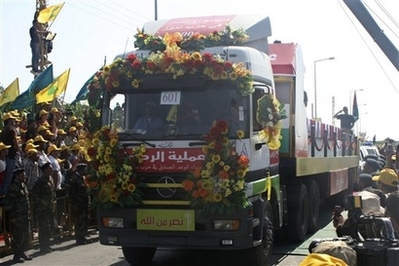 Hezbollah also received the bodies of almost 200 people, including the body of Dalal al-Maghrebi, a female fighter with the Palestinian Fatah movement. Before the exchange there had been speculation that at least one of the Israeli soldiers had been alive, but Hezbollah TV confirmed that both were dead. Two coffins containing the bodies were taken in Red Cross vehicles across the border from Lebanon into Israel to be identified. ‘Difficult decision’ The prisoners were brought across the border in a convoy of four International Committee of the Red Cross vehicles and were greeted by Wafiq Safa, Hezbollah’s chief prisoner swap negotiator."The Israeli cabinet agonised over it [the exchange] and voted in favour of it against the advice of the Israeli intelligence service … which thinks it will only encourage kidnappings," David Chater, Al Jazeera’s correspondent in Israel, said. "But the bulk of Israeli public opinion is behind this deal," he said, reporting from Rosh Hanikra – the Israeli side of the border – where he said there was a strong military presence ahead of the exchange. Miri Eisin, a former aide to Ehud Olmert, the Israeli prime minister, said Israel found the release of Kuntar an "incredibly difficult decision". "Today in Israel we are mainly reflecting on the price we pay in our country to defend our borders," she told Al Jazeera. At the family home of reservist Regev, a crowd of about 50 mourners gathered and his family wept, seeing their son’s coffin displayed on television for the first time. "Eldad! Eldad! What have they done to you?" Hana, Regev’s aunt, said.
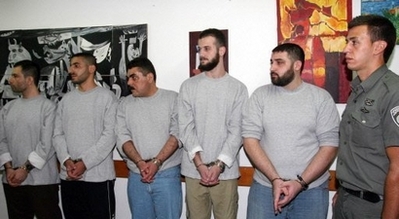 The four others are Hezbollah fighters captured in the 2006 conflict. All five were to be flown to Beirut ahead of a huge Hezbollah rally to welcome them in the evening. President Michel Suleiman, Prime Minister Fouad Siniora and
 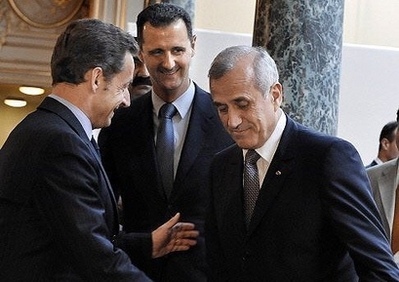 PARIS (AFP) – Lebanon and Syria have agreed to establish diplomatic relations, opening embassies in each others’ capitals for the first time since their independence from colonial rule.
 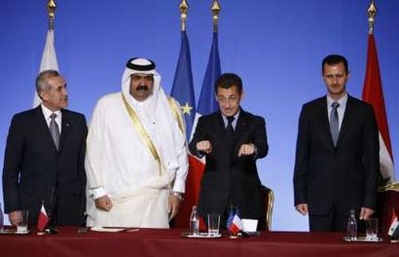 According to Suleiman, the legal and administrative arrangements needed to implement "this agreement would be taken as soon as possible in coordination between the two capitals," Beirut and Damascus. "We look forward to tackling the topic of demarcating the Lebanese-Syrian borders through the required mechanism based on the brotherly relations between the two sisterly states," Suleiman said. He said Lebanon is "committed to regaining its full sovereignty over the Shebaa Farms," an area occupied by Israel since 1967. Answering reporters’ questions as to whether Lebanon would go into peace talks with Israel, Suleiman said: "We expect Israel to implement international resolutions, especially UN Security Council Resolution 1701 that was adopted two years ago and Israel has not pulled out of the Ghajar (village) Shebaa Farms and Kfar Shouba hills." On May 24, 2000, Israel withdrew its troops from a large territory in southern Lebanon, which it had been occupying since 1978. A significant issue relating to the withdrawal remains unsettled. This relates to the status of certain villages and adjacent land on the eastern side of Alsheikh Mountain, known as the Shebaa Farms. The Lebanese government advised the United Nations that it considers the area to be Lebanese territory and that, as such, the withdrawal must encompass it. Israel insists that the land was captured from Syria in 1967 and its fate should be discussed in future peace talks between Israel and Damascus. Meanwhile Druze leader Walid Jumblatt, a key member of Lebanon’s ruling majority, lashed out at France for receiving the Syrian president. "Receiving the head of the Syrian regime by the French leadership is a clear disrespect to the feelings of the Lebanese people and its prisoners who are still held in Syria," Jumblatt told a group of his followers on Sunday. No-one knows exactly how many Lebanese political prisoners are in Syrian jails. Syria and Lebanon’s former pro-Syrian president Emile Lahoud have denied there are any. They claim all political prisoners were released in December 2000. But Ghazi Aad, head of a group called SOLIDE (Support of Lebanese in Detention and Exile) said he has been working with the families of detainees for 15 years. He added that his organization has files on 176 known detainees in Syrian prisons and there could be more.
  by Rana Moussaoui
 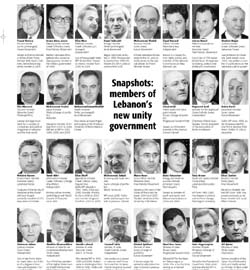 By Hussein Abdallah, BEIRUT: Lebanon announced a 30-member national unity government on Friday after almost five weeks of disputes over the distribution of portfolios. The lineup was announced in a decree signed by President Michel Sleiman and Prime Minister Fouad Siniora following a short meeting between them and Parliament Speaker Nabih Berri. The formation of the Cabinet came in line with the accord sealed in Doha on May 21 which allocated 16 cabinet seats to the parliamentary majority, 11 to the opposition, and three to the president.
  by Omar Ibrahim
  by Omar Ibrahim
 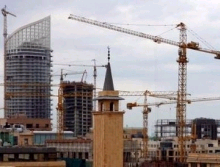 BEIRUT: Lebanon expects over 1.3 million tourists this year thanks to the positive political atmosphere following the election of a new president, outgoing Tourism Minister Joe Sarkis said Friday. The minister made the remarks during a tour of Rafik Hariri International Airport, adding that most of the hotels in Beirut and the mountain are fully booked. According to the figures released by Rafik Hariri International Airport, arriving passengers totaled 598,392 in the first five months of the year, while departing passengers amounted to a higher 633,255.