By Ian Sample - theguardian.com
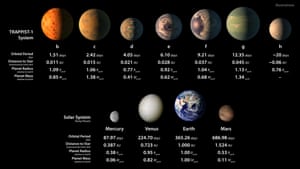
A huddle of seven worlds, all close in size to Earth, and perhaps warm
enough for water and the life it can sustain, has been spotted around a
small, faint star in the constellation of Aquarius The discovery, which has thrilled astronomers, has raised hopes that
the hunt for alien life beyond the solar system could start much sooner
than previously thought, with the next generation of telescopes that are
due to switch on in the next decade.
It is the first time that so many Earth-sized planets have been found
in orbit around the same star, an unexpected haul that suggests the
Milky Way may be teeming with worlds that, in size and firmness
underfoot at least, resemble our own rocky home. The planets closely circle a dwarf star named Trappist-1,
which at 39 light years away makes the system a prime candidate to
search for signs of life. Only marginally larger than Jupiter, the star
shines with a feeble light about 2,000 times fainter than our sun.
“The star is so small and cold that the seven planets are temperate, which means that they could have some liquid water and maybe life, by extension, on the surface,” said Michaël Gillon, an astrophysicist at the University of Liège in Belgium. Details of the work are reported in Nature. While the planets have Earth-like dimensions, their sizes ranging from 25% smaller to 10% larger, they could not be more different in other features. Most striking is how compact the planet’s orbits are. Mercury, the innermost planet in the solar system, is six times farther from the sun than the outermost seventh planet is from Trappist-1.
by Naharnet – Palestinian President Mahmoud Abbas held talks Thursday with President Michel Aoun at the Baabda Palace at the beginning of …

By english.aawsat.com
Beirut-Lebanese Prime Minister Saad Hariri has said that endorsing the state budget tops the list of government’s goals, adding any new tax would take into consideration interests of both citizens and the economic sectors. Hariri said that approving the ranks and salaries scale should be linked to administrative reforms and ensuring financial resources to finance them. Speaking to a delegation from the economic bodies headed by former Minister Adnan Kassar, the Prime Minister said that a package of taxes and fees made headlines in the past few days, as it is expected to overwhelm citizens -mainly those with limited income-, and some sectors, including the banking sector.
The PM clarified that ongoing discussions on new taxes and fees in the cabinet, will secure the balance between interests of citizens and different economic sectors, and will ensure additional resources to finance the budget. Hariri also noted that the country is battling hard economy conditions, and the government aims to hold a practical discussion to define the taxes and fees that should be applied, with the least impact on the economic growth and on the low-income class.
He added that discussions held in the cabinet are open to reach a balance between the needs of the private sector, citizens and the state. On the other hand, there is a package of incentives to motivate the private sector, which will likely be included in the draft state budget. Hariri said that approving the ranks and salaries scale is being studied by the cabinet; in case it is approved, it should be linked to administrative reforms and suitable financial resources to finance them. Without reforms and commitment to implement them, the ranks and salaries scale cannot be approved, as it is not possible to increase wages without improving productivity in the public sector and activating public administration.
As for increasing the electricity tariff, Hariri said: “I personally believe that it is not permissible to increase the tariff before increasing and improving electricity hours.” The Prime Minister concluded by saying that the government works on developing a new plan to deal with the Syrian refugee issue; it intends to benefit from the international support to develop the infrastructure used by the displaced Syrians especially roads, schools, universities, hospitals, electricity and water sectors.
By Wassim Seifeddine Lebanese President Michel Aoun expressed hope Tuesday that U.S. support for the Lebanese army would continue “to allow Lebanon …




Population Movements to Keserwan - The Khazens and The Maans
ما جاء عن الثورة في المقاطعة الكسروانية
ثورة أهالي كسروان على المشايخ الخوازنة وأسبابها
Origins of the "Prince of Maronite" Title
Growing diversity: the Khazin sheiks and the clergy in the first decades of the 18th century
Historical Members:
Barbar Beik El Khazen [English]
Patriach Toubia Kaiss El Khazen(Biography & Life Part1 Part2) (Arabic)
Patriach Youssef Dargham El Khazen (Cont'd)
Cheikh Bishara Jafal El Khazen
Patriarch Youssef Raji El Khazen
The Martyrs Cheikh Philippe & Cheikh Farid El Khazen
Cheikh Nawfal El Khazen (Consul De France)
Cheikh Hossun El Khazen (Consul De France)
Cheikh Abou-Nawfal El Khazen (Consul De France)
Cheikh Francis Abee Nader & his son Yousef
Cheikh Abou-Kanso El Khazen (Consul De France)
Cheikh Abou Nader El Khazen
Cheikh Chafic El Khazen
Cheikh Keserwan El Khazen
Cheikh Serhal El Khazen [English]
Cheikh Rafiq El Khazen [English]
Cheikh Hanna El Khazen
Cheikha Arzi El Khazen
Marie El Khazen