by Michael Karam
The Lebanese have a wonderful ability to adapt. I guess it comes from having to fend for themselves under various occupiers down the millennia. But even today, 74 years after winning independence from France, the average Lebanese knows that he cannot rely on the state for health care, education, electricity and water. It is a situation that has allowed sectarian politics to flourish to the extent that allegiance to a political party is often greater than that to the government, but it has also prompted the private sector to take matters into its own hands. Lebanon is, after all, arguably the purest expression of a mercantile culture.
I was thinking about this last week when the British media was once again in a fit of angst over the National Health Service (NHS). Now I happen to think, having lived full-time in the UK for over two decades, that the NHS, along with that of the Sécurité Sociale in France, is not only one of the best healthcare systems in the world, but also one of the greatest expressions of the welfare state anywhere on the planet. Even if it appears to be in terminal crisis: staff shortages, overcrowding (often attributed to so-called health tourists and EU immigration) and underfunding (the austerity measures implemented by the Conservative government have been blamed). Accident and Emergency departments across the country are the regular focus of "NHS in turmoil" stories, with tales of patients lying on stretchers in corridors for hours waiting for treatment. It’s a sorry situation all round. Part of the problem lies with the fact that many people will pop into A&E with non-life- threatening conditions such as a sprained ankle or a bad cold, either because their GP is not available or they are simply lazy and selfish, or both, and there have been calls to give pharmacists greater powers to treat conditions that do not really require a hospital visit. This would in theory free up hospitals to deal with more deserving cases.
The Lebanese have been doing this for decades. The local pharmacy is not just a place to buy Panadol and lozenges. Pharmacists in Lebanon are almost as highly regarded as physicians and play an integral role in coordinating with the ministry of health to ensure what healthcare system there is can function.
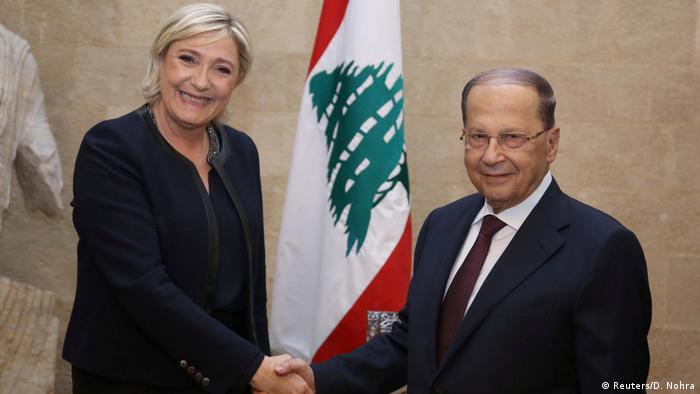


Le Pen, who is trying to establish international credentials as part of her current bid for the Elysée Palace, was also meeting business and religious leaders during the two-day visit to the Middle Eastern nation. "We discussed the long and fruitful friendship between our two countries," the National Front (FN) leader said after meeting Aoun at the presidential palace in the hilltop suburb of Baabda. She said they also discussed the refugee crisis in Lebanon, where more than one million war-weary Syrians have fled in recent years. "We raised... the concerns we share over the very serious refugee crisis," she said. "These difficulties are being overcome by the courage and generosity of Lebanon but this cannot go on forever." Opinion polls show that Le Pen is on pace to win the first round of France's presidential election on April 23, but that she will be beaten in the run-off ballot on May 7.
Word of caution
The leader of the anti-immigration FN party also met Lebanese Prime Minister Saad Hariri, a Sunni Muslim, who cautioned against associating his religion with jihadists who have repeatedly targeted France. "The worst mistake would be the amalgam between Islam and Muslims on one hand and terrorism on the other hand," Hariri said, in a statement issued by his office. "The Lebanese and Arabs, like the majority of the world, consider France to be the homeland of human rights and of the republican state that makes no ethnic, religious or class distinction between its citizens," he said. On Tuesday, Le Pen is to meet Lebanon's grand mufti, the leader of its Sunni community, the Maronite Christian patriarch and rightist Christian party leader Samir Geagea.

By Hashem Osseiran - Middle-East Online - BEIRUT
A city with staggeringly slow internet service, a severe economic slowdown and perpetual political stalemates does not seem to be a likely place for a burgeoning tech sector. Beirut, however, is defying expectations by emerging as a tech gateway for the Middle East. In the past three years, Beirut has developed many of the elements necessary to become a regional tech powerhouse: Greater access to funding, government support and a growing number of accelerators and incubators.
A database compiled by Arabnet, a start-up incubator and media company, indicates that Lebanon boasts nearly 200 start-ups. A report by the group put Lebanon in second place regionally, after the United Arab Emirates, for the number and value of investments in its tech sector. Beirut has also become a regional hub for tech conferences and seminars. It is one of four cities to host the annual Arabnet conference, the region’s leading forum on digital business. Lebanon’s BDL (Banque du Liban) Accelerate conference last year was one of the ten biggest tech conferences in the world.
Only six years ago, limited funding opportunities and little government support made development of Lebanon’s tech industry difficult for emerging start-ups, said Omar Omran, a Paris-based tech entrepreneur who in 2011 founded Lebanon’s first mobile app development company. “Back then, it was not easy to find investors or receive support from Lebanese banks. We were funding everything,” Omran said during a Skype interview.

French far-right presidential candidate Marine Le Pen arrived in Lebanon on Sunday evening for a two-day visit during which she was to have her first official meeting with a foreign head of state, President Michel Aoun. She was also set to meet Prime Minister Saad Hariri. Le Pen's meeting with Aoun will be the first time she has been officially received by a foreign leader since taking over the party leadership from her father, Jean-Marie, in 2011.
Her National Front (FN) party hopes it will show she is taken seriously abroad, following a number of disappointments in that field. The Lebanese leaders have already met centrist candidate Emmanuel Macron and would have met mainstream right presidential candidate François Fillon had he not cancelled his visit because of the Penelopegate scandal.
Population Movements to Keserwan - The Khazens and The Maans
ما جاء عن الثورة في المقاطعة الكسروانية
ثورة أهالي كسروان على المشايخ الخوازنة وأسبابها
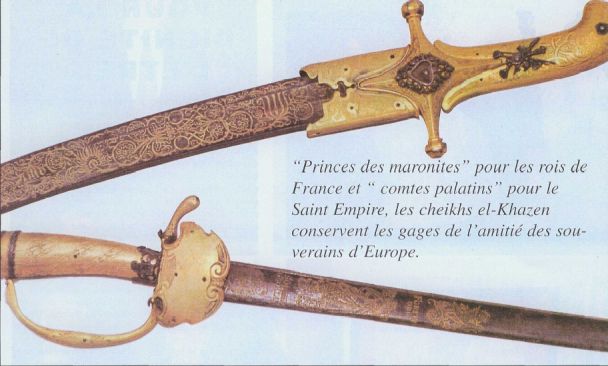
Origins of the "Prince of Maronite" Title
Growing diversity: the Khazin sheiks and the clergy in the first decades of the 18th century
Historical Members:
Barbar Beik El Khazen [English]
Patriach Toubia Kaiss El Khazen(Biography & Life Part1 Part2) (Arabic)
Patriach Youssef Dargham El Khazen (Cont'd)
Cheikh Bishara Jafal El Khazen
Patriarch Youssef Raji El Khazen
The Martyrs Cheikh Philippe & Cheikh Farid El Khazen
Cheikh Nawfal El Khazen (Consul De France)
Cheikh Hossun El Khazen (Consul De France)
Cheikh Abou-Nawfal El Khazen (Consul De France)
Cheikh Francis Abee Nader & his son Yousef
Cheikh Abou-Kanso El Khazen (Consul De France)
Cheikh Abou Nader El Khazen
Cheikh Chafic El Khazen
Cheikh Keserwan El Khazen
Cheikh Serhal El Khazen [English]
Cheikh Rafiq El Khazen [English]
Cheikh Hanna El Khazen
Cheikha Arzi El Khazen
Marie El Khazen