By Gulf News – Joseph A. Kechichian, Senior Writer Beirut: Notoriously undisciplined drivers in Lebanon loathe the many speed bumps on public …

By Robert Cusack
Israeli aircraft reportedly bombed a number of Syrian airbases near Damascus for the second time this year on Wednesday night. The Israeli military has not officially commented on the reported airstrikes. The Lebanese army has said Tel Aviv's jets used Lebanese airspace at around 3:00am [0100GMT] to launch the strikes, reported Al-Jadeed Lebanon. One of the targets was a Hizballah arms convoy travelling with the Syrian army's 3rd division, reported the Jerusalem Post.
Lebanese media reported that the strike was launched from Lebanese airspace in order to bypass the Russian-made air defence systems in southern Syria. Hizballah's leader, Hassan Nasrallah, last week reiterated his organisation's opposition to Israel. "Hizballah will have no red lines in the next war with Israel," he said. "Israel should think a million times before it goes to war with Lebanon."
Lebanon's President Aoun spoke in support of Hizballah's arms stockpile in the country's south, saying it was "essential" for the country's defence. "Hizballah weapons are not contradictory to the state, but are an essential part in defending the country," he said. Syria issued a warning when Israel last struck an arms convoy on January 13 near Damascus airport, a short distance from President Assad's palatial residence.

BEIRUT — France’s Presidential candidate Marine Le Pen refused to don a headscarf for a meeting with Lebanon’s top Sunni Muslim cleric on Tuesday and walked away from the scheduled appointment after a brief squabble at the entrance. Le Pen, who is on a three-day visit to Lebanon this week and has met senior officials, was to meet with the country’s grand mufti, Sheikh Abdel-Latif Derian. Shortly after she arrived at his office, one of his aides handed her a white headscarf to put on. Following a discussion with his aides that lasted few minutes, she refused and returned to her car.
On Monday, she met with President Michel Aoun and Prime Minister Saad Hariri. She said Syrian President Bashar Assad was “the most reassuring solution for France,” adding that the best way to protect minority Christians is to “eradicate” the Islamic State group preying on them — not turn them into refugees. Some Lebanese officials including, including Hariri, a Sunni, have taken umbrage at what is widely seen as her stigmatization of Muslims, who her followers claim are changing the Christian face of France. There was also apparent displeasure at her comments on Assad.
Lebanese Forces leader, Samir Geagea said after meeting with Le Pen on Tuesday that “terrorism has no religion.” He described Assad as “the biggest terrorist in Syria and the region.” PSP Leader Walid Jumblatt, in Lebanon, tweeted on Tuesday that Le Pen’s statements in Lebanon “were an insult toward the Lebanese people and Syrian people.”
After walking away from the meeting with the grand mufti, Le Pen said she had previously told the cleric’s office that she would not wear a headscarf. “They didn’t cancel the meeting, so I thought they would accept the fact that I wouldn’t wear one,” she said. “They tried to impose it upon me.” The office of Lebanon’s mufti issued a statement saying that Le Pen was told in advance through one of her aides that she would have to put on a headscarf during the meeting with the mufti. “This is the protocol” at the mufti’s office, the statement said. It said the mufti’s aides tried to give her the headscarf and that Le Pen refused to take it
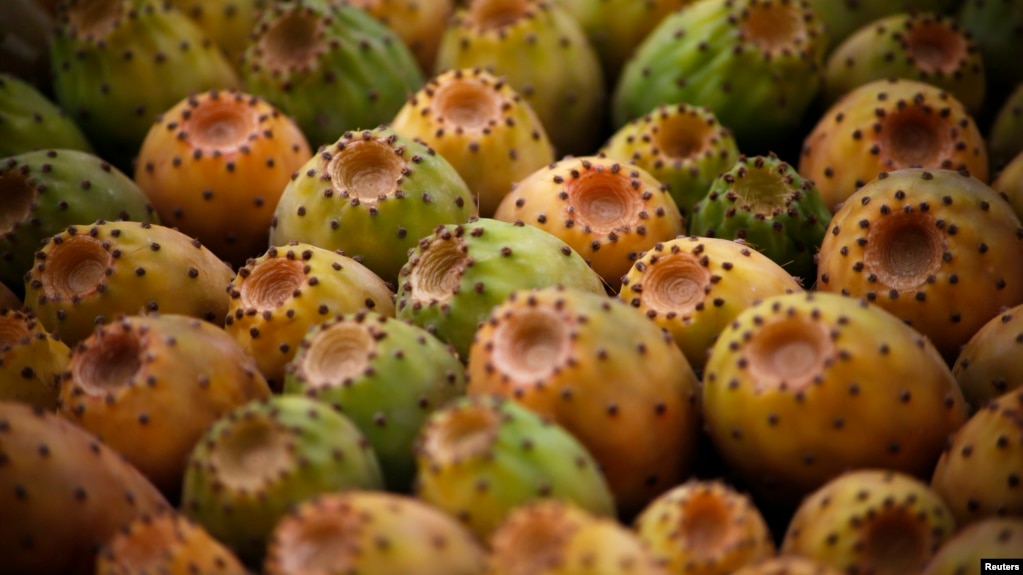
Prickly pears are displayed for sale at a stall in Beirut. A dozen prickly pears are sold for approximately $4 in the Lebanese market.
by Jessica Berman -- From VOA Learning English, this is the Health & Lifestyle report.
In the future, chemicals from plants found in and around the Mediterranean may be used to help treat people with brain diseases such as Alzheimer's and Parkinson's. These two diseases are age-related and neurodegenerative. Neurodegenerative relates to the degeneration of nervous tissue, especially the brain. People suffering from Alzheimer's and Parkinson's have deposits of sticky plaque in their brains. Over time, this plaque reduces brain function. Eventually, it causes death.
Scientists say plaque can be reduced
But scientists say the plaque deposits can be reduced with chemicals from plants, including prickly pear and brown seaweed. Scientists say the chemicals — or, extracts — appear to replace the harmful, sticky plaque with deposits that are less harmful. These scientists are researchers at the University of Malta and the National Center of Scientific Research at the University of Bordeaux. They tested the chemical extracts of the plants on a substance called Brewer's yeast. This yeast had plaque deposits similar to those seen in Alzheimer's disease. Scientists say the health of the yeast improved greatly after exposure to the chemical extracts. Researchers then tested the extracts in fruit flies that were genetically changed to develop symptoms of Alzheimer's.
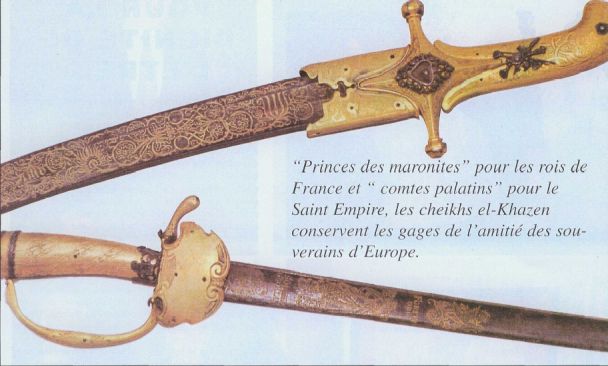

Population Movements to Keserwan - The Khazens and The Maans
ما جاء عن الثورة في المقاطعة الكسروانية
ثورة أهالي كسروان على المشايخ الخوازنة وأسبابها
Origins of the "Prince of Maronite" Title
Growing diversity: the Khazin sheiks and the clergy in the first decades of the 18th century
Historical Members:
Barbar Beik El Khazen [English]
Patriach Toubia Kaiss El Khazen(Biography & Life Part1 Part2) (Arabic)
Patriach Youssef Dargham El Khazen (Cont'd)
Cheikh Bishara Jafal El Khazen
Patriarch Youssef Raji El Khazen
The Martyrs Cheikh Philippe & Cheikh Farid El Khazen
Cheikh Nawfal El Khazen (Consul De France)
Cheikh Hossun El Khazen (Consul De France)
Cheikh Abou-Nawfal El Khazen (Consul De France)
Cheikh Francis Abee Nader & his son Yousef
Cheikh Abou-Kanso El Khazen (Consul De France)
Cheikh Abou Nader El Khazen
Cheikh Chafic El Khazen
Cheikh Keserwan El Khazen
Cheikh Serhal El Khazen [English]
Cheikh Rafiq El Khazen [English]
Cheikh Hanna El Khazen
Cheikha Arzi El Khazen
Marie El Khazen